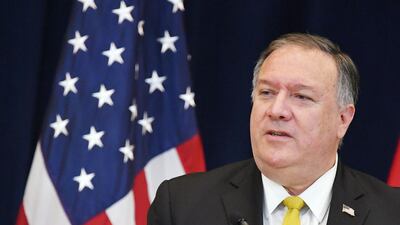
The United States on Thursday hit Syrian President Bashar Al Assad's government and military with sanctions on key individuals in a bid to end the regime’s attacks on civilians.
The sanctions came on the eve of the seventh anniversary of the chemical weapons attack on Syria’s Ghouta. Hundreds of people were killed in the eastern suburb of Damascus on August 21, 2013.
The final death toll ranges between 281 people, according to the French government, and 1,728, according to the Syrian opposition.
“We reaffirm our commitment to not stand by idly while Assad prolongs this conflict and the suffering of the Syrian,” Mr Pompeo said.
He said the US was designating the leadership of several Syrian military units as well as key regime officials for preventing efforts to achieve a national ceasefire in the country.
National Defence Forces commander Fadi Saqr was designated as was 42nd Brigade Commander Brig Gen Ghaith Dalah of the 4th Division, one of the best-equipped and well-trained arms of the Syrian military. The US also listed Tiger Force Hayder Regiment commander Samer Ismail. The Tiger Force is also known as the 25th Special Mission Forces Division.
“They have shattered the social contract between citizens and the military sworn to protect them," Mr Pompeo said.
Officials in the presidential office and in the Baath Party were also among the six targeted.
Washington named Luna Al Shibl and her husband Mohamad Ammar Saati bin Mohamad Nawzad.
“These Syrian government officials actively contribute to the oppression of the Assad regime,” said Treasury Secretary Steven Mnuchin. “The United States will continue to impose costs on those facilitating the Assad regime’s ongoing war against its own people.”
Ms Al Shibl, a former television anchor turned presidential adviser, was described by Washington as a prominent member of Mr Al Assad’s inner circle and one of the most senior press officers for the regime.
Washington said she was targeted with sanctions as she has been instrumental in developing Mr Al Assad’s false narrative that he maintains control of the country.
“Despite countless Syrian civilians living under desperate siege in Syria’s decade-long war, Al Shibl orchestrated photo ops for Assad among cheering Syrians,” the treasury department said.
The Office of Foreign Assets Control also targeted Mr Saati, a senior Syrian Baath Party official and a member of the Central Committee headed by Mr Al Assad.
Mr Saati was also accused of using the National Union of Students, which he headed, to promote the Baath Party abroad.

The specs: 2018 Nissan Patrol Nismo
Price: base / as tested: Dh382,000
Engine: 5.6-litre V8
Gearbox: Seven-speed automatic
Power: 428hp @ 5,800rpm
Torque: 560Nm @ 3,600rpm
Fuel economy, combined: 12.7L / 100km
The President's Cake
Director: Hasan Hadi
Starring: Baneen Ahmad Nayyef, Waheed Thabet Khreibat, Sajad Mohamad Qasem
Rating: 4/5
UAE currency: the story behind the money in your pockets
What the law says
Micro-retirement is not a recognised concept or employment status under Federal Decree Law No. 33 of 2021 on the Regulation of Labour Relations (as amended) (UAE Labour Law). As such, it reflects a voluntary work-life balance practice, rather than a recognised legal employment category, according to Dilini Loku, senior associate for law firm Gateley Middle East.
“Some companies may offer formal sabbatical policies or career break programmes; however, beyond such arrangements, there is no automatic right or statutory entitlement to extended breaks,” she explains.
“Any leave taken beyond statutory entitlements, such as annual leave, is typically regarded as unpaid leave in accordance with Article 33 of the UAE Labour Law. While employees may legally take unpaid leave, such requests are subject to the employer’s discretion and require approval.”
If an employee resigns to pursue micro-retirement, the employment contract is terminated, and the employer is under no legal obligation to rehire the employee in the future unless specific contractual agreements are in place (such as return-to-work arrangements), which are generally uncommon, Ms Loku adds.
Why it pays to compare
A comparison of sending Dh20,000 from the UAE using two different routes at the same time - the first direct from a UAE bank to a bank in Germany, and the second from the same UAE bank via an online platform to Germany - found key differences in cost and speed. The transfers were both initiated on January 30.
Route 1: bank transfer
The UAE bank charged Dh152.25 for the Dh20,000 transfer. On top of that, their exchange rate margin added a difference of around Dh415, compared with the mid-market rate.
Total cost: Dh567.25 - around 2.9 per cent of the total amount
Total received: €4,670.30
Route 2: online platform
The UAE bank’s charge for sending Dh20,000 to a UK dirham-denominated account was Dh2.10. The exchange rate margin cost was Dh60, plus a Dh12 fee.
Total cost: Dh74.10, around 0.4 per cent of the transaction
Total received: €4,756
The UAE bank transfer was far quicker – around two to three working days, while the online platform took around four to five days, but was considerably cheaper. In the online platform transfer, the funds were also exposed to currency risk during the period it took for them to arrive.
