
A group of anonymous US philanthropists plans to send 150,000 doses of the Pfizer-BioNTech vaccine to Iran in coming weeks, Iranian media reported on Monday.
Details in the report by the semi-official Tasnim news agency were scarce.
It quoted the chief of the country’s Red Crescent Society as saying he expected the vaccine created by US drug maker Pfizer and its German partner BioNTech to be imported by January 19, “based on co-ordination with a group of benefactors in the US”.
Iran has struggled to stem the worst virus outbreak in the Middle East, which has infected more than 1.2 million people and killed about 55,000.
Red Crescent director Karim Hemmati said his organisation planned to receive an additional 1 million vaccine doses that will be offered free of charge to citizens.
The semi-official Khabaronline.it news website reported on Sunday that the doses would arrive from China.
Officials said that importing the Pfizer-BioNTech vaccine, which must be shipped and stored at minus 70°C, poses major logistical challenges for Iran.
-

A health care professional prepares one of Spain's first doses of the Pfizer/BioNTech Covid-19 vaccine at the Vallecas Elderly Centre in Madrid, Spain. Getty Images -
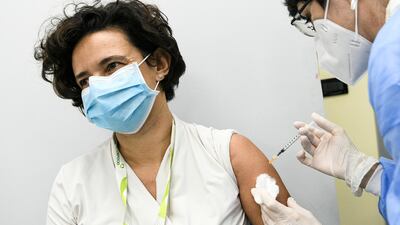
Head of the ASST Cremona vaccination Department, Antonella Laiolo, administers the Pfizer/BioNTech COVID-19 vaccine to a worker of the Cremona hospital in Cremona, Italy. Reuters -
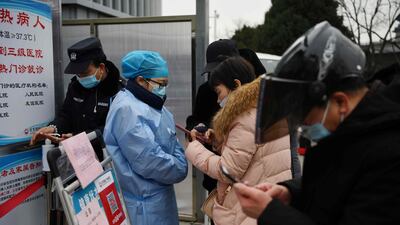
A medical worker checks the health code of visitors before they have their temperature taken outside a hospital in Beijing. AFP -
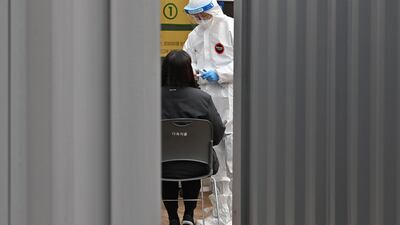
A medical staff member takes a swab from a visitor to test for the Covid-19 coronavirus at a temporary testing station outside the City Hall in Seoul. AFP -

A man sits in front of a mural representing a frontline warrior of the Covid-19 coronavirus, painted on a wall along the roadside in New Delhi. AFP -
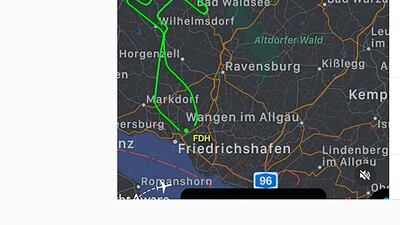
A screenshot from Instagram shows the flying route in form of a giant syringe in the sky during a nearly 300-kilometre flight in southern Germany, just as the European covid-19 vaccination campaign began. AFP -
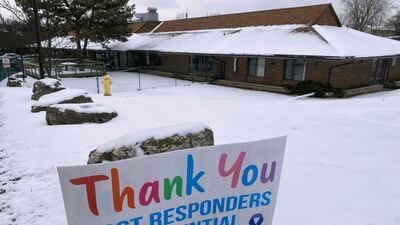
A sign thanking first responders is displayed at the entrance of the ThorntonView, a long-term seniors care facility which is the site of a Covid-19 outbreak, in Oshawa, Ontario, Canada. Reuters -
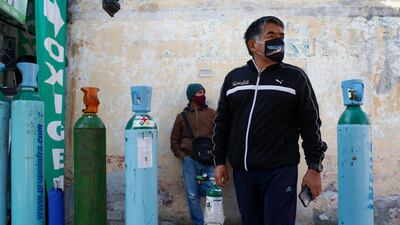
Jorge Perez lines up to refill an oxygen tank for a family member sick with Covid-19 in Mexico City. AP Photo -
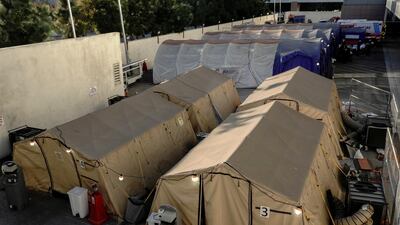
Triage tents for treating Covid-19 patients are seen outside LAC + USC Medical Center in Los Angeles, California, USA. Reuters -
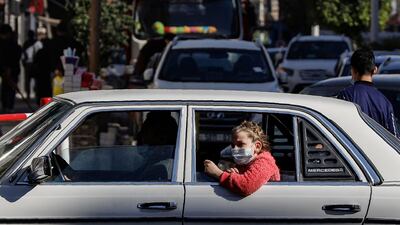
A mask-clad Palestinian girl looks out of the window of a taxi in Gaza City. AFP -
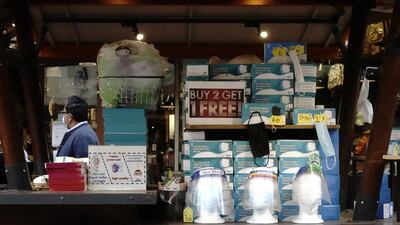
Personal protective equipment is seen for sale at Citadel Outlets in Commerce, California, USA. Reuters -

A passenger is seen at the check-in area of the international flight terminal at Tokyo International Airport in Tokyo, Japan. Reuters


Iran has signed up for Covax, an international programme created to distribute coronavirus vaccines to participating countries regardless of their wealth.
It is run in part by Gavi, the global vaccine alliance, which said the US Treasury’s Office of Foreign Asset Control has already issued a licence for Iran to take part.
The US Treasury has not reacted to Iran’s participation.
The Governor of Iran’s central bank, Abdolnaser Hemmati, told state TV last week that Iran had received approval to transfer $244 million through an unidentified bank in a third country to pay for about 17 million doses of Covid-19 vaccines from Covax.
Mr Hemmati did not provide further details, such as which vaccine or how the money would be sent.
Under Covax rules, Iran could at best order enough doses to vaccinate half of its 82 million people.
President Hassan Rouhani said on Saturday that Iran would refuse to make the Covax payment through US banks for fear of confiscation.
International banks and financial institutions are also reluctant to deal with Iran because of US sanctions.
Since the start of the pandemic, political figures in Iran have pushed anti-American conspiracy theories about the spread of the virus and vaccine production, dismissing the prospect of US assistance.
“Who trusts you? Wherever you found our money you stole it,” Mr Rouhani said.
He said that Iran would not take part in human trials of foreign-made vaccines and pledged to provide the country with imported and locally produced vaccines.
Iran’s home-made vaccine is due to enter a Phase 1 clinical trial soon.
The country is enrolling 54 volunteers across the country to receive two shots, state-run IRNA news agency reported.
Iran’s vaccine research has gained urgency as officials claim that heavy American sanctions will hamper the country's mass inoculation efforts.
Meanwhile, hardline officials in Iran’s Islamic Revolutionary Guard Corps rejected the use of foreign-made vaccines.
Last week, Gen Mohammad Naghdi, deputy chief of the IRGC, said the force “does not recommend the injection of any foreign vaccine” based on genetic material known as messenger RNA, which carries the instructions for cells to make proteins.

