
Two Turkish soldiers have been killed fighting in Libya, Turkey's President Recep Tayyip Erdogan said on Tuesday.
That came after reports claimed 16 troops had been killed since Ankara sent forces to the country in January.
Mr Erdogan sent fighters from Turkey’s proxy militias in Syria, as well as several soldiers, to Libya after signing a defence agreement with the internationally recognised government in the capital of Tripoli in December.
He gave no details about when the soldiers died but on Saturday he acknowledged an unspecified number of soldiers were killed in Libya.
Libyan National Army spokesman Khalid Al Mahjoub said this week that LNA forces killed 16 Turkish soldiers during battles in Tripoli, the port city of Misurata and in the town of Al Falah, south of the capital.
The Tripoli administration government, led by Fayez Al Sarraj, has been battling against the eastern-based LNA under Field Marshal Khalifa Haftar since last April. The LNA chief said he launched the offensive to end the rule of militias, including extremist groups, who back Mr Al Sarraj’s government.
-
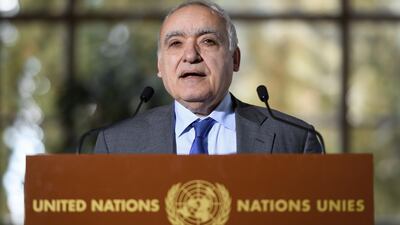
UN Envoy for Libya Ghassan Salame holds a press briefing during UN-brokered military talks. AFP -
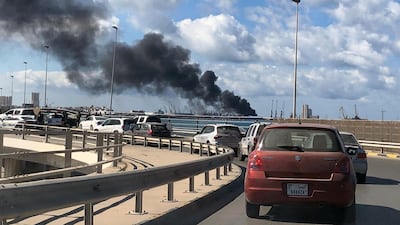
Smoke rises from a port of Tripoli, Libya after being attacked. REUTERS -
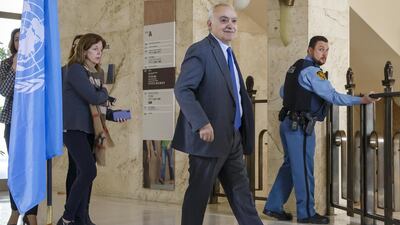
Ghassan Salame (C), special representative of the United Nations Secretary-General and head of the United Nations Support Mission in Libya, leaves a press stakeout after informing the media about new meeting round of the 5+5 Libyan Joint Military Commission, at the European headquarters of the United Nations in Geneva, Switzerland. EPA -
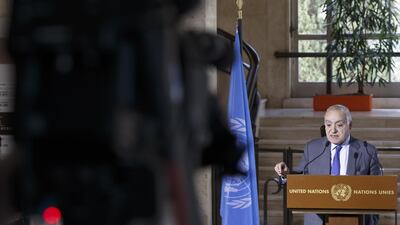
Ghassan Salame, special representative of the United Nations Secretary-General and head of the United Nations Support Mission in Libya, informs the media about a new meeting round of the 5+5 Libyan Joint Military Commission, during a press stakeout, at the European headquarters of the United Nations in Geneva, Switzerland. EPA -

Ghassan Salame, special representative of the United Nations Secretary-General and head of the United Nations Support Mission in Libya, arrives for a press stakeout to inform the media on a new meeting round of the 5+5 Libyan Joint Military Commission, at the European headquarters of the United Nations in Geneva, Switzerland. EPA -
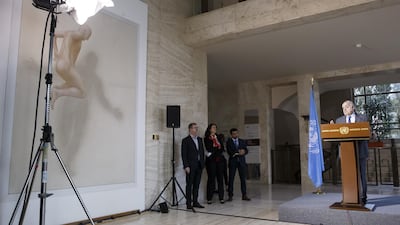
Ghassan Salame (R), special representative of the United Nations Secretary-General and head of the United Nations Support Mission in Libya, informs the media about a new meeting round of the 5+5 Libyan Joint Military Commission, during a press stakeout, at the European headquarters of the United Nations in Geneva, Switzerland. EPA -
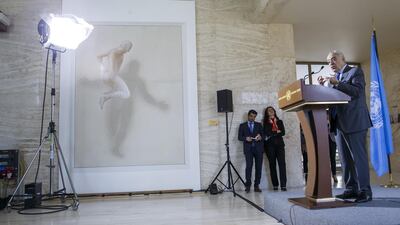
Ghassan Salame, special representative of the United Nations Secretary-General and head of the United Nations Support Mission in Libya, informs the media about a new meeting round of the 5+5 Libyan Joint Military Commission, during a press stakeout, at the European headquarters of the United Nations in Geneva, Switzerland. EPA -
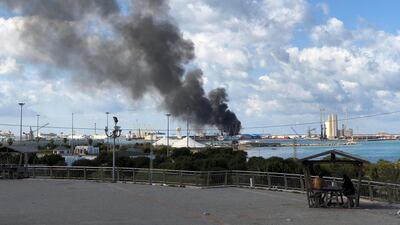
Smoke rises from a port in Tripoli, Libya after being attacked. REUTERS -
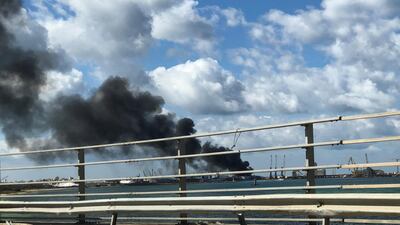
Smoke rises from a port of Tripoli after being attacked in Tripoli, Libya. REUTERS


But the fighting has largely reached a stalemate, with little ground changing hands, but international powers have increasingly intervened to back both sides even as the UN tried to mediate a ceasefire.
Discussions appeared to fall apart again on Monday as both sides suspended participation at the Geneva talks, even as a UN spokesman said negotiations would still go ahead.
The eastern-based parliament said it would not take part in Wednesday’s talks as the UN had not approved all 13 representatives, while the Tripoli side said it would not attend until progress was made in military negotiations.
"It is in light of conclusions [from military discussions] that the high council would decide to take part or not in political dialogue," the Tripoli government said.
A joint military commission with five members from each side wound up talks in Geneva on Sunday with a "draft ceasefire agreement" to be finalised in March, according to the UN mission.
The Libyan political dialogue will go ahead as scheduled on February 26, Jean El Alam, a spokesman for UN Support Mission to Libya told AFP. "Many participants have already arrived in Geneva and we hope all invited participants follow suit," he said.
But Khaled Al Mishri of the Tripoli-aligned High State Council said it would not be bound by the outcome of political talks if they went ahead "before knowing the military dialogue's conclusions".

