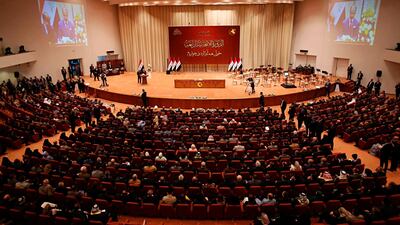

Twenty members of the Iraqi parliament have the novel coronavirus, Speaker Mohammed Al Halbousi said, as the number of cases increased across the country.
“Six deputies personally informed me that they have been infected with the disease, as well as their families and security guards,” Mr Al Hablousi said during a television interview on Monday.
The official said the total number of infected MPs was 20 and more cases were suspected.
A further 28 employees of parliament caught the virus, including a general manager and officials in the security department, Mr Al Halbousi said.
Parliamentary sessions will not be held because of “this dangerous situation”, he said.
Iraq has recorded about 31,000 cases of the disease and 1,100 deaths since the outbreak began this year.
Two Iraqi officials died from the disease during the past week.
Footballer Ahmed Radhi died on Sunday from complications of the disease. Veteran politician Tawfiq Al Yasiri succumbed to the infection last week.
Health Minister Hassan Al Timimi said on Monday that the rise in cases indicated that “Iraq has entered a dangerous epidemic phase.”
Mr Al Timimi assured the public that efforts were being made “to complete an emergency hospital that would cater to 400 patients”.
"Until now, there is no treatment for the virus, and we are intensifying our efforts to accommodate the rising numbers of people infected," he said.
Since Iraq recorded its first infected case, it has taken drastic measures to curb the virus’s spread, including closing schools and restaurants, banning public gatherings and shutting international borders.
But a report by the Associated Press said that healthcare workers were concerned that the measures put in place will not be enough to stop people from contracting the virus.
-
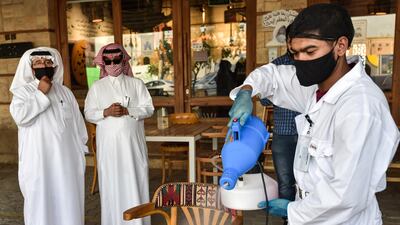
A latex glove-and-mask-clad worker sanitises a table for clients at a cafe in Saudi Arabia's capital Riyadh, as the country begins to re-open following the lifting of a lockdown. AFP -
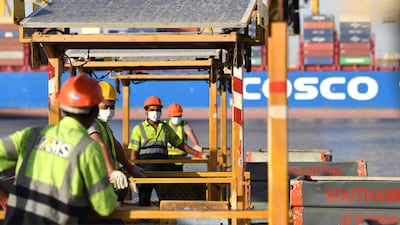
Employees wearing face masks are pictured at the port of Jebel Ali, operated by the Dubai-based ports operator DP World, in the southern outskirts of Dubai. AFP -
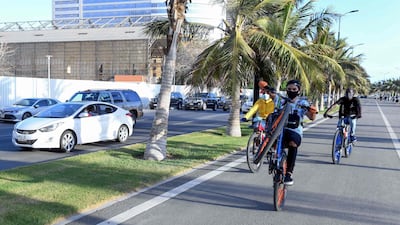
Saudi youths ride bicycles at the seafront promenade in the Saudi seaport of Jeddah, as the country re-opens following the lifting of a lockdown due to the pandemic. AFP -

Syrian refugees enjoy their weekend at Menekse Beach, amid the ongoing pandemic in Istanbul, Turkey. EPA -
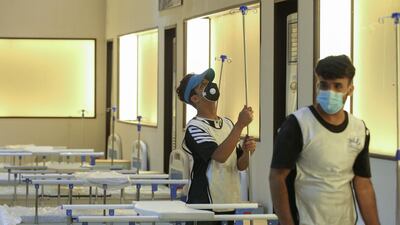
Iraqi volunteers with the Aqiq Institution for Charity work on building a 525-bed field hospital at the Baghdad International Fair exhibition centre in the capital Baghdad. AFP -
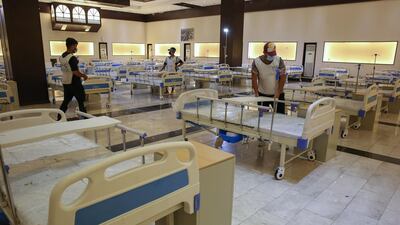
Iraqi volunteers with the Aqiq Institution for Charity work on building a 525-bed field hospital at the Baghdad International Fair exhibition centre in the capital Baghdad. AFP -
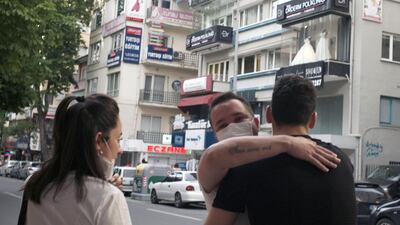
A man wearing a face mask to protect against the spread of coronavirus, embraces a friend in city the centre, in Ankara, Turkey. AP Photo -
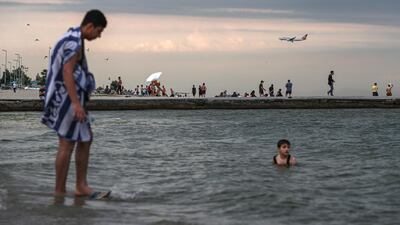
A Turkish Airlines plane prepares for landing as Syrian refugees enjoy their weekend at Menekse Beach, amid the ongoing pandemic in Istanbul, Turkey. EPA -
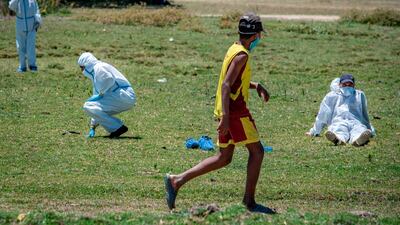
Members of the medical staff rest in a field during their break in the town of Moulay Bousselham, north of the capital Rabat, as authorities received around 700 Covid-19 patients. AFP -
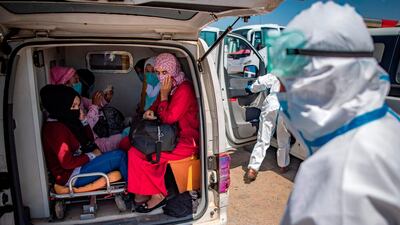
Moroccans, who tested positive for Covid-19, arrive in a parking lot in the town of Moulay Bousselham, north of the capital Rabat, ahead of being transferred to a medical centre in another city. AFP -
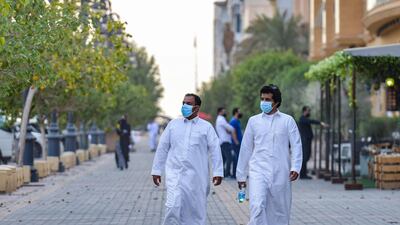
Mask-clad men walk along the promenade of Tahlia street in the centre of Saudi Arabia's capital Riyadh. AFP


Government officials said the public must not ignore the rules, as dismissing the threat would result in a failure of efforts to contain the pandemic.
Hospitals were scrambling to cope with the large rise in case numbers.
“Its overcrowding hospitals,” said a doctor in Baghdad. “It’s chaos.”
A hospital in the southern city of Karbala reached capacity this week, and its manager ordered staff not to conduct tests if symptoms were not present because “there are no more beds to admit people,” a doctor said.
“We are in a fog. We don’t know what is going on," said the doctor, adding that gloves, masks and protective suits had run out.
Health ministry spokesman Said Al Badr said the rise in cases was a result of more testing and the public's refusal to follow official guidelines.
Testing increased from nearly 4,000 people a day last month to more than 13,000 in recent days.
By next week, Mr Badr said, 20,000 samples would be examined daily.
Iraq's health system has been depleted by years of conflict and corruption, and officials complained that they were not prepared to deal with a full-blown crisis.

