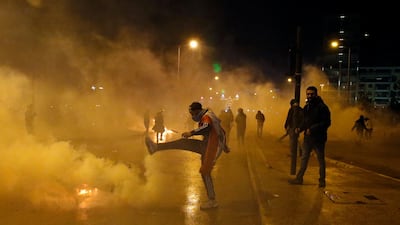
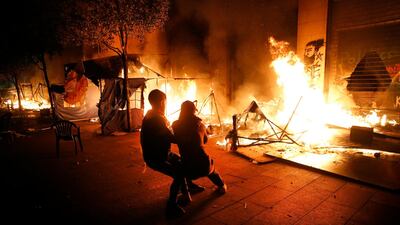
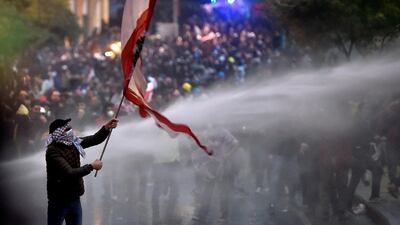
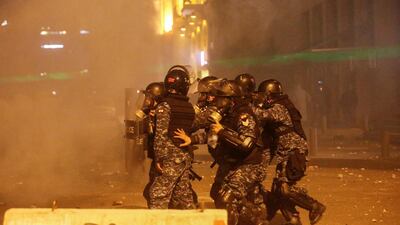
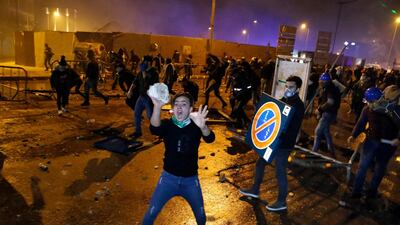
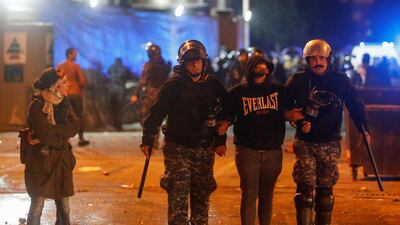
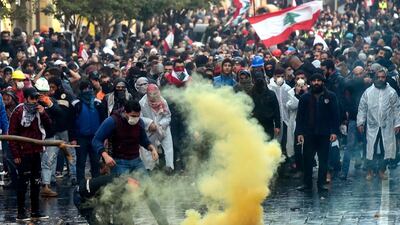
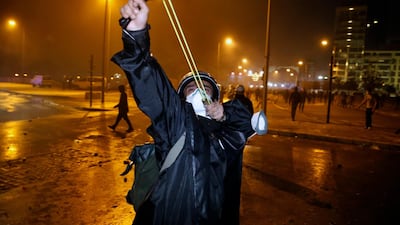
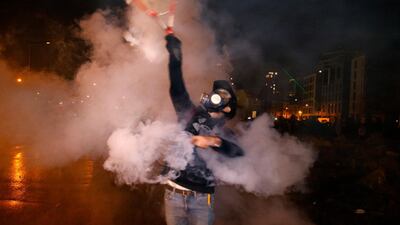
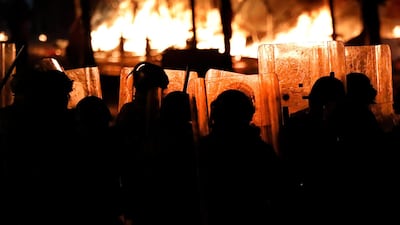
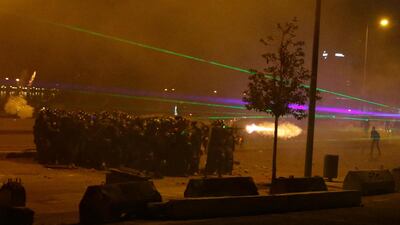
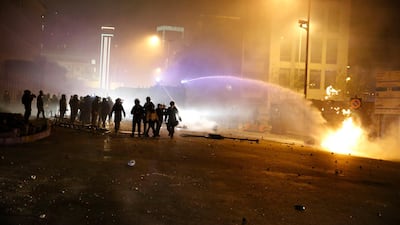
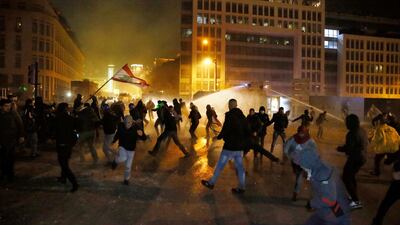
Protesters, activists and journalists accuse Lebanon’s riot police of disproportionate use of force against largely peaceful crowds during several days of demonstrations in the capital Beirut.
Occasional bouts of violence have erupted since anti-government protests started on October 17, but the number of injured soared this week as frustration increased, culminating in violent clashes on Saturday evening.
The Lebanese are exasperated by the lack of political leadership to counter the country’s worst economic crisis in living memory. They accuse politicians of bickering over power sharing instead of implementing reforms.
“Riot police have declared war on us in downtown Beirut,” activist Nizar Hassan tweeted on Saturday after police fired tear gas and rubber bullets, injuring people in the face. “There is a clear political decision to end the uprising.”
The ISF has also complained of violence, claiming that injured policemen were attacked in hospitals on Saturday evening. Protesters broke ATMs as well as parking meters, telephone booths and the walls of an upscale shopping mall to throw debris at the police.
However, many protesters say they were beaten and humiliated even when demonstrating peacefully.
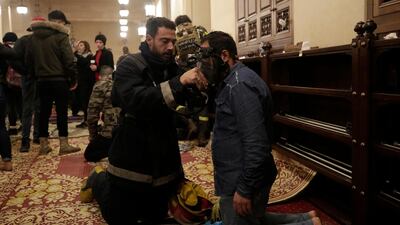
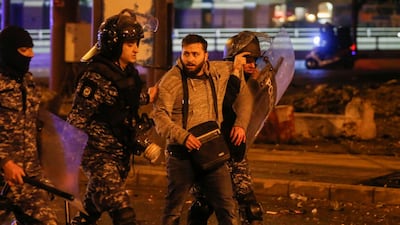
Chebl Yassine, 38, was one of more than 30 men who were detained on Wednesday during a protest outside a Beirut police station to demand the release of people arrested the previous night.
Riot police dragged him away by his hoodie and beat him after he tried to escort a female friend out of the protest as it turned violent, he said. A photographer for the Associated Press captured the moment as he choked on his back, mouth open, surrounded by a sea of riot police. It quickly went viral.
"They beat us from the moment we were arrested until we reached the police station. One policeman held a man by his hair and circled him on the ground, saying 'this is how we walk', and kicked him in the stomach," Mr Yassine told The National on Thursday, hours after his release.
“The whole time, our hands were tied with plastic straps” he said, showing red marks on his wrists. His head still in a bandage after a sleepless night at the police station, he was back protesting in Beirut on Thursday evening.
He said that riot police taunted the men as they beat them, saying “You want a revolution? This is your revolution”, and “If this were Syria, I would have trampled you with my feet, you son of a dog.”
Syrian security forces responded to peaceful protests in 2011 with torture and killings, eventually tipping the country into a bloody civil war. Syria and Lebanon share a long land border and have strong historical and commercial ties.
“Another guy told me: “Who do you think you are?” Even the Israeli army did not manage to enter the police station in 1982,” Mr Yassine said. “He meant that we were like Israelis and traitors to our country. I answered I was not Israeli, and he told me to shut up.”
Israel is widely hated in Lebanon. Its 1982 invasion of the capital, where the Palestine Liberation Organisation was based, is remembered as a traumatic experience. The two countries are still officially at war.
Mr Yassine said the detainees were treated decently once they arrived at the police station. They were interrogated before their release early on Thursday afternoon, he said.
Journalists have also faced violence from the riot police.
French photojournalist Greg Demarque told The National he suffered broken ribs and facial bruising after an altercation with a policeman who tried to take away his camera. He was the only journalist to be detained overnight on Wednesday. Seven others suffered injuries and two were detained and released within an hour, according to Human Rights Watch.
Journalists protested by staging a sit-in outside the interior ministry, pushing ISF chief Maj Gen Imad Othman to apologise on Thursday.
Echoing Mr Yassine’s story, a video emerged on social media of police beating handcuffed protesters after their arrest as they got out of a police truck on Saturday. The ISF retweeted it in the night, saying that Maj Gen Othman had ordered an investigation into the incident.
"There are small mistakes that take place during our work and we will punish those responsible. But how many have we done in 3 months? Nothing compared to our heavy workload," an ISF official told The National.
"We waited an hour and a half before intervening. We were attacked with rocks, tiles, fireworks and insults. Nobody could stand that."
He said 142 policemen were among the injured on Saturday night.
An aide to caretaker Interior Minister Raya Al Hassan did not respond to a request for comment.
In numbers: China in Dubai
The number of Chinese people living in Dubai: An estimated 200,000
Number of Chinese people in International City: Almost 50,000
Daily visitors to Dragon Mart in 2018/19: 120,000
Daily visitors to Dragon Mart in 2010: 20,000
Percentage increase in visitors in eight years: 500 per cent
Key facilities
- Olympic-size swimming pool with a split bulkhead for multi-use configurations, including water polo and 50m/25m training lanes
- Premier League-standard football pitch
- 400m Olympic running track
- NBA-spec basketball court with auditorium
- 600-seat auditorium
- Spaces for historical and cultural exploration
- An elevated football field that doubles as a helipad
- Specialist robotics and science laboratories
- AR and VR-enabled learning centres
- Disruption Lab and Research Centre for developing entrepreneurial skills
Where to donate in the UAE
The Emirates Charity Portal
You can donate to several registered charities through a “donation catalogue”. The use of the donation is quite specific, such as buying a fan for a poor family in Niger for Dh130.
The General Authority of Islamic Affairs & Endowments
The site has an e-donation service accepting debit card, credit card or e-Dirham, an electronic payment tool developed by the Ministry of Finance and First Abu Dhabi Bank.
Al Noor Special Needs Centre
You can donate online or order Smiles n’ Stuff products handcrafted by Al Noor students. The centre publishes a wish list of extras needed, starting at Dh500.
Beit Al Khair Society
Beit Al Khair Society has the motto “From – and to – the UAE,” with donations going towards the neediest in the country. Its website has a list of physical donation sites, but people can also contribute money by SMS, bank transfer and through the hotline 800-22554.
Dar Al Ber Society
Dar Al Ber Society, which has charity projects in 39 countries, accept cash payments, money transfers or SMS donations. Its donation hotline is 800-79.
Dubai Cares
Dubai Cares provides several options for individuals and companies to donate, including online, through banks, at retail outlets, via phone and by purchasing Dubai Cares branded merchandise. It is currently running a campaign called Bookings 2030, which allows people to help change the future of six underprivileged children and young people.
Emirates Airline Foundation
Those who travel on Emirates have undoubtedly seen the little donation envelopes in the seat pockets. But the foundation also accepts donations online and in the form of Skywards Miles. Donated miles are used to sponsor travel for doctors, surgeons, engineers and other professionals volunteering on humanitarian missions around the world.
Emirates Red Crescent
On the Emirates Red Crescent website you can choose between 35 different purposes for your donation, such as providing food for fasters, supporting debtors and contributing to a refugee women fund. It also has a list of bank accounts for each donation type.
Gulf for Good
Gulf for Good raises funds for partner charity projects through challenges, like climbing Kilimanjaro and cycling through Thailand. This year’s projects are in partnership with Street Child Nepal, Larchfield Kids, the Foundation for African Empowerment and SOS Children's Villages. Since 2001, the organisation has raised more than $3.5 million (Dh12.8m) in support of over 50 children’s charities.
Noor Dubai Foundation
Sheikh Mohammed bin Rashid Al Maktoum launched the Noor Dubai Foundation a decade ago with the aim of eliminating all forms of preventable blindness globally. You can donate Dh50 to support mobile eye camps by texting the word “Noor” to 4565 (Etisalat) or 4849 (du).
Who's who in Yemen conflict
Houthis: Iran-backed rebels who occupy Sanaa and run unrecognised government
Yemeni government: Exiled government in Aden led by eight-member Presidential Leadership Council
Southern Transitional Council: Faction in Yemeni government that seeks autonomy for the south
Habrish 'rebels': Tribal-backed forces feuding with STC over control of oil in government territory
World Sevens Series standing after Dubai
1. South Africa
2. New Zealand
3. England
4. Fiji
5. Australia
6. Samoa
7. Kenya
8. Scotland
9. France
10. Spain
11. Argentina
12. Canada
13. Wales
14. Uganda
15. United States
16. Russia
THE BIO
Favourite author - Paulo Coelho
Favourite holiday destination - Cuba
New York Times or Jordan Times? NYT is a school and JT was my practice field
Role model - My Grandfather
Dream interviewee - Che Guevara
UAE currency: the story behind the money in your pockets
POWERWASH%20SIMULATOR
%3Cp%3E%3Cstrong%3EDeveloper%3A%3C%2Fstrong%3E%20FuturLab%3Cbr%3E%3Cstrong%3EPublisher%3A%20%3C%2Fstrong%3ESquare%20Enix%20Collective%3Cbr%3E%3Cstrong%3EConsole%3A%20%3C%2Fstrong%3ENintendo%20Switch%2C%3Cstrong%3E%20%3C%2Fstrong%3EPlayStation%204%20%26amp%3B%205%2C%20Xbox%20Series%20X%2FS%20and%20PC%3Cbr%3E%3Cstrong%3ERating%3A%3C%2Fstrong%3E%204%2F5%3C%2Fp%3E%0A
UAE cricketers abroad
Sid Jhurani is not the first cricketer from the UAE to go to the UK to try his luck.
Rameez Shahzad Played alongside Ben Stokes and Liam Plunkett in Durham while he was studying there. He also played club cricket as an overseas professional, but his time in the UK stunted his UAE career. The batsman went a decade without playing for the national team.
Yodhin Punja The seam bowler was named in the UAE’s extended World Cup squad in 2015 despite being just 15 at the time. He made his senior UAE debut aged 16, and subsequently took up a scholarship at Claremont High School in the south of England.
UAE currency: the story behind the money in your pockets
The%20specs
%3Cp%3E%3Cstrong%3EEngine%3A%3C%2Fstrong%3E%20Dual%20synchronous%20electric%20motors%0D%3Cbr%3E%3Cstrong%3EPower%3A%20%3C%2Fstrong%3E660hp%0D%3Cbr%3E%3Cstrong%3ETorque%3A%20%3C%2Fstrong%3E1%2C100Nm%0D%3Cbr%3E%3Cstrong%3ETransmission%3A%20%3C%2Fstrong%3ESingle-speed%20automatic%0D%3Cbr%3E%3Cstrong%3ETouring%20range%3A%20%3C%2Fstrong%3E488km-560km%0D%3Cbr%3E%3Cstrong%3EPrice%3A%20%3C%2Fstrong%3EFrom%20Dh850%2C000%20(estimate)%0D%3Cbr%3E%3Cstrong%3EOn%20sale%3A%20%3C%2Fstrong%3EOctober%3C%2Fp%3E%0A
MATCH INFO
What: 2006 World Cup quarter-final
When: July 1
Where: Gelsenkirchen Stadium, Gelsenkirchen, Germany
Result:
England 0 Portugal 0
(Portugal win 3-1 on penalties)
Seven%20Winters%20in%20Tehran
%3Cp%3E%3Cstrong%3EDirector%20%3A%3C%2Fstrong%3E%20Steffi%20Niederzoll%3C%2Fp%3E%0A%3Cp%3E%3Cstrong%3EStarring%3A%3C%2Fstrong%3E%20Reyhaneh%20Jabbari%2C%20Shole%20Pakravan%2C%20Zar%20Amir%20Ebrahimi%3C%2Fp%3E%0A%3Cp%3E%3Cstrong%3ERating%3A%3C%2Fstrong%3E%204%2F5%3C%2Fp%3E%0A
Mercer, the investment consulting arm of US services company Marsh & McLennan, expects its wealth division to at least double its assets under management (AUM) in the Middle East as wealth in the region continues to grow despite economic headwinds, a company official said.
Mercer Wealth, which globally has $160 billion in AUM, plans to boost its AUM in the region to $2-$3bn in the next 2-3 years from the present $1bn, said Yasir AbuShaban, a Dubai-based principal with Mercer Wealth.
“Within the next two to three years, we are looking at reaching $2 to $3 billion as a conservative estimate and we do see an opportunity to do so,” said Mr AbuShaban.
Mercer does not directly make investments, but allocates clients’ money they have discretion to, to professional asset managers. They also provide advice to clients.
“We have buying power. We can negotiate on their (client’s) behalf with asset managers to provide them lower fees than they otherwise would have to get on their own,” he added.
Mercer Wealth’s clients include sovereign wealth funds, family offices, and insurance companies among others.
From its office in Dubai, Mercer also looks after Africa, India and Turkey, where they also see opportunity for growth.
Wealth creation in Middle East and Africa (MEA) grew 8.5 per cent to $8.1 trillion last year from $7.5tn in 2015, higher than last year’s global average of 6 per cent and the second-highest growth in a region after Asia-Pacific which grew 9.9 per cent, according to consultancy Boston Consulting Group (BCG). In the region, where wealth grew just 1.9 per cent in 2015 compared with 2014, a pickup in oil prices has helped in wealth generation.
BCG is forecasting MEA wealth will rise to $12tn by 2021, growing at an annual average of 8 per cent.
Drivers of wealth generation in the region will be split evenly between new wealth creation and growth of performance of existing assets, according to BCG.
Another general trend in the region is clients’ looking for a comprehensive approach to investing, according to Mr AbuShaban.
“Institutional investors or some of the families are seeing a slowdown in the available capital they have to invest and in that sense they are looking at optimizing the way they manage their portfolios and making sure they are not investing haphazardly and different parts of their investment are working together,” said Mr AbuShaban.
Some clients also have a higher appetite for risk, given the low interest-rate environment that does not provide enough yield for some institutional investors. These clients are keen to invest in illiquid assets, such as private equity and infrastructure.
“What we have seen is a desire for higher returns in what has been a low-return environment specifically in various fixed income or bonds,” he said.
“In this environment, we have seen a de facto increase in the risk that clients are taking in things like illiquid investments, private equity investments, infrastructure and private debt, those kind of investments were higher illiquidity results in incrementally higher returns.”
The Abu Dhabi Investment Authority, one of the largest sovereign wealth funds, said in its 2016 report that has gradually increased its exposure in direct private equity and private credit transactions, mainly in Asian markets and especially in China and India. The authority’s private equity department focused on structured equities owing to “their defensive characteristics.”
ELIO
Starring: Yonas Kibreab, Zoe Saldana, Brad Garrett
Directors: Madeline Sharafian, Domee Shi, Adrian Molina
Rating: 4/5