

Lebanon faces a 'catastrophe', Prime Minister Hassan Diab said on Wednesday after his newly unveiled Cabinet held its first meeting to tackle the twin challenges of a tenacious protest movement and a nosediving economy.
Hassan Diab, who replaced Saad Hariri as prime minister, vowed to meet the demands from the street but demonstrators were unconvinced and scuffled with police overnight.
The 61-year-old academic was thrown in at the deep end for his first experience on the political big stage and admitted that the situation he inherited was desperate.
"Today we are in a financial, economic and social dead end," he said in a statement read by a government official after the new Cabinet's inaugural meeting in Beirut. "We are facing a catastrophe," he said.
His comments came after President Michel Aoun told Lebanon’s new “rescue team” Cabinet that ministers must work to meet the demands of the people during the first session of the new administration on Wednesday.
“Your mission is to gain the confidence of the Lebanese people and work to achieve the goals they aspire to,” Mr Aoun said. “It is necessary to address the economic situation, restore the confidence of the international community in Lebanese institutions and work to reassure the Lebanese people of their future.
"We have already prepared an economic plan and financial reforms that the government will have to implement or amend when necessary."
He suggested that ministers organise a run of Cabinet sessions to make up for lost time since the resignation of the previous government on October 29.
The ministers formed a committee to prepare the ministerial statement to put before a vote in parliament.
Mr Diab finally formed his new administration late on Tuesday evening after meeting with Mr Aoun and Parliament Speaker Nabih Berri at Baabda Palace. The move ends a political crisis amid nationwide rallies against the dire economic situation.
But reaction to the announcement was mixed. "Government of last resort," was the headline on the front page of Al-Akhbar, a daily newspaper close to the powerful Hezbollah movement that gave its blessing to Mr Diab's designation last month.
The new prime minister vowed to work quickly to start fixing the country’s ills.

“The new government is a rescue team,” Mr Diab said. “It is important now to preserve stability.”
“It’s time to work,” he said vowing to work to build an independent judiciary, recover “looted funds” and draw up a new electoral law.
He said his first visit would be to the Gulf region as he sought support for the country and that he would have “intensive” discussions with the central bank.
He “saluted” the nationwide uprising and vowed to meet protesters' demands.
“It’s a government of specialists that will give no heed except to the nation’s interest. A government of non-partisan ministers who cannot be influenced by political struggles,” he said. “It’s a government of youth who are looking for a promising future in their country.”
However, on the streets of the capital, protesters were beginning to gather even before the official announcement.
Mr Diab’s administration is already being referred to as a “one colour” government as it was negotiated by the Iran-backed Hezbollah and its allies, including the Free Patriotic Movement founded by the president.
Most of the parties with strong links to the West and the Gulf, including the Future Movement, the Lebanese Forces, the Kataeb party and the Progressive Socialist Party, have not taken seats.
Instead, the alliance of pro-Syrian factions that largely made up the old March 8 political coalition selected and approved all the new ministers.
Protesters on the streets referred to the largely unknown figures as a “government of advisers.”
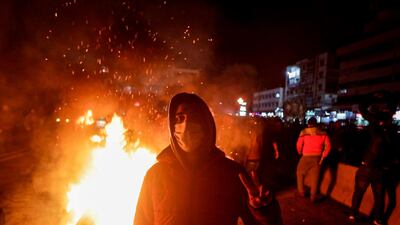
In central Beirut, on the motorways out of Beirut towards the airport, in the central squares of north Lebanon’s Tripoli and in southern Sour on Tuesday night, protesters blocked roads, burned tires and rubbish bins and clashed with police.
-
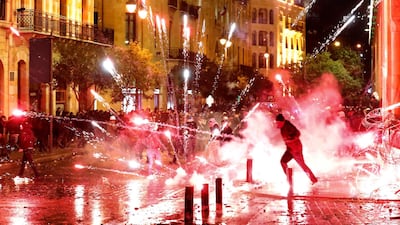
Anti-government protesters throw firecrackers at riot police during a demonstration against the new government, near Parliament Square, in Beirut, Lebanon. AP Photo -
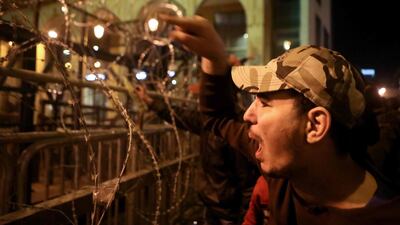
Lebanese anti-corruption protesters shout slogans outside the parliament during a protest in downtown Beirut. AFP -
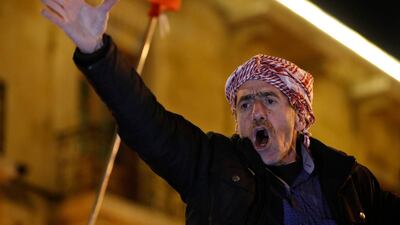
An anti-government protester shouts slogans during a protest against the new government, near the parliament square, in Beirut. AP Photo -

An anti-government protester shows off the liquid pepper on his hand after he was sprayed by the riot police during continuous anti-government protests outside of the Lebanese Parliament building in downtown Beirut. EPA -
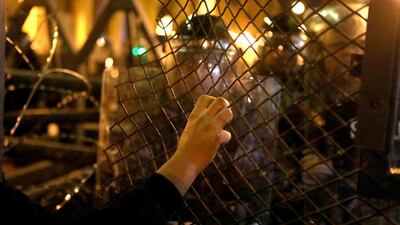
A Lebanese anti-government protester holds on to a police fence as riot police guard an access to the parliament during clashes with anti-government protesters in downtown Beirut. AFP -
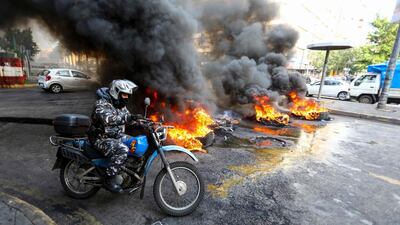
A Lebanese policeman rides his motocycle passed a road, blocked by anti-government protesters with burning tyres, in the capital Beirut. AFP -

An anti-government protester is sprayed by a water cannon as he films by his mobile phone during a protest against the new government, near the parliament square, in Beirut. AP Photo -
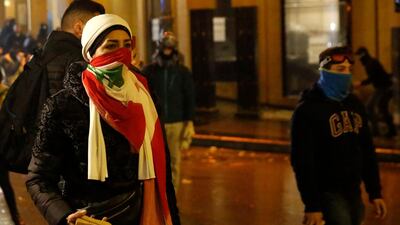
An anti-government protester holds a stone as she prepares to throw it at the riot police during a protest against the new government, near the parliament square, in Beirut. AP Photo -
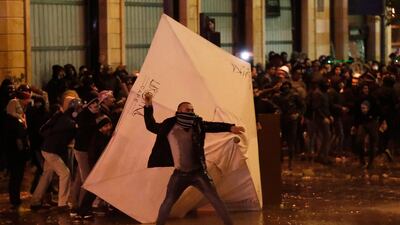
An anti-government protester prepares to throw stones at the riot police during a protest against the new government, near the parliament square, in Beirut. AP Photo -

Anti-government protesters remove barbed wire during continuous anti-government protests outside of the Lebanese Parliament building in downtown Beirut. EPA -
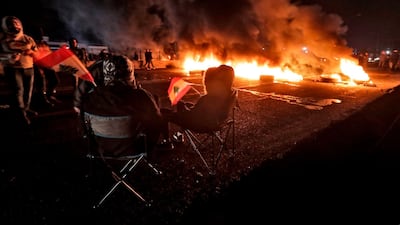
Anti-government protesters sit on chairs waving Lebanese national flags as tyres are aflame to cut off a section of the Beirut-Byblos highway in the coastal city of Byblos, as they protest the newly-announced government formed by Prime Minister Hassan Diab. AFP -
An anti-government protester flashes the victory gesture while tyres are set aflame as demonstrators cut off a section of the Beirut-Byblos highway in Byblos, as they protest the newly-announced government formed by Prime Minister Hassan Diab. AFP


Speaker Berri nominated economist Ghazi Wazni, who previously served as a financial adviser to Parliament’s finance and budget committee, was named finance minister.
The FPM picked Nassif Hitti, a former ambassador to the Arab League, to be the new foreign minister.
The FPM also backed Zeina Akar to be the Middle East’s first female defence minister and she also holds the post of defence minister.
Lebanon is facing its worst economic crisis since the end of the 1975-90 civil war with the value of the Lebanese Lira tumbling and banks implementing capital controls to prevent a run on financial institutions.
Despite the Lebanese Lira being pegged at 1507 to the US dollar, the rate at exchange houses has topped 2500 lira to the dollar. However, on Tuesday night, exchange houses agreed to fix the rate at 2,000 to the dollar.
Mr Diab said he wanted to stabilise the value of the lira. “God willing, the Lebanese pound will strengthen,” he said.
Mass protests raged since mid-October at years of ineffectual governance that has left the country saddled with the third-highest debt-to-GDP ratios, a crumbling infrastructure, regular power and water cuts and rampant corruption.
The protests led to the resignation of Saad Hariri as prime minister on October 29 causing a political crisis.
The international community has been urging the swift formation of a government that can pass urgently needed reforms and start addressing the challenges.
The 2018 CEDRE conference in Paris saw countries pledge $11 billion in grants and loans to fix the country’s infrastructure and bring in 24/7 electricity among other things. However, the funds are contingent on specific reforms that so far politicians have failed to pass.
-
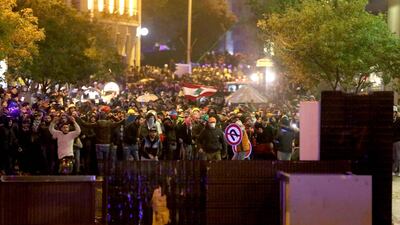
Lebanese protesters gather behind a barricade near a road leading to parliament in central Beirut amid ongoing anti-government demonstrations. AFP -
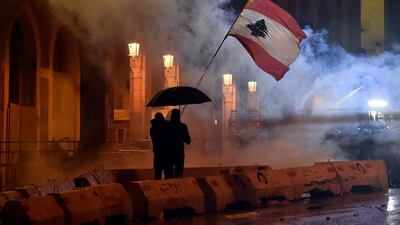
Two anti-government protesters wave a Lebanese national flag as they protect themselves with an umbrella during continuous protests and clashes with police outside the Lebanese Parliament building in downtown Beirut. EPA -
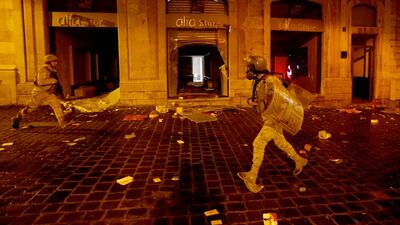
Lebanese army soldiers run past a damaged Alfa shop during a protest against a ruling elite accused of steering Lebanon towards an economic crisis in Beirut. REUTERS -
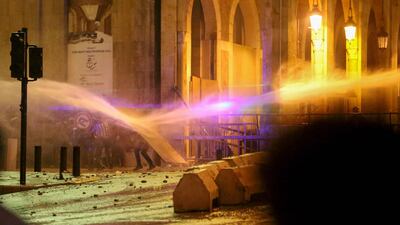
Lebanese riot police spray water to disperse anti-government protesters amid clashes near the parliament in central Beirut during ongoing anti-government demonstrations. AFP -

Lebanese protesters use laser pointers amid clashes with riot police near the parliament in central Beirut during ongoing anti-government demonstrations. AFP -

Lebanese protesters clash with riot police guarding a road leading to parliament in central Beirut amid ongoing anti-government demonstrations. AFP -
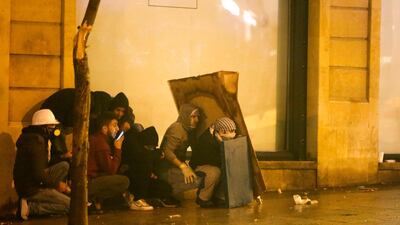
Lebanese protesters take cover amid clashes with riot police guarding a road leading to parliament in central Beirut. AFP -
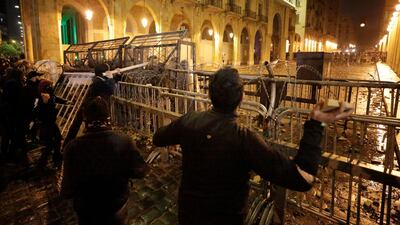
Anti-government protesters throw stones and clash with the riot police, during ongoing protests against the political elites who have ruled the country for decades, in Beirut. AP Photo -
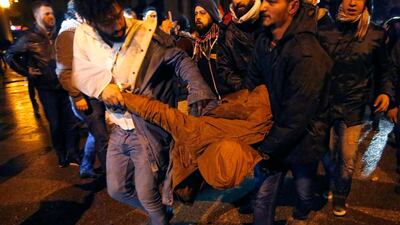
Anti-government protesters carry their friend who was injured by rubber bullet while clashing with the riot police, during ongoing protests against the political elites who have ruled the country since decades, in Beirut. AP Photo -
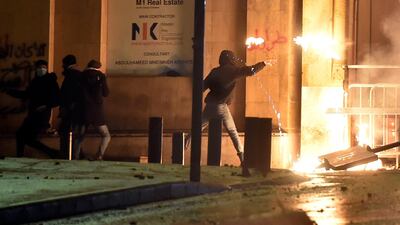
An anti-government protester hurls a Molotov cocktail at Lebanese riot police behind a barricade during continuous anti-government protests outside of the Lebanese Parliament building in downtown Beirut. EPA


UN Secretary General Antonio Guterres on Wednesday morning welcomed the formation of the government and said he “looks forward to working with Prime Minister Hassan Diab and the incoming Council of Ministers, including in support of Lebanon’s reform agenda and to address the pressing needs of its people.”
In the past week, the mass demonstrations have become increasingly violent in central Beirut.
Nearly 400 protesters were injured in a demonstration on Saturday in the bloodiest night of rallies so far.
The International Support Group for Lebanon noted on Tuesday that it was "alarmed by the situation which is increasingly marked by growing violence".

