Lebanon's government resigns after Beirut blast


Liz Cookman
  • English
  • Arabic

Lebanon's Prime Minister Hassan Diab announced the resignation of his government on Monday amid public anger over the huge explosion that devastated the capital Beirut last week.

In a televised address, Mr Diab blamed the blast, which killed at least 160 people and left 6,000 wounded, on "endemic corruption" and said his government had been the "victim of rumours”.

But he said they must give in to demands for change from the public, who have taken to the streets over several nights in protest against the government's handling of the disaster.

“We want to open the door for national salvation," Mr Diab said. "I declare today the resignation of this government. May God protect Lebanon."

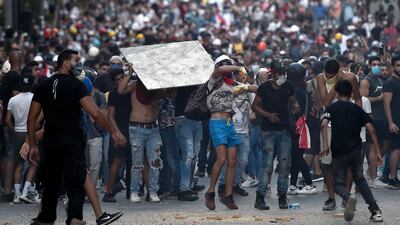
  • Lebanese anti-government protesters clash with security forces in the area close to the parliament in Beirut. EPA
    Lebanese anti-government protesters clash with security forces in the area close to the parliament in Beirut. EPA
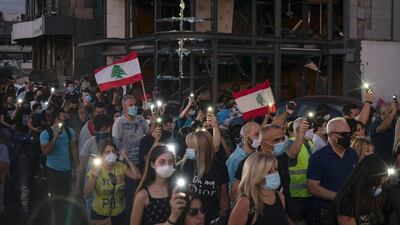
  • Demonstrators march past a damaged building holding candles and flashlights honouring the victims. AP
    Demonstrators march past a damaged building holding candles and flashlights honouring the victims. AP
  • Lebanese anti-government protesters clash with security forces in the area close to the parliament in Beirut. EPA
    Lebanese anti-government protesters clash with security forces in the area close to the parliament in Beirut. EPA
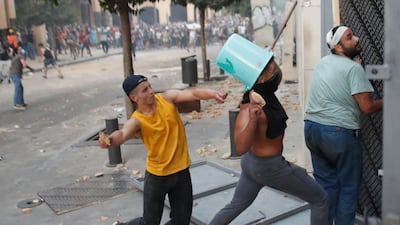
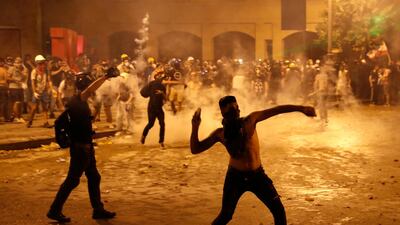
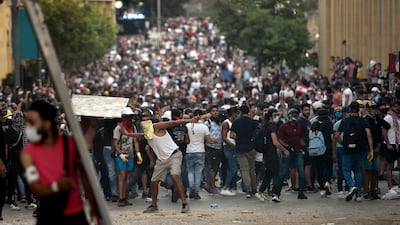
  • Demonstrators throw stones during a protest following Tuesday's blast in Beirut's port area, in Beirut. Reuters
    Demonstrators throw stones during a protest following Tuesday's blast in Beirut's port area, in Beirut. Reuters
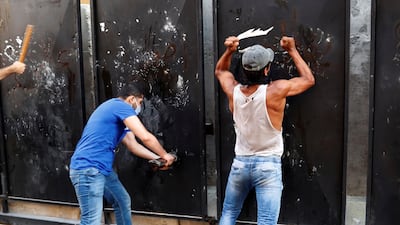
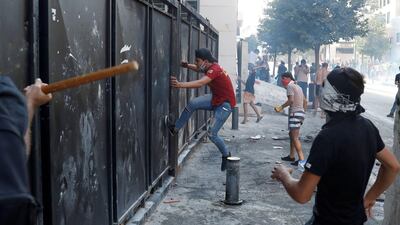
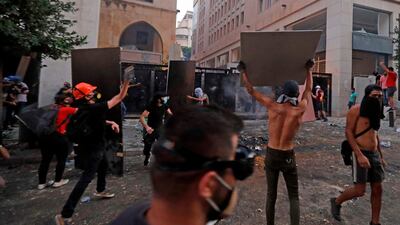
  • Demonstrators try to break a fence during a protest following Tuesday's blast in Beirut's port area. Reuters
    Demonstrators try to break a fence during a protest following Tuesday's blast in Beirut's port area. Reuters
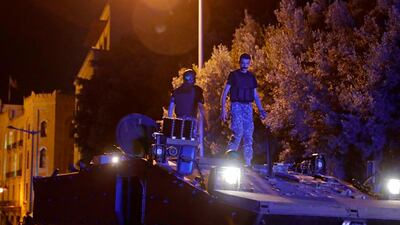
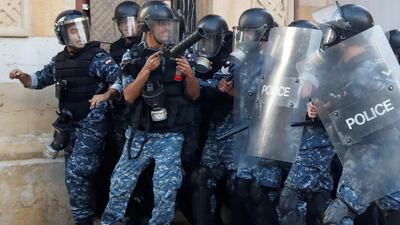
  • Lebanese anti-riot police stand guard atop an armoured vehicle during anti-government protests in central Beirut. AFP
    Lebanese anti-riot police stand guard atop an armoured vehicle during anti-government protests in central Beirut. AFP
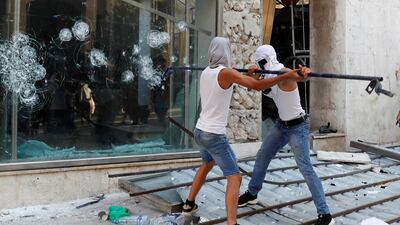
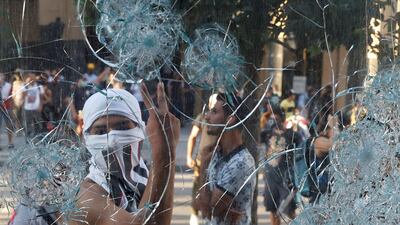
  • Demonstrators try to break a glass with a metal bar during a protest following Tuesday's blast in Beirut's port area. Reuters
    Demonstrators try to break a glass with a metal bar during a protest following Tuesday's blast in Beirut's port area. Reuters
  • A protester throws stones against the Lebanese riot police. AP
    A protester throws stones against the Lebanese riot police. AP
  • Demonstrators try to break a fence during a protest following Tuesday's blast in Beirut's port area. Reuters
    Demonstrators try to break a fence during a protest following Tuesday's blast in Beirut's port area. Reuters
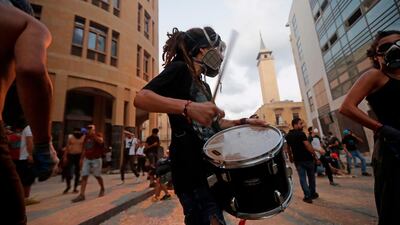
  • A Lebanese protester beats a drum amid clashes with security forces near an access street to the parliament in central Beirut. AFP
    A Lebanese protester beats a drum amid clashes with security forces near an access street to the parliament in central Beirut. AFP
  • Lebanese protesters, enraged by a deadly explosion blamed on government negligence, clash with police. AFP
    Lebanese protesters, enraged by a deadly explosion blamed on government negligence, clash with police. AFP
  • Lebanese anti-government protesters clash with security forces in the area close to the parliament in Beirut. EPA
    Lebanese anti-government protesters clash with security forces in the area close to the parliament in Beirut. EPA
  • Policemen withdraw as demonstrators throw stones during a protest following Tuesday's blast in Beirut's port area, in Beirut. Reuters
    Policemen withdraw as demonstrators throw stones during a protest following Tuesday's blast in Beirut's port area, in Beirut. Reuters
  • A demonstrator gestures during a protest following Tuesday's blast in Beirut's port area, in Beirut. Reuters
    A demonstrator gestures during a protest following Tuesday's blast in Beirut's port area, in Beirut. Reuters

Mr Diab's announcement followed the resignation of his information, environment, justice and health ministers, and several members of parliament since the explosion last Tuesday.

On Sunday, Mr Diab told Britain's ITV News that the Lebanese people had a right to be furious after "decades of unbelievable corruption”.

“I am not afraid of the people’s fury," he said, as pressure mounted on him and his government to resign.

"Absolutely they have a right to be furious, not just because of this. It is absolutely diabolical what happened.

“However, they were also furious before that, about three decades of unbelievable corruption. We are here facing all of these accumulated problems.”

Member of Parliament Alain Aoun told The National  that the government's resignation would not affect the continuing investigation into the explosion at Beirut's port.

“The government will likely stay as a caretaker but the investigation is in the hands of the judges and the attorney general, and they are not affected by changes to the government,” Mr Aoun said.

“Maybe the ministerial committee will not survive but the judges will continue their work. They have already started.”

Tuesday's blast compounded months of difficulties in Lebanon, which was already dealing with an economic collapse that had prompted months of protests.

Its strained health infrastructure was also struggling to deal with the coronavirus pandemic.

Veteran politician and leader of the Progressive Socialist Party Walid Joumblatt said the resignation of the government met the "basic demand" of the people after the disaster.

"Today, the demand has been fulfilled and we consider it a great political victory," Mr Joumblatt told Sky News.

Over the weekend, public anger spilled out on to the streets, with police using tear gas to disperse rock-throwing protesters.

Despite the resignation of Mr Diab and his government, protesters hurled rocks and fireworks at Parliament on Monday night, as riot police and military personnel tried to keep them back.

Lebanon's National News Agency reported that bullets were fired into the air in the northern city of Tripoli to mark the decision.

Winners

Best Men's Player of the Year: Kylian Mbappe (PSG)

Maradona Award for Best Goal Scorer of the Year: Robert Lewandowski (Bayern Munich)

TikTok Fans’ Player of the Year: Robert Lewandowski

Top Goal Scorer of All Time: Cristiano Ronaldo (Manchester United)

Best Women's Player of the Year: Alexia Putellas (Barcelona)

Best Men's Club of the Year: Chelsea

Best Women's Club of the Year: Barcelona

Best Defender of the Year: Leonardo Bonucci (Juventus/Italy)

Best Goalkeeper of the Year: Gianluigi Donnarumma (PSG/Italy)

Best Coach of the Year: Roberto Mancini (Italy)

Best National Team of the Year: Italy 

Best Agent of the Year: Federico Pastorello

Best Sporting Director of the Year: Txiki Begiristain (Manchester City)

Player Career Award: Ronaldinho

Name: Peter Dicce

Title: Assistant dean of students and director of athletics

Favourite sport: soccer

Favourite team: Bayern Munich

Favourite player: Franz Beckenbauer

Favourite activity in Abu Dhabi: scuba diving in the Northern Emirates 


Who's who in Yemen conflict

Houthis: Iran-backed rebels who occupy Sanaa and run unrecognised government

Yemeni government: Exiled government in Aden led by eight-member Presidential Leadership Council

Southern Transitional Council: Faction in Yemeni government that seeks autonomy for the south

Habrish 'rebels': Tribal-backed forces feuding with STC over control of oil in government territory

The specs
  • Engine: 3.9-litre twin-turbo V8
  • Power: 640hp
  • Torque: 760nm
  • On sale: 2026
  • Price: Not announced yet

Best Academy: Ajax and Benfica

Best Agent: Jorge Mendes

Best Club : Liverpool   

 Best Coach: Jurgen Klopp (Liverpool)  

 Best Goalkeeper: Alisson Becker

 Best Men’s Player: Cristiano Ronaldo

 Best Partnership of the Year Award by SportBusiness: Manchester City and SAP

 Best Referee: Stephanie Frappart

Best Revelation Player: Joao Felix (Atletico Madrid and Portugal)

Best Sporting Director: Andrea Berta (Atletico Madrid)

Best Women's Player:  Lucy Bronze

Best Young Arab Player: Achraf Hakimi

 Kooora – Best Arab Club: Al Hilal (Saudi Arabia)

 Kooora – Best Arab Player: Abderrazak Hamdallah (Al-Nassr FC, Saudi Arabia)

 Player Career Award: Miralem Pjanic and Ryan Giggs

Jeff Buckley: From Hallelujah To The Last Goodbye
By Dave Lory with Jim Irvin

COMPANY%20PROFILE
%3Cp%3E%3Cstrong%3EName%3A%3C%2Fstrong%3E%20SupplyVan%3Cbr%3E%3Cstrong%3EBased%3A%3C%2Fstrong%3E%20Dubai%2C%20UAE%3Cbr%3E%3Cstrong%3ELaunch%20year%3A%3C%2Fstrong%3E%202017%3Cbr%3E%3Cstrong%3ENumber%20of%20employees%3A%3C%2Fstrong%3E%2029%3Cbr%3E%3Cstrong%3ESector%3A%3C%2Fstrong%3E%20MRO%20and%20e-commerce%3Cbr%3E%3Cstrong%3EFunding%3A%3C%2Fstrong%3E%20Seed%3C%2Fp%3E%0A
Where to apply

Applicants should send their completed applications - CV, covering letter, sample(s) of your work, letter of recommendation - to Nick March, Assistant Editor in Chief at The National and UAE programme administrator for the Rosalynn Carter Fellowships for Mental Health Journalism, by 5pm on April 30, 2020

Please send applications to nmarch@thenational.ae and please mark the subject line as “Rosalynn Carter Fellowship for Mental Health Journalism (UAE programme application)”.

The local advisory board will consider all applications and will interview a short list of candidates in Abu Dhabi in June 2020. Successful candidates will be informed before July 30, 2020.