


Protesters in crisis-hit Lebanon clashed with security forces in Beirut on Wednesday, a day after demonstrators outraged by restrictions on dollar withdrawals attacked bank branches with metal rods, fire extinguishers and rocks.
Hundreds gathered again outside the central bank on Wednesday evening, moving to a police station where more than 50 people were still detained following clashes between demonstrators and security forces the previous night.
They chanted slogans and demanded the release of their comrades before security forces fired teargas to disperse them.
The Red Cross said a total of 47 people were injured on Wednesday night, 37 of whom were taken to nearby hospitals. The ten others were treated on the spot.
A lawyer in the place told local media that 17 protesters were also arrested during Wednesday clashes, the latest since Lebanon's anti-government protests demanding sweeping reform began on October 17.
Four months into a protest movement against Lebanon's political class, demonstrators have turned their anger at the banks, most of which have imposed informal capital controls to stave off a liquidity crunch.
That has trapped the savings of ordinary depositors in Lebanon's worst economic crisis since the 1975-1990 civil war.
Protester Yumna Mroue, 22, said the central bank's financial policies had been harming small savers for years.
"We're in free-fall now. What happened last night comes from people's real pain and anger," she said.

After a long day of protests and clashes, security forces released 10 people out of more than 50 who were detained on Tuesday night, according to local media and activists.
On Wednesday morning in Hamra, most bank branches were left with smashed windows, destroyed ATMs and graffiti-daubed walls after violent protest the previous night.
Banks opened despite the wreckage, as cleaners scrubbed paint off walls and workers replaced smashed windows.
-
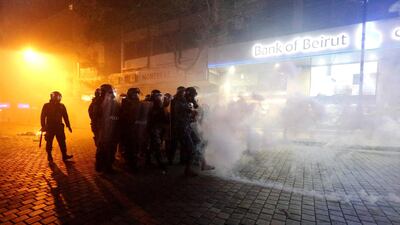
Riot police officers stand behind riot shields amid a cloud of tear gas during protests against the economic crisis outside a Bank of Beirut office in Beirut, Lebanon. Reuters -
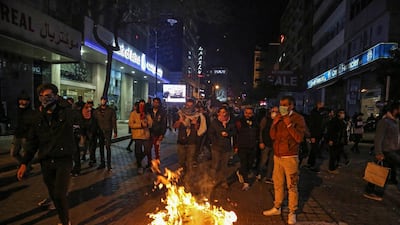
Anti-government protesters clash with riot police as they block a road and calling for 'the fall of the rule of the bank' during a protest in front of the Lebanese Central Bank headquarters at Hamra Street in Beirut, Lebanon. EPA -

Demonstrators take to the streets as they protest against what they say is economic hardship and a lack of new government in Beirut, Lebanon. Reuters -
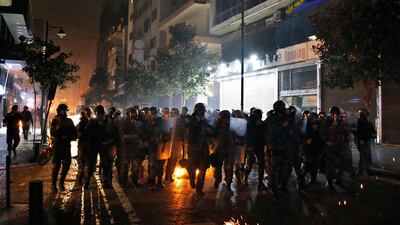
Riot police run toward anti-government protesters, during ongoing protests against the Lebanese central bank's governor and against the deepening financial crisis, at Hamra trade street, in Beirut, Lebanon. AP -

Anti-government protesters run to escape tear gas that fired by riot police, during ongoing protests against the Lebanese central bank's governor and against the deepening financial crisis, at Hamra trade street, in Beirut, Lebanon. AP -

Police keep watch along a street as protests against the government continue in Beirut, Lebanon. Reuters -
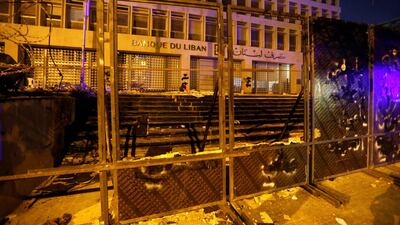
The Banque du Liban, the central bank of Lebanon, is seen as protests against the government continue in Beirut, Lebanon. Reuters -
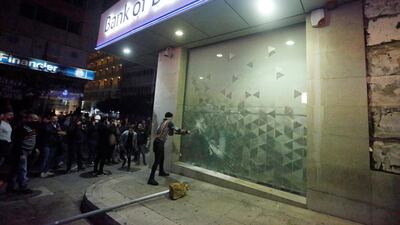
Protesters smash the window of a Bank of Beirut office as demonstrations against the government continue in Beirut, Lebanon. Reuters -
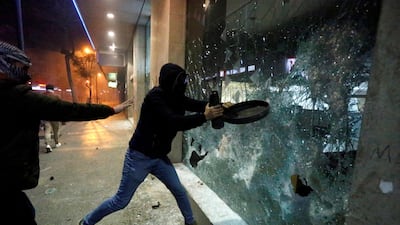
Protesters smash the window of a bank as demonstrations against the government continue in Beirut, Lebanon. Reuters -
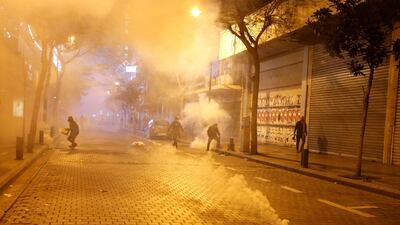
Protesters are seen amid a cloud of tear gas as protests against the economic crisis continue in Beirut, Lebanon. Reuters -
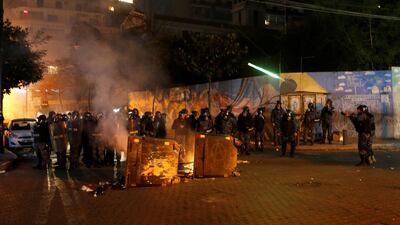
Riot police officers stand near burning garbage bins during protests against the economic crisis in Beirut, Lebanon. Reuters -
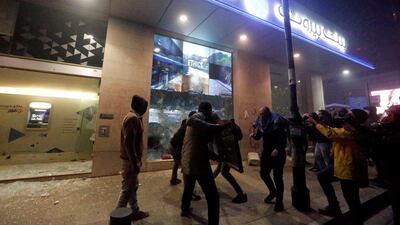
Protesters smash the window of a bank as demonstrations against the economic crisis continue in Beirut, Lebanon. Reuters -
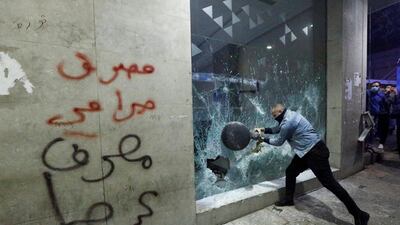
SENSITIVE MATERIAL. THIS IMAGE MAY OFFEND OR DISTURB An anti-bank message is seen on a wall as a protester smashes the window of a bank, as demonstrations against the economic crisis continue in Beirut, Lebanon January 14, 2020. REUTERS/Mohamed Azakir TPX IMAGES OF THE DAY


"There is a lot of anger," Alia, a passerby, told AFP in front a damaged branch. "You have to go to the bank twice to withdraw just $200."
On Wednesday evening, hundreds of demonstrators gathered in front of the central bank, whose governor Riad Salameh they partly blame for the country's financial crisis.
Security forces meanwhile imposed tight movement restrictions in Hamra, closing the main road to the central bank.
The state-run National News Agency reported that some teargas canisters had fallen inside the Russian embassy, near the police station housing the detainees.
Activists said several people including at least one video journalist had been injured in the clashes.
Since September, banks have limited the number of dollars customers can withdraw or transfer abroad, in a country where the greenback and the Lebanese pound are used interchangeably.
Although no formal policy is in place, most lenders have limited withdrawals to about $1,000 (Dh 3,700) a month, while others have imposed tighter curbs.
Prompted by a grinding liquidity crisis, the controls are increasingly forcing depositors to deal in the pound.
But the local currency has plunged by over a third against the dollar on the parallel market, hitting almost 2,500 against the US dollar over the past week.
The official rate was pegged at 1,507 Lebanese pounds to the greenback in 1997.
Demonstrators accuse banks of holding their deposits hostage while allowing politicians, senior civil servants and bank owners to transfer funds abroad.
The central bank has announced it is investigating capital flight, saying it wants to standardise and regulate the ad hoc banking restrictions.
Compounding the situation, debt-burdened Lebanon has been without a government since Saad Hariri resigned as prime minister on October 29 under pressure from the anti-government protests.
Its under-fire politicians have yet to agree on a new cabinet despite the designation last month of Hassan Diab, a professor and former education minister, to replace Mr Hariri.
Mr Diab has pledged to form a government of independent experts - a key demand of protesters - but said last week that some parties were hindering his attempts.
Authorities on Wednesday condemned the night-time attacks and called for perpetrators to be prosecuted.
Mr Hariri called the rampage "unacceptable," while parliament speaker Nabih Berri questioned whether the aim was to "destroy the country".
But in a strongly worded statement, United Nations envoy to Lebanon, Jan Kubis, blamed politicians for the turmoil, accusing them of inaction while watching the economy "collapse".
"Politicians, don't blame the people, blame yourselves for this dangerous chaos," he said.

