
Lebanon's Christian authorities slammed politicians on Sunday for failing to remedy an economic meltdown that has left many poor, piling pressure on the country's leaders as it spirals deeper into crisis.
In a sermon, Maronite Patriarch Bechara Rai, the top Christian cleric, accused politicians of thinking only of their own vested interests and urged the president to take action.
"It appears politicians want to hide their responsibility in emptying the treasury and not enact any reforms," he said.
Hopes of salvation through an IMF deal have retreated, with the government unwilling or unable to enact reforms, hamstrung by the conflicting agendas of sectarian leaders who don't want to yield power or privileges.
The crisis, which has decimated the local currency and raised fears of mass hunger, is seen as the biggest threat to Lebanon's stability since its 1975-1990 civil war.
"Political officials...do not have the courage nor the freedom to meet and find ways out of the suffering," Mr Rai said. He warned this was depriving the country of help it needs from foreign donors.
-
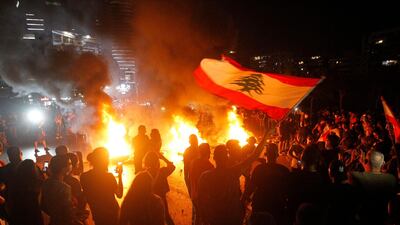
Anti-government protesters carry Lebanese flags and burn tyres as they block the main highway in north of Beirut during a protest over deteriorating living conditions. EPA -

Lebanon has been seeing months of protests against the current government fuelled by the dire state of the domestic economy. EPA -

Many citizens fear that the combination of rising unemployment, poverty, sectarian tensions, the devaluation of the Lebanese pound and the ongoing pandemic disease may spark another violent conflict. EPA -

Lebanese army soldiers intervene as anti-government protesters attempt to block the main highway but with crashing currencies salaries have lost most of their value with soldiers reportedly earning the equivalent of as little as $110 a month. EPA -
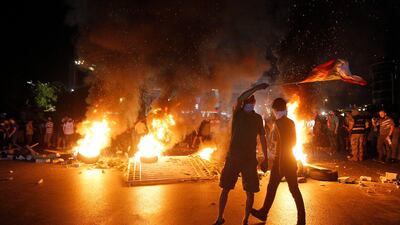
Anti-Government protestors burn tyres as they block the main highway during a protest over deteriorating living conditions after the government raised subsidized bread prices. EPA -
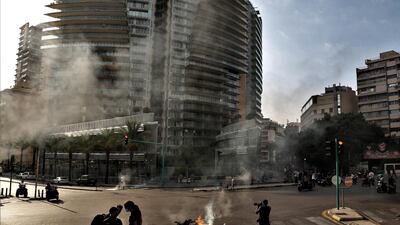
Anti-Government protestors set garbage bins on fire and block the majority of the main roads during a protest over deteriorating living conditions. EPA -
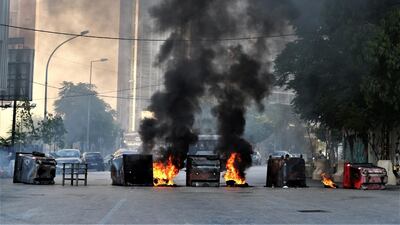
Anti-Government protestors set garbage bins on fire and block the majority of the main roads. EPA -

Anti-Government protestors set garbage bins on fire and block the majority of the main roads. EPA -
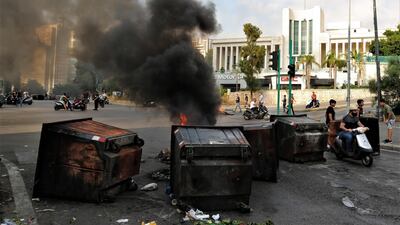
Anti-Government protestors set garbage bins on fire and block the majority of the main roads. EPA -

A man counts US dollar banknotes next to Lebanese pounds at a currency exchange shop in Beirut. Reuters, file


The clergyman has been vocal in his support of the aims of the mass uprisings against the dire economic situation, regularly using the pulpit to call for swift action during his Sunday sermons to a congregation that often includes ministers and senior officials.
Economic woes, rooted in state waste and corruption, came to the fore last year after capital inflows slowed and protests erupted against leaders in power since the war.
Lebanon's sectarian political system parcels out state posts based on religious sect, with the presidency reserved for a Maronite Christian.
The largest Christian bloc, the Free Patriotic Movement, and its leader President Michel Aoun, have long portrayed themselves as the vanguard of Christian rights in Lebanon, making Mr Rai's regular criticisms of the administration all the more pointed. The FPM is close to the Iran-backed Hezbollah movement and both backed the current cabinet, which took office in January.
In recent weeks there has been mounting talk in political circles of the current administration being hamstrung, with some saying the country needs a unity administration again headed by former prime minister Saad Hariri.
Talks with the International Monetary Fund on an emergency bailout have reportedly hit "rock bottom" with two senior members of the Lebanese negotiating team resigning in recent weeks.
In another sermon in a central Beirut church, Greek Orthodox Archbishop Elias Audi also lambasted the political elite on Sunday.
"Oh respected leaders, I address whatever conscience remains in you," he said. "Do you sleep comfortably at night while those under your care starve and die of thirst and by suicide?"
Earlier this week, dozens of people mourned a man who killed himself in a busy Beirut district, blaming the country's leaders for the hardship which they said caused his death.

