

The resignation of Lebanese Foreign Minister Nassif Hitti on Monday morning will weaken the government of Prime Minister Hassan Diab, who is increasingly under fire from Lebanon's traditional parties for not responding effectively to the country's economic collapse, analysts said.
“They cannot just ignore it and move on,” said Maha Yahya, director of the Carnegie Middle East Centre. “This is not a one-off thing with a disgruntled minister… It’s only a matter of time until the next one comes along. It depends under what kind of pressure ministers are under.”
Alain Aoun, an MP and member of President Michel Aoun’s Free Patriotic Movement, said that Mr Hitti’s resignation represents “an opportunity for those who think they can still change things with this government to come to the same conclusion.”
"It can't work. There must be a replacement and create new conditions for political success," he told The National.
Environment and administrative development minister Damianos Kattar was to act as interim foreign minister, but on Monday afternoon, President Aoun's diplomatic adviser Charbel Wahbi was named as the new foreign minister.
Lebanese ministers have openly talked of Cabinet change in the past month, with some of them questioning the “benefit of continuing in light of the lack of achievements,” said Energy Minister Raymond Ghajar on July 5.
Sami Nader, director of the Levant Institute for Strategic Affairs, warned that Mr Hitti’s resignation would precipitate Lebanon in a “failed state” scenario. ‘As long as the government does not achieve critical reforms, as long as it does not respect neutrality at the international level to pave the way for financial aid, it’s going to hell,” he said.
The neutrality, or lack of involvement in regional conflicts, of Lebanon’s main religious groups – Christian, Sunni Muslim and Shiite Muslim – remains an important pillar of the state.
Last month, Maronite Patriarch Bechara Rai launched a diplomatic push for Lebanon to remain neutral, despite the military intervention of local party Hezbollah in Syria for nearly a decade.
-
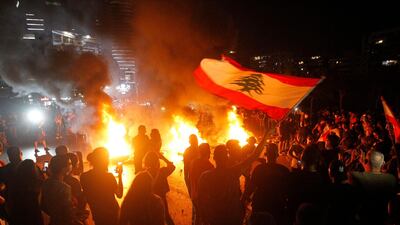
Anti-government protesters carry Lebanese flags and burn tyres as they block the main highway in north of Beirut during a protest over deteriorating living conditions. EPA -

Lebanon has been seeing months of protests against the current government fuelled by the dire state of the domestic economy. EPA -

Many citizens fear that the combination of rising unemployment, poverty, sectarian tensions, the devaluation of the Lebanese pound and the ongoing pandemic disease may spark another violent conflict. EPA -
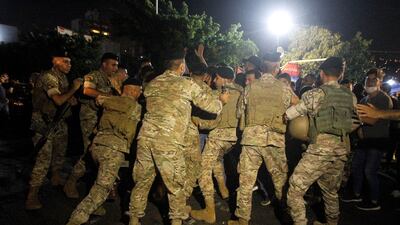
Lebanese army soldiers intervene as anti-government protesters attempt to block the main highway but with crashing currencies salaries have lost most of their value with soldiers reportedly earning the equivalent of as little as $110 a month. EPA -
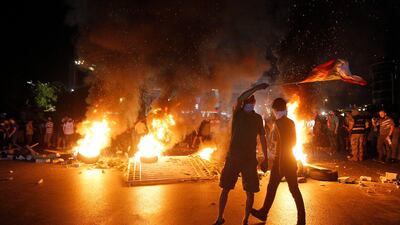
Anti-Government protestors burn tyres as they block the main highway during a protest over deteriorating living conditions after the government raised subsidized bread prices. EPA -
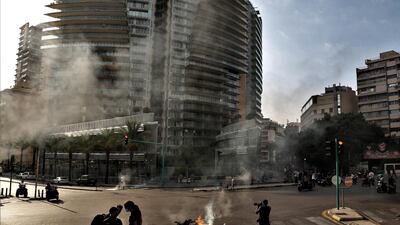
Anti-Government protestors set garbage bins on fire and block the majority of the main roads during a protest over deteriorating living conditions. EPA -
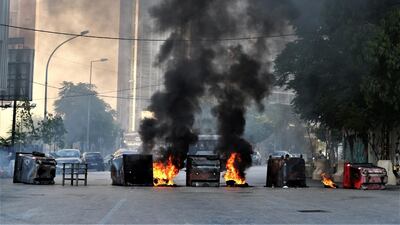
Anti-Government protestors set garbage bins on fire and block the majority of the main roads. EPA -

Anti-Government protestors set garbage bins on fire and block the majority of the main roads. EPA -
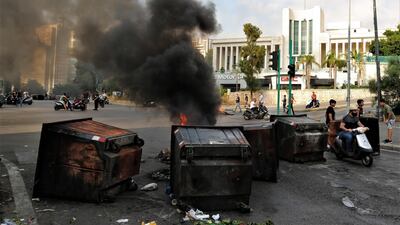
Anti-Government protestors set garbage bins on fire and block the majority of the main roads. EPA -
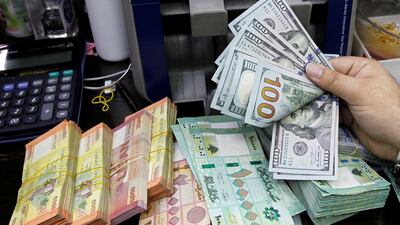
A man counts US dollar banknotes next to Lebanese pounds at a currency exchange shop in Beirut. Reuters, file


Mr Rai argued the United States, European Union and Arab Gulf countries would not help Lebanon because they did not want their financial aid to be used by Iran-backed Hezbollah.
When it was formed in late January amid nationwide social unrest, Prime Minister Hassan Diab, a little known former Education minister and a vice-president of the American University of Beirut, vowed to respond to requests for change and more transparency voiced by Lebanese protesters and to tackle the country’s worst-ever economic crisis.
But despite promises of independence from political parties, backdoor politics continued unabated, disappointing those who had supported the anti-government protests. Those who had initially backed Mr Diab, including the FPM, started to openly talk of his resignation as the country collapsed. “The earlier [he resigns], the less time the country would lose,” said Mr Aoun, the MP.
In addition to being unable to access their savings since capital controls were put in place in November, the Lebanese are suffering from increasing power cuts, fuel shortages, hyperinflation, mass unemployment, and a looming Covid-19 health crisis. The local currency has lost around 80 per cent of its value on the black market.
But Mr Diab has repeatedly vowed to not resign, and no clear alternative has emerged. “An alternative would not be found easily. We will be a caretaker government for perhaps a year or two, and this is a crime against the country and against the Lebanese,” he warned on July 19.
Negotiations to appoint political leaders can take months or years in Lebanon as political parties need consensus to satisfy the country’s delicate sectarian power balance.
“The most important thing is for a debate to take place between the Lebanese, and also with some friends of Lebanon, to understand what the formula would be to unlock the situation internally and externally so that Lebanon can receive help in these difficult circumstances,” said Mr Aoun, the MP.
Last month, French Foreign Minister Jean-Yves Le Drian, delivered a stern message to Lebanese politicians during a two-day visit, saying there would be no international aid unless they delivered on reforms to increase transparency and fight corruption.
But political parties have repeatedly stalled reforming the country. It would mean giving up power, which is based on clientelism, including giving government jobs to political supporters. Negotiations with the International Monetary Fund, which started in May, have also stalled.
“If they’re serious about getting the country out of this mess …, they [Lebanese politicians] would need to appoint an independent Prime Minister with a Cabinet of people who know what they are doing and who are given exceptional powers and a mandate to work on economic issues and push forward on [the 2022] parliamentary elections,” said Mrs Yahya.
But Lebanon is in a “Catch-22,” she said. “Economically, the country will not survive without an IMF deal, which will not happen unless political consensus allows reforms to take place. Gulf support will not follow unless an IMF deal happens, and Gulf support is contingent on how Hezbollah positions itself,” explained Mrs Yahya.
In late June, UAE Minister of State for Foreign Affairs Anwar Gargash told broadcaster CNBC that his country would only offer financial support to Lebanon in concert with other states.
The small Mediterranean country is “paying the price” for the “deterioration” of its relations with the Gulf in the past decade, he said. He accused Hezbollah, considered a terrorist organisation by Gulf states and the US, of dictating “political discourse.”
Tackling these multiple crises is “very complicated” for Lebanese politicians, observed Mrs Yahya. Instead, they “would rather buy time until there is an opening somewhere,” she said.
“Meanwhile, the country is collapsing.”

