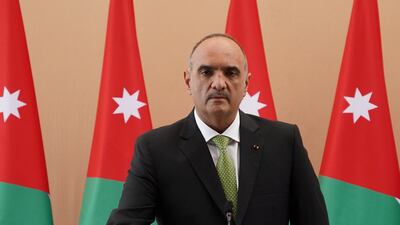
Jordan’s King Abdullah swore in an interim government on Monday that takes office facing historic levels of unemployment and a coronavirus pandemic that its predecessor failed to contain.
Bisher Al Khasawneh, the replacement for prime minister Omar Razzaz, is a longtime diplomat who is new to governance. He formed an administration made mostly of Cabinet veterans, former ministers and ambassadors.
Sources at the prime minister's office and those close to the Royal Court said the “safe hands” were selected to guide Jordan through the biggest economic crisis and wave of public discontent in modern history.
At a socially-distanced swearing-in ceremony in front of the king at the Husseini Palace on Monday, Mr Al Khasawneh said the government will give the pandemic file special importance.
He vowed to enhance health services, improve the co-ordination between partners in the health sector, and develop “a new epidemiological monitoring and investigation strategy to cope with the communal transmission phase of the virus” and better contact tracing.
For interior minister, Mr Al Khasawneh replaced Salamah Hamad with Gen Tawfiq Al Halalmeh, the first director of Jordan’s gendarmerie, who helped develop the service into an elite internal security and counter-terrorism force. Gen Al Halalmeh is an influential voice in Jordan’s security sector.
Ali Al Ayad, a former minister and ambassador to Israel, returned to the post of minister of media affairs and government spokesman, nine years since he last served in the post.
For the post of deputy prime minister and minister of state for economic affairs, Mr Al Khasawneh called on Umayya Toukan, a former finance minister and longtime governor of the Central Bank of Jordan.
Nayef Al Fayez is another former minister returned to an old post, serving again as minister of tourism to address a critical sector that accounts for 14 per cent of the kingdom’s GDP and has been badly hit by the pandemic.
Mr Al Fayez has served as tourism minister three times over the past decade, most recently in 2016.

Most notably, the new government replaced Saad Al Jaber, the health minister who relied heavily on his casual and personable media presence to convince Jordanians of the seriousness of the coronavirus and the need for a costly three-month lockdown.
Mr Al Jaber’s sometimes flippant and often quotable approach made him a polarising figure. His claims that coronavirus had “dried up and died” in Jordan in June after a three-month lockdown was emblematic of the government’s squandering of its hard-earned gains against the virus.
Replacing Mr Al Jaber is Dr Nathir Obeidat, spokesman for Jordan’s Covid-19 taskforce whose measured, sober and facts-based discussion on the pandemic with media throws Mr Al Jaber's approach into sharp relief.
The post of foreign minister was one of the few left unchanged, with Ayman Safadi retaining the post as the kingdom’s top diplomat, a position he has held since 2017. Minister of Education Tayseer Naimi also kept his role.
King Abdullah selected Mr Al Khasawneh, who served as Jordan’s ambassador to Egypt, France and the Arab League, as prime minister on Wednesday, noting in his letter of designation that the new government arrived at an “exceptional time”.
Although constitutionally the king-appointed prime minister forms a government independently, former ministers and royal court officials told The National that the palace and security services have great sway over Cabinet selections.
The interim government has several tall tasks at hand, the most immediate of which is the coronavirus.
Despite “crushing the curve” in the spring and pushing cases down to zero for weeks, mismanagement at the country’s borders with Syria and Saudi Arabia allowed infected lorry drivers and border staff to take the virus into Jordanian communities.
Since then, the Razzaz government struggled to find a balance between reviving the economy and stopping the spread of Covid-19, following a strategy of localised lockdowns and weekend curfews that did little to prevent the infections jumping to more than 1,000 new cases and 10 to 15 deaths a day.
Health experts are speaking of a potential collapse of the health system, after dozens of nurses and doctors caught the virus and hospital beds became scarce.
The economic crisis is just as immediate and, for Jordan, with longer-term implications. Jordan’s economy has struggled to recover from the three-month coronavirus lockdown imposed in March.
Its debt crisis has widened to more than 100 per cent of GDP, exacerbated by a drop in tax revenue and costly social measures designed to keep citizens afloat.
Jordan’s unemployment is at a historic high of 23 per cent, according to official statistics, but independent researchers and think tanks put that at close to 40 per cent.
The vast majority of Jordanians still in work receive 50 per cent to 75 per cent of their normal monthly salaries.
Compounding the challenges facing the government is the uncertainty surrounding its shelf-life and its constitutional mandate.
The country’s constitution mandates that once parliament is dissolved upon completion of its ordinary session to pave way for elections, government must also resign to prevent a prime minister running the government without the constitutional check of the legislative body.
King Abdullah instructed Mr Al Khasawneh’s interim government to serve until parliamentary elections – scheduled for November 10 – are complete and a new government is sworn in.
But the country’s Independent High Electoral Commission hinted several times this month that elections may be postponed should Jordan’s coronavirus case numbers continue to climb.
Hanging over the elections, as with everything else in Jordan, is the prospect of a second national lockdown.
To prevent a collapse of the health system, experts in the Covid-19 taskforce have pushed the government to impose a two or three-week national lockdown to slow transmission.
Incoming health minister Dr Obeidat, in his capacity as Covid-19 taskforce spokesman, said last week that weekend and local lockdowns as enacted by the previous government were “ineffective at this stage” and that a “two or three-week lockdown” would be needed to curb communal transmission.
It is unclear how a national lockdown would delay an election campaign season that is already in full swing, and whether the Khasawneh government will serve past its interim period.

