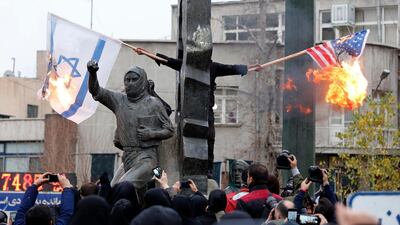
Comments last week from an unnamed Israeli defence official that Iran was reducing its presence in Syria sparked debate about Tehran's next moves and how Israel should respond.
Iranian policy will be a big concern for the Israeli government to be sworn in Thursday, a unity coalition agreed after more than a year of unprecedented political deadlock.
US Secretary of State Mike Pompeo, who will be in Israel on Wednesday, is to discuss Iran with Prime Minister Benjamin Netanyahu and incoming defence minister Benny Gantz.
Their focus will be on Iranian nuclear ambitions, with the US pursuing a campaign of "maximum pressure", backed by Israel, to deter an Iranian weapons programme.
But developments in Syria have switched attention to Iranian action in Israel's northern neighbour.
Israel has launched hundreds of attacks in Syria since the start of the civil war in 2011 – targeting government troops, allied Iranian forces and fighters from Tehran-backed Lebanese militant group Hezbollah.
But in what may be an intensification, six air strikes attributed to Israel have been carried out on Iranian targets in Syria over the past three weeks.
Israel almost never claims – or denies – such strikes, telling reporters that it "does not comment on foreign reports".
But following the most recent bombing last week, outgoing Israeli Defence Minister Naftali Bennett said: "Iran has nothing to do in Syria ... (and) we won't stop before they leave Syria."
-
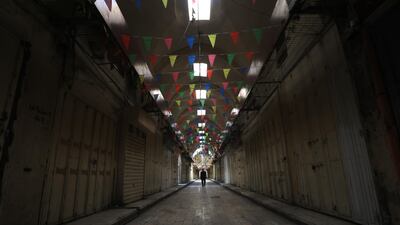
epa08360794 Palestinians walk in empty street inside al-Tujjar caravanserai in the West Bank city of Nablus, 13 April 2020. Nablus was closed due to the current novel coronavirus emergency after the Palestinian National Authority (PA) has imposed a new 14-day period of home confinement for all Palestinians living in the West Bank amid the ongoing pandemic of the COVID-19 disease caused by the SARS-CoV-2 coronavirus. EPA/ALAA BADARNEH -

epa08362541 Palestinians deliver food for patients and health workers at three quarantine centres in the West Bank city of Nablus, 14 April 2020. Nablus was closed due to the current novel coronavirus emergency after the Palestinian National Authority (PA) has imposed a new 14-day period of home confinement for all Palestinians living in the West Bank amid the ongoing pandemic of the COVID-19 disease caused by the SARS-CoV-2 coronavirus. EPA/ALAA BADARNEH -
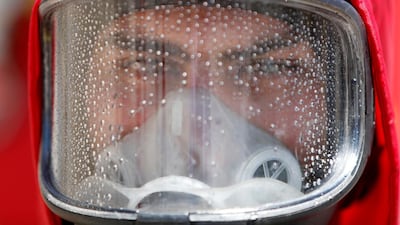
A member of Palestinian Civil Defence wears a face shield as he takes part in a drill for dealing with coronavirus cases, amid concerns about the spread of the disease (COVID-19), in Ramallah in the Israeli-occupied West Bank April 23, 2020. REUTERS/Mohamad Torokman -

epa08362952 Palestinians fly a kite from their home roof over a neighborhood of the West Bank City of Nablus, 14 April 2020. Nablus was closed due to the current novel coronavirus emergency after the Palestinian National Authority (PA) has imposed a new 14-day period of home confinement for all Palestinians living in the West Bank amid the ongoing pandemic of the COVID-19 disease caused by the SARS-CoV-2 coronavirus. EPA/ALAA BADARNEH -
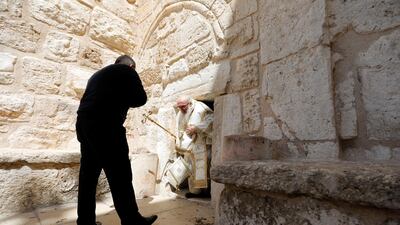
The head of the Greek Orthodox Church in Bethlehem Bishop Theofilactos leaves the Church of the Nativity to receive the Holy Fire as the ceremony is celebrated without a crowd due to the coronavirus disease restrictions in Bethlehem in the Israeli-occupied West Bank April 18, 2020. REUTERS/Mussa Qawasma -
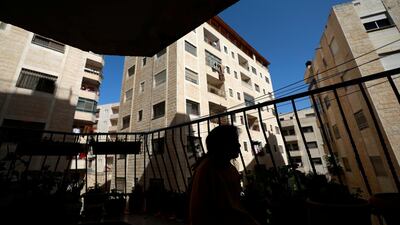
A Palestinian girl looks out of her family apartment during a home-confinement order imposed to prevent the spread of the coronavirus disease (COVID-19), in Ramallah in the Israeli-occupied West Bank April 19, 2020. REUTERS/Mohamad Torokman -

A Palestinian groom, Rafeh Qassim, wears a mask as he sits in a car with his bride on their wedding day amid concerns about the spread of the coronavirus disease (COVID-19), in Ramallah in the Israeli-occupied West Bank April 18, 2020. REUTERS/Mohamad Torokman TPX IMAGES OF THE DAY -
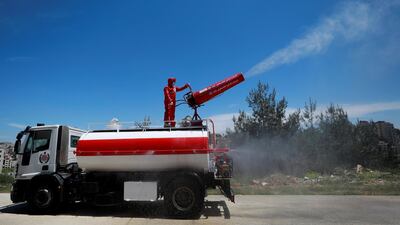
A member of Palestinian Civil Defence on a truck sprays disinfectants during a drill for dealing with coronavirus cases, amid concerns about the spread of the disease (COVID-19), in Ramallah in the Israeli-occupied West Bank April 23, 2020. REUTERS/Mohamad Torokman -

epa08380077 Medical staff of the Palestinian health ministry checks the temperature of workers crossing the checkpoint of Mitar, near the West Bank town of Hebron, 23 April 2020. The instructions of the National Authority Ministry of Health forbid gatherings and movement between cities to prevent the spread of the SARS-CoV-2 coronavirus which causes the COVID-19 disease. EPA/ABED AL HASHLAMOUN -
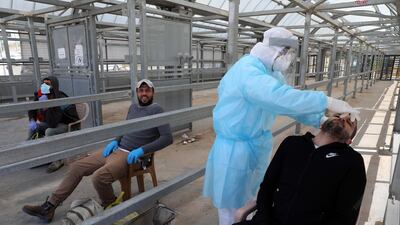
epa08380080 Medical staff of the Palestinian health ministry takes a swab sample from a worker crossing the checkpoint of Mitar, near the West Bank town of Hebron, 23 April 2020. The instructions of the National Authority Ministry of Health forbid gatherings and movement between cities to prevent the spread of the SARS-CoV-2 coronavirus which causes the COVID-19 disease. EPA/ABED AL HASHLAMOUN -

Dr Hani Abdin, dean of the Faculty of Medicine at the Palestinian Al-Quds University, speaks during an interview at the campus in Abu Dis in the West Bank on April 23, 2020, as he showcases a respirator device built on campus and certified by Palestinian health authorities. Al-Quds University announced on April 23 that the Palestinian Ministry of Health had approved the computerised artificial respiration apparatus built by the university in the fight against the COVID-19 coronavirus pandemic. The university will launch its first devices for hospital use in the following week while working to register a patent. / AFP / ABBAS MOMANI -
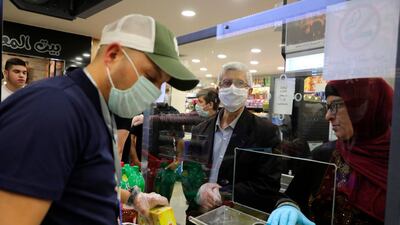
Palestinians, wearing protective masks due to the COVID-19 coronavirus pandemic, pay for their shopping at the checkout counter of a supermarket on the last day before the start of the Muslim holy month of Ramadan, beginning later in the night, at a supermarket in the city of Hebron in the occupied West Bank on April 23, 2020. / AFP / HAZEM BADER -

Palestinian security officers look at an ostrich in a cage at the Qalqilya Zoo in the occupied West Bank, after the animal park was completely closed to visitors due to the novel coronavirus pandemic, on April 21, 2020. The zoo manager said the animals had started mating more due to the calm atmosphere, with the lack of visitors also improving their behaviour. The zoo is funded by the local municipality but faces a potential financial crisis with budget cuts. / AFP / JAAFAR ASHTIYEH -
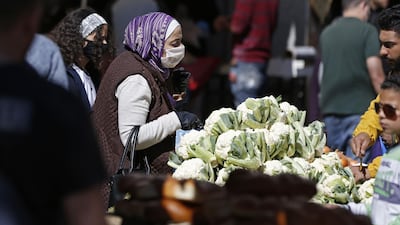
Palestinians, some wearing protective masks, shop at a fruit and vegetables market during the Muslim holy month of Ramadan amid the COVID-19 pandemic, in the occupied West Bank city of Ramallah on April 26, 2020. / AFP / ABBAS MOMANI -

Palestinian Reem Abu Ayyash shows a spoon filled with rice during a video call with her husband Rami, a nurse who treats the coronavirus disease (COVID-19) patients and has avoided his family during Ramadan out of fear of contagion, as she prepares to have her Iftar (breaking fast) meal with her daughter at their home near Hebron in the Israeli-occupied West Bank April 28, 2020. Picture taken April 28, 2020. REUTERS/Mussa Qawasma TPX IMAGES OF THE DAY -

A Palestinian preacher speaks before a camera while recording a sermon and broadcasting the audio onto loudspeakers inside an empty mosque, due to the COVID-19 coronavirus pandemic, in the village of Salem east of Nablus in the occupied West Bank on the first Friday of the Muslim holy month of Ramadan on April 24, 2020. / AFP / JAAFAR ASHTIYEH


Mr Bennett, who may be out of government entirely depending on last-minute coalition negotiations, accused Iran of "trying to establish itself on the border with Israel to threaten Tel Aviv, Jerusalem and Haifa".
Since the start of the year, Iran has faced multiple crises: the killing of strategist General Qassem Suleimani by the US, the region's deadliest coronavirus outbreak, with more than 109,000 people infected, and tumbling oil prices slashing the state budget.
All of which has some observers wondering whether Iran is trying to reduce the cost of its involvement in Syria.
Such speculation was further fuelled by an Israeli defence official recently quoted in Israeli media as saying: "For the first time since (deploying forces to) Syria, Iran is reducing the number of its soldiers there and evacuating bases."
A US diplomat said: "It would make sense at a certain point that Iran would want to cut its losses and downsize its presence there just because it's increasingly costly to them in terms of life and property."
But not everyone in Israel is convinced that Tehran is ready to abandon Syria.
"The Iranians are not leaving," said Amos Yadlin, a former head of Israeli military intelligence, who suggested that Iran may instead be relying more heavily on local forces.
"Still, the commanders are from Hezbollah and Iran and the cheap soldiers are Shia militia and local Syrians," he said.
A source in Jerusalem working on Iran policy agreed that Tehran remained committed to Syria and likely views its investment as a "sunk cost".
"They are waiting for the revenues, they can't withdraw so fast without getting the economic fruit that they think they should get," the source said.
Another source in Jerusalem claimed that Iran was attempting to divert funding for its coronavirus response towards paying its proxies in Syria.
"They are using the virus as an opportunity to increase funds for destabilising activities in the region," the source said, without giving further details.
In April, sanctions-hit Iran urged the International Monetary Fund to issue a US$5 billion emergency loan to help it combat the virus.
Yoram Schweitzer, an analyst at the Institute for National Security Studies in Tel Aviv, said strikes on Syria were either a response to growing Iranian operations or a bid to weaken an enemy already burdened by the pandemic.
But Israel will need to tread carefully, warned the Yediot Aharonot newspaper.
"What Israel needs is a defence minister and an IDF (army) chief of staff who can do the necessary risk-management work together, and act to continue to degrade the Iranian military presence in Syria without creating situations that might draw the entire region into renewed conflict," the paper said.

