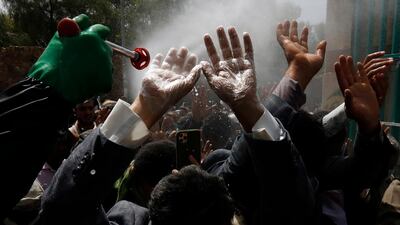

Already ravaged by war and famine, Yemen is suffering another blow to its future as the coronavirus kills off dozens of the country's top public servants, academics and the most educated.
While a lack of widespread testing is masking the true scale of the crisis, scores of doctors, academics, engineers, politicians, judges, lawyers and business leaders, as well as high-ranking members of the Houthi militia, are thought to be among the dead as the virus spreads.
It is a devastating blow for a county that has already suffered six years of civil war, further scuppering hopes for recovery as the government and institutions struggle to fill the skills gap. The loss of leading members of society has also taken a toll on public morale.
The country has limited capacity to test for the virus, but The National has seen evidence that those who have died from symptoms linked to Covid-19 include: a number of prominent members of parliament; lawyer Abdulaziz Al Samawi, who helped to found Yemen's Bar Association and represented the Al Qaeda members accused of the 2000 bombing of the USS Cole off the coast of Aden; and revered poet Hassan Abdullah Al Sharafi.
About 30 professors from Sanaa, Aden and Taiz universities have died, as have leading consultants in ophthalmology, gynaecology and other medical fields.
High-ranking commanders in the Yemeni army who have died include commander of the Marib special forces, Col Mohammed Al Hajwri.
Several sources said that a number of members of the internationally recognised government’s health ministry have gone into isolation after contracting the virus.
The official number of coronavirus cases in Yemen stands at a little more than 500; there have been almost 130 deaths from Covid-19. An estimate of the actual number of cases is difficult to give, but according to a local union, at least 57 doctors and pharmacists alone have died.
Health professionals in Yemen said the virus has rampaged across the country and is rife in Hodeidah, Hadramawt, Ibb, Taez, Aden, Al Dhalea and other governates, with the centre being in the capital, Sanaa.
“There are a number of doctors who have died – just one hour ago I was informed that general surgery specialist Dr Mohammed Ahmed Sayed died today due to coronavirus in Al Hikma hospital,” Dr Abdulrahim Alsamie, chairman of Al Thawra Hospital in Taez, said on Thursday.
Taez is Yemen’s most populous governorate and is among those with the highest number of recorded cases.
“When the community sees the highly educated, especially those who are able to isolate from the virus, are affected, it sends a bad message,” Dr Alsamie said.
He said that there was an added problem when those people are health workers. "The first thing that comes to their minds is: ‘If those on the frontline are dying in front of us, what chance do we have?’" he said. "It’s very bad for the community."
-
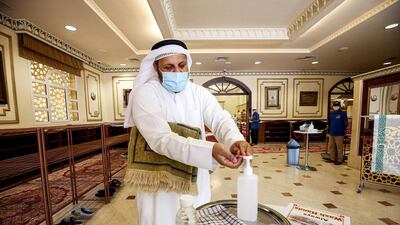
A worshipper sanitises his hands at a mosque in Kuwait City. AFP -
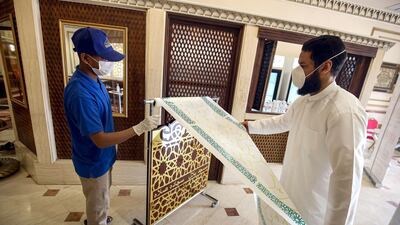
A worshipper pulls a sheet of paper to fashion as a disposable prayer mat for noon prayers at a mosque in Kuwait City. AFP -
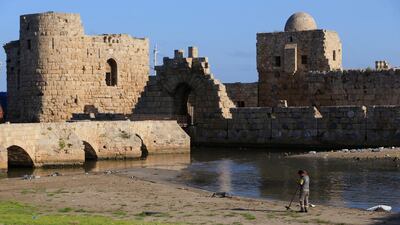
A worker cleans a beach outside the closed sea castle of the port city of Sidon. Reuters -
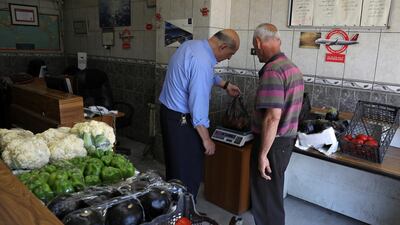
Mohammed Natour, who went from selling airline tickets to selling fruit and vegetables, after the coronavirus outbreak brought the tourism industry in Jordan to a sudden halt, serves a customer at his office in Amman, Jordan. Reuters -
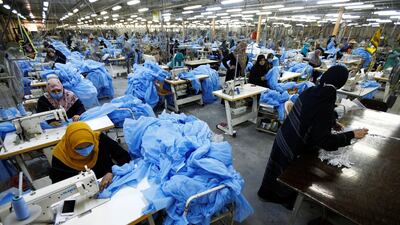
Women sew protective suits at a factory in Najaf, Iraq. Reuters -

Iraqi orphan children draw in the classroom of an orphanage house during a curfew in Baghdad, Iraq. Reuters -

A worker installs cut-out portraits of Fenerbahce fans at Fenerbahce Sukru Saracoglu Stadium in Istanbul, Turkey. Getty Images -

Mannequins are seen placed between tables to help customers adhere to new restaurant social distancing rules at Varuna Gezgin restaurant in Istanbul, Turkey. Getty Images -

Iraqi orphan children shave each other at an orphanage house in Baghdad, Iraq. Reuters -

A man repairs a vacuum cleaner at a repair shop in Iraq's southern city of Nasiriyah in Dhi Qar province. AFP -
A boy flies a kite near sheep, in agriculture land named "El Shouna" at El-Marg district, east of Cairo. Reuters -

A man carries a television while wearing a face mask near the Medina of Rabat in Morocco. AP Photo -
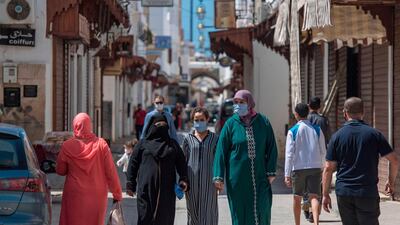
Pedestrians, wearing protective masks due to the pandemic, walk past closed shops in the Moroccan capital Rabat. AFP -
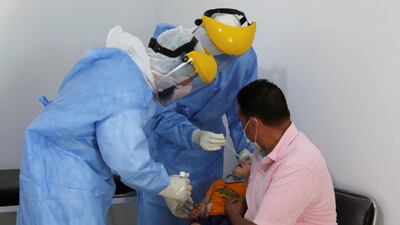
A member of a medical team wearing a protective suit takes a swab from a child at a medical clinic in Tripoli, Libya. Reuters -
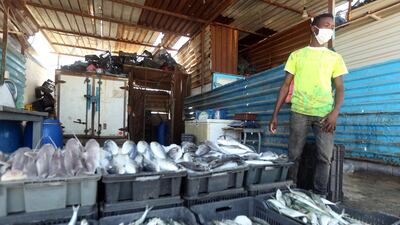
A man wearing a mask against the coronavirus Covid-19 stands at a fish stall in the Libyan capital Tripoli. AFP -
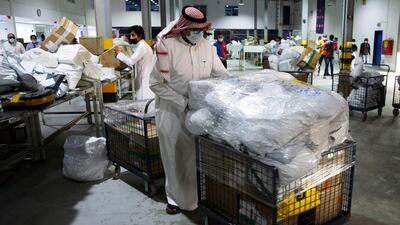
A Saudi employee sorts out boxes at the warehouse of Naqel Company Express in Riyadh, Saudi Arabia. Reuters


In tandem with the pandemic, an outbreak of cholera, with 115,000 suspected cases since January, has left the country struggling to cope.
There is not enough personal protective equipment and facilities are ill-prepared.
“There is not enough equipment in hospitals and a lot of crowding,” said the General Director of Hodeidah Health Office, Dr Ali Al Ahda.
“This week, a doctor in Hodeidah called me and said there are no masks or gloves, and they have to buy them themselves because there is no official money for them.”
The north of the country, which is controlled by the Iran-backed Houthi militia and includes Sanaa, is facing one of the toughest battles with the virus. The main cemetery in the capital has reportedly had to close temporarily as it was inundated with bodies.
If the dead are tested at all, the results are not made public.
Discussion of the pandemic is suppressed and rumours have made people with symptoms scared to visit hospitals.
“In Houthi areas, patients are not allowed to talk about the virus. People who say, for example, on Facebook ‘I am sick and have a fever and suspect I have coronavirus’ – they are told to delete the post,” Dr Al Ahda said.
A widely spread rumour believed by many – but denied by the Houthis – is that the rebels have given hospitals orders to kill suspected Covid-19 patients with a lethal injection, meaning many do not want to seek treatment.
Dr Alsamie said that people in Taez even refuse to believe that the pandemic has reached the country.
“They say it is a seasonal virus – they don’t want to hear that there is coronavirus,” he said.
“They don’t have the ability to stay home, they don’t have food and they don’t have security. They earn their money daily and many live off $1.
“For people here, life is more complicated than death.”

