


A year after Sudan’s uprising began against the country’s dictator of 29 years, Ghadeer Hamdi says the revolution continues to live inside her.
Only if it lives on, she says, will its motto of "freedom, peace and justice" finally become a reality.
“For the revolution to die, we must all die first,” said Ms Hamdi, 28, a self-employed graphic designer. “I will spread the revolution and I will feed it to my children.”
She told The National of her first street protest.
It was on April 6, four months into the uprising, when she joined tens of thousands of protesters who endured tear gas, rubber bullets and live rounds to reach the headquarters of the armed forces and start a sit-in protest.
-

Sudanese protesters run for cover from tear gas canisters fired by police outside the military headquarters in the capital Khartoum on April 6, 2019. AFP -
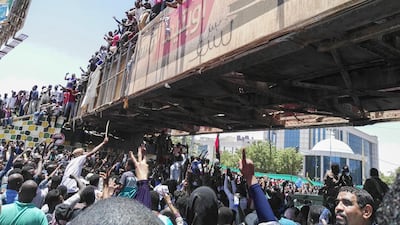
Sudanese protesters rally in front of the military headquarters in the capital Khartoum on April 8, 2019. AFP -
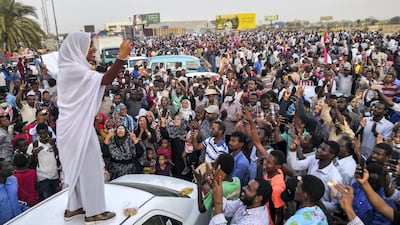
Alaa Salah, a Sudanese woman propelled to internet fame earlier this week after clips went viral of her leading powerful protest chants against President Omar Al Bashir, addresses protesters during a demonstration in front of the military headquarters in the capital Khartoum on April 10, 2019. AFP -
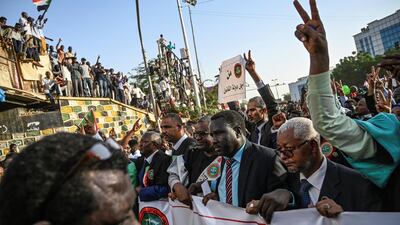
Sudanese judges, dressed in their robes, gather for a "million-strong" march outside the army headquarters in the capital Khartoum on April 25, 2019. AFP -

A Sudanese anti-regime protester kisses a soldier on the head during protests on April 11, 2019 in the area around the army headquarters in Sudan's capital Khartoum. AFP -
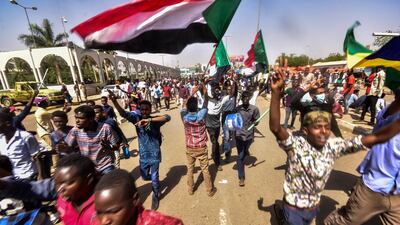
Sudanese demonstrators march with national flags as they gather during a rally demanding a civilian body to lead the transition to democracy. AFP -
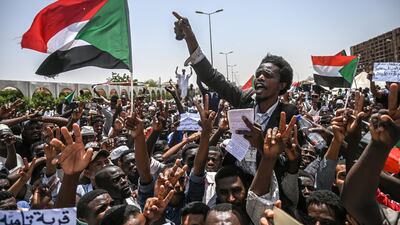
Protesters massed outside the army complex in central Khartoum on April 6, initially to demand the overthrow of longtime leader Omar Al Bashir. AFP -
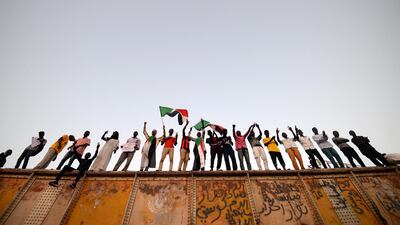
Sudanese protesters gather outside the army headquarters in Khartoum on May 6, 2019. AFP -
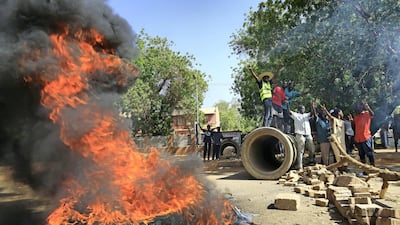
Sudanese protesters burn tyres as they block Nile Street for the second consecutive day during continuing protests in Sudan's capital Khartoum on May 13, 2019. AFP -
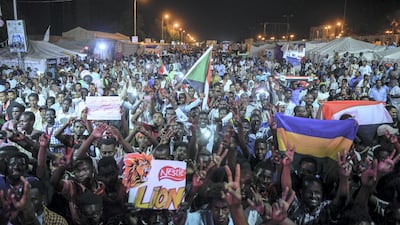
Sudanese protesters wave flags and flash victory signs as they gather for a sit-in outside the military headquarters in Khartoum on May 19, 2019. AFP -
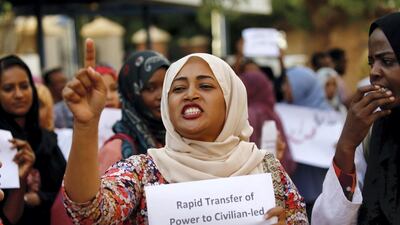
A Sudanese health worker carries a placard as scores of medics hold a rally in front of a hospital in the capital Khartoum on May 23, 2019. AFP -
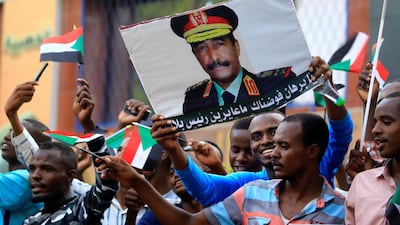
Sudanese supporters of the ruling Transitional Military Council (TMC) hold up a sign showing a portrait of its head General Abdel Fattah Al Burhan with a caption below reading in Arabic "we have delegated you Burhan, we want no president but you", during a rally in the centre of the capital Khartoum on May 31, 2019. AFP -
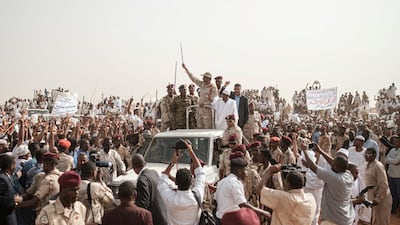
Mohamed Hamdan Dagalo, known as Himediti, deputy head of Sudan's ruling Transitional Military Council and commander of the Rapid Support Forces paramilitaries, waves a baton to supporters on a vehicle as he arrives for a rally in the village of Abraq, about 60 kilometres northwest of Khartoum, on June 22, 2019. AFP -
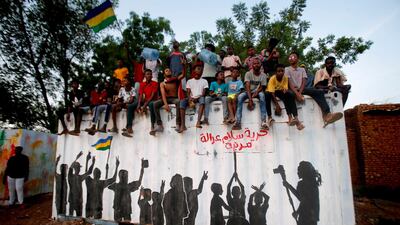
Sudanese protestors celebrate in the streets of Khartoum after ruling generals and protest leaders announced they have reached an agreement on the disputed issue of a new governing body on July 5, 2019. AFP -
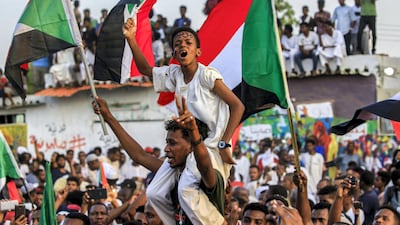
Thousands went to the streets to welcome the agreement on Saturday. AFP -
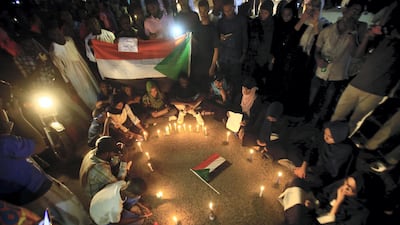
Sudanese protesters take part in a vigil in the capital Khartoum to mourn dozens of demonstrators killed last month in a raid on a Khartoum sit-in. AFP -
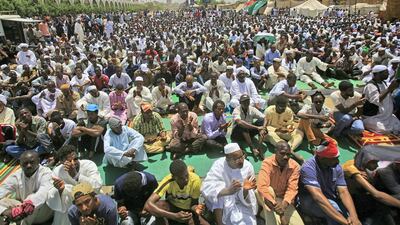
Sudanese protesters gather during Friday noon prayers outside the army headquarters in Khartoum on May 3, 2019, as they continue to protest demanding that the ruling military council hand power to a civilian administration. AFP -
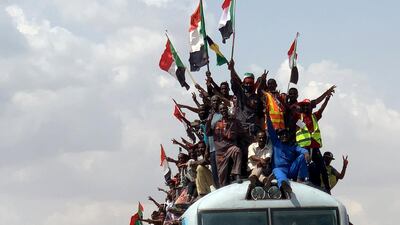
Sudanese civilians from other provinces ride on the train to join in the celebrations of the signing of Sudan's power-sharing deal. Reuters -
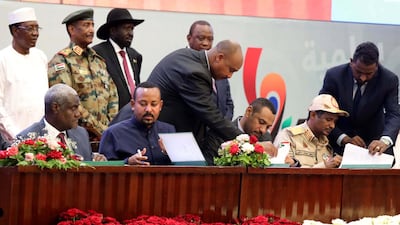
Sudan's Forces of Freedom and Change coalition leader Ahmad Rabiah (3-R) and Sudan's General and Vice President of Sudanese Transitional Military Council, Mohamed Hamdan Dagalo (2-R) sign power-sharing agreement,. EPA -
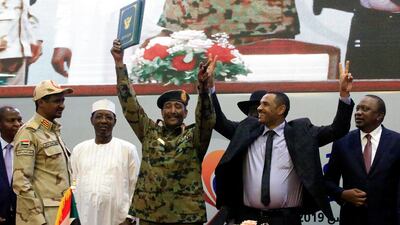
Sudan's Head of Transitional Military Council, Lieutenant General Abdel Fattah Al-Burhan, and Sudan's opposition alliance coalition's leader Ahmad Rabiah, celebrate the signing of the power-sharing deal, that paves the way for a transitional government, and eventual elections. Reuters -
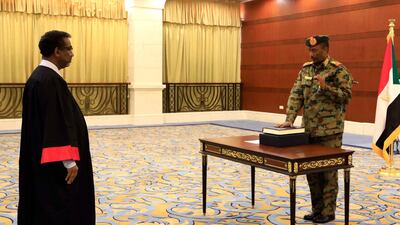
epa07783624 Leader of Sudan's transitional council, Lieutenant General Abdel Fattah Abdelrahman Burhan (R) is sworn in as the Head of the newly formed transitional Council at the presidential palace in Khartoum, Sudan, 21 August 2019. The Sudanese opposition and military council signed on 17 August a power sharing agreement. The agreement sets up a sovereign council made of five generals and six civilians, to rule the country until general elections. Protests had erupted in Sudan at the end of 2018, culminating in a long sit-in outside the army headquarters which ended with more than one hundred people being killed and others injured. Sudanese President Omar Hassan al-Bashir stepped down on 11 April 2019. EPA/STRINGER -
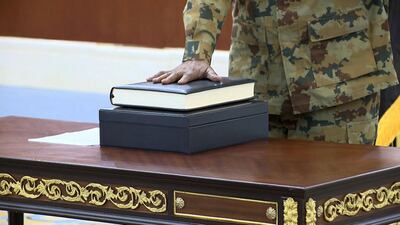
A pictured released by Sudan's Presidential Palace shows General Abdel Fattah al-Burhan, the head of Sudan's ruling military council, during a swearing in ceremony in Khartoum on August 21, 2019. Burhan was sworn today as chairman of Sudan's new sovereign council that will steer the country through a three-year transition to civilian rule. "General Abdel Fattah al-Burhan Abdel Rahman was sworn in as president of the sovereign council," the official SUNA news agency reported. / AFP / SUDAN PRESIDENTIAL PALACE / - / RESTRICTED TO EDITORIAL USE - MANDATORY CREDIT "AFP PHOTO / SUDAN PRESIDENTAIL PALACE" - NO MARKETING NO ADVERTISING CAMPAIGNS - DISTRIBUTED AS A SERVICE TO CLIENTS -
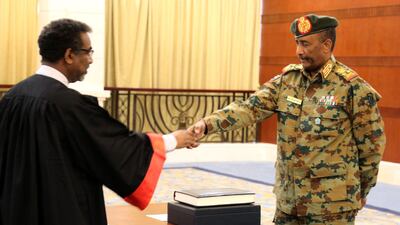
A picture released by Sudan's Presidential Palace shows General Abdel Fattah al-Burhan, the head of Sudan's ruling military council, during a swearing in ceremony in Khartoum on August 21, 2019. Burhan was sworn today as chairman of Sudan's new sovereign council that will steer the country through a three-year transition to civilian rule. "General Abdel Fattah al-Burhan Abdel Rahman was sworn in as president of the sovereign council," the official SUNA news agency reported. / AFP / SUDAN PRESIDENTIAL PALACE / - / RESTRICTED TO EDITORIAL USE - MANDATORY CREDIT "AFP PHOTO / SUDAN PRESIDENTAIL PALACE" - NO MARKETING NO ADVERTISING CAMPAIGNS - DISTRIBUTED AS A SERVICE TO CLIENTS -
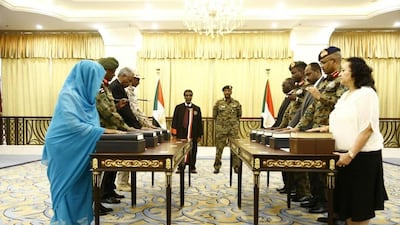
A picture released by Sudan's Presidential Palace shows General Abdel Fattah al-Burhan (C-R), the head of Sudan's ruling military council, standing during a swearing in of the new sovereign council, in Khartoum on August 21, 2019. Sudan took further steps in its transition towards civilian rule today with the swearing in of a new sovereign council, to be followed by the appointment of a prime minister. The body replaces the Transitional Military Council (TMC) that took charge after months of deadly street protests brought down longtime ruler Omar al-Bashir in April. Burhan, who already headed the TMC, was sworn in as the chairman of the new sovereign council in the morning. / AFP / SUDAN PRESIDENTIAL PALACE / - / RESTRICTED TO EDITORIAL USE - MANDATORY CREDIT "AFP PHOTO / SUDAN PRESIDENTAIL PALACE" - NO MARKETING NO ADVERTISING CAMPAIGNS - DISTRIBUTED AS A SERVICE TO CLIENTS -
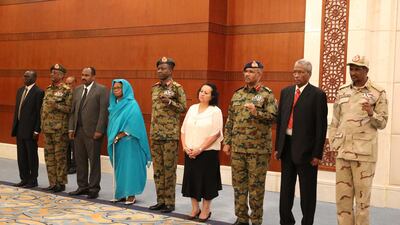
epa07784051 Members of Sudan's newly formed transitional Council (R-L) General Mohamed Hamdan Dagalo, Hassan Sheikh Idris, Genereal Ibrahim Jaber, Raja Nicola Issa Abdul-Masseh, General Shams al-Din Kabashi, Aisha Moussa, Mohamed Alfaki, General Yasser al-Atta and Sadeek Tawer look on during their sweaing-in ceremony at the presidential palace in Khartoum, Sudan, 21 August 2019. The Sudanese opposition and military council signed on 17 August a power sharing agreement. The agreement sets up a sovereign council made of five generals and six civilians, to rule the country until general elections. Protests had erupted in Sudan at the end of 2018, culminating in a long sit-in outside the army headquarters which ended with more than one hundred people being killed and others injured. Sudanese President Omar Hassan al-Bashir stepped down on 11 April 2019. EPA/MORWAN ALI -

Demonstrators march with banners and the old (L) and current (R) flags of Sudan outside a courthouse complex in the capital's twin city of Omdurman on August 21, 2019 during the trial of 40 members of Sudan's now-dissolved National Intelligence and Security Service facing charges over the death in custody of Ahmed al-Kheir, a teacher from the eastern town of Khashma el-Girba, in the early days of the wave of nationwide protests that eventually brought longtime ruler Omar al-Bashir. / AFP / Ahmed Mustafa -
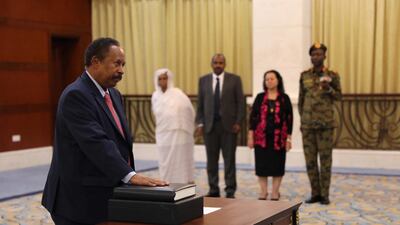
epa07784904 Sudan's new Prime Minister Abdalla Hamdok (L) swears in during a ceremony at the presidential palace in Khartoum, Sudan, 21 August 2019. The Sudanese opposition and military council signed on 17 August a power sharing agreement. The agreement sets up a sovereign council made of five generals and six civilians, to rule the country until general elections. Protests had erupted in Sudan in December 2018, culminating in a long sit-in outside the army headquarters which ended with more than one hundred people being killed and others injured. Sudanese President Omar Hassan al-Bashir stepped down on 11 April 2019. EPA/MARWAN ALI -
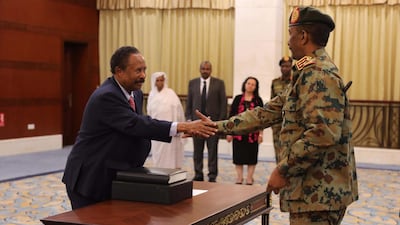
epa07784903 Sudan's new Prime Minister Abdalla Hamdok (L) shakes hands with Abdel Fattah Abdelrahman Burhan (R) after being sworn in during a ceremony at the presidential palace in Khartoum, Sudan, 21 August 2019. The Sudanese opposition and military council signed on 17 August a power sharing agreement. The agreement sets up a sovereign council made of five generals and six civilians, to rule the country until general elections. Protests had erupted in Sudan in December 2018, culminating in a long sit-in outside the army headquarters which ended with more than one hundred people being killed and others injured. Sudanese President Omar Hassan al-Bashir stepped down on 11 April 2019. EPA/MARWAN ALI -
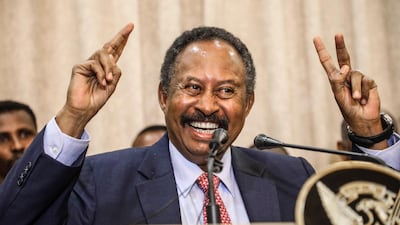
Sudan's new Prime Minister Abdalla Hamdok speaks duringa press conference in Khartoum, Sudan, Wednesday, Aug. 21, 2019. (AP Photo)


They wanted the generals to remove Omar Al Bashir, Sudan’s president. The leaders of the military obliged five days later.
The sit-in remained as the focus shifted to pressing the military to hand over power to a civilian administration.
For nearly two months after the sit-in began, Ms Hamdi designed posters and banners that were hung up at the sprawling site.
They ranged from revolutionary slogans to hygiene tips and words of caution against the sexual harassment of women protesters.
The encampment remained for 58 days. Then elements of the security forces violently broke it up on June 3.
“I left my phone behind at home and stuck in my pocket a piece of paper with my father’s name and phone number, in case I was killed,” Ms Hamdi said. “I was thinking, ‘I will either die or we all move forward’.”

An official government investigation into the events of June 3, led by prominent lawyer Nabil Adib, is expected to report its findings early next year.
In some ways, Ms Hamdi’s memories of her personal contribution to the uprising and her enduring commitment to its principles romanticise a historic event that will probably be remembered as much for its violence as for the sweeping change it brought.
But her assertion that the revolution lives on to this day is not empty talk.
The neighbourhood committees who played a vital role in organising protests throughout four months of unrest are still organising today.
They identify and fight corruption, and make sure Al Bashir loyalists do not regain the power and influence they wielded for years.
The committees also organise medical care and markets where goods are sold at a discount to help poor families.
Activists who used social media networks to gather protesters now help ministries of the transitional government to set up websites to inform the public about the functions of government departments and their services.
The committees and the Sudanese Professional Association, the body that largely orchestrated the protests, are operating as watchdog agencies to monitor and assess the work of the new government. But they are also partners.
“The ministers cannot do everything alone," Ms Hamdi said. "We all have to work together.
"When people say the government has done nothing since it came to office three months ago, I ask them about what they have done in the past three months."
Meanwhile, the transitional government of Prime Minister Abdalla Hamdok has been moving, albeit slowly according to some protesters, to dismantle Al Bashir’s legacy.
It is purging members of the former ruler’s now-dissolved party from the government, security agencies and the civil service.
This week, the government disbanded and confiscated the assets of Al Bashir-era trade and professional associations, paving the way for the groups who led the protest movement to become registered unions.
Also this week, several media outlets created and run by the security services were disbanded.
“The neighbourhood committees have taken ownership in today’s Sudan,” said Ameen Maki, a prominent activist and member of the Sudanese Professional Association.
“The committees now enjoy the tacit recognition of the government.”

But while the revolution lives on for those who began it, a mixed picture emerges after examining how much the government has fulfilled the high hopes of Sudan’s 40 million people.
Virtually overnight, Sudan turned from the brutal dictatorship it was under Al Bashir to a new democracy of freedom, celebration of diversity and, perhaps most importantly, a place for everyone to speak their minds freely and without fear.
Curiously, there is little fear of a backlash by Al Bashir’s supporters or remnants of his ruling National Congress party.
Although they continue to wield significant economic influence, their ability to exercise it appears to have been greatly weakened.
The “Green March” protests on December 14 – the day Al Bashir was convicted of corruption and sentenced to two years in prison – only attracted several hundred loyalists of the old regime.
But the military appears to pose no major threat to the new Sudan, where the millions who protested against Al Bashir’s rule remain filled with revolutionary fervour.
“I see the complacency or maybe arrogance of some of the revolutionaries as the most serious threat,” Ms Hamdi said, referring to the leaders of the protest movement, the Forces of Freedom and Change.
“They may be thinking that we’re already there. But in reality, we still need to work all the time.”
Analysts, diplomats and activists in Sudan say another challenge lies in whether the transitional government can quickly steer the economy to meet some of the expectations of the people.
There is also the question of whether it can resolve the long and costly conflicts in the west and south of the country.
The two goals are intertwined.
If a peaceful settlement is found for the conflicts, it could substantially reduce the 25 per cent of the budget assigned to defence and free up vital public funds for health care and education.
If they are not settled, then the country will continue to pour its limited financial and logistical resources into wars that could end the same way as the decades-long civil war in the south.
South Sudan seceded in 2011 with devastating consequences. Sudan lost a third of its territory and most of its oil wealth, plunging into its worst economic crisis in living memory.
"The general impression so far is that the government is weak, slow, too lenient and without a defined programme of action," said Othman Mirghani, a prominent analyst and editor of Khartoum daily Al Tayar.
“People want to see goals and not just a lot of passing in midfield."
There is some truth in that, but the legacy left by Al Bashir’s regime is heavy and complex.
The government spends about $2 billion (Dh7.34bn) a year on subsidising fuel and bread.
If the economy is to recover, those subsidies must be gradually reduced and replaced with money for the most vulnerable.
And the country’s infrastructure has for years been falling apart, something that harms the key agricultural sector.
Corruption, to which Al Bashir turned a blind eye, is institutional and has wasted substantial resources.
The Sudanese pound is not doing well. The official exchange rate is 45 to the dollar, but the greenback is traded at almost twice that much on the black market.
Sudan has been on the US list of state sponsors of terrorism since 1993 for its links to militant groups, which prevents it from receiving desperately needed aid from international donors.
Mr Hamdok, a career economist, was in Washington this month lobbying for Sudan to be taken off that list, but he acknowledged on his return that it was a long process.
Sudan’s economic predicament is so deep that the state 2020 budget has yet to be announced with less than two weeks left before the year’s end.
The delay, says a top western diplomat in Khartoum, is caused by lack of resources to cover expenditure. At this point, he said, it was more like an “aspirational” budget.
The long peace talks between the transitional government and rebel groups in western and southern Sudan have made little or no progress on main issues such as self-determination, the role of religion and a fair distribution of national resources and power.
The agreement signed by the military and the protest movement stipulates that comprehensive peace accords should be reached within six months from the time the pact was signed in August.
Some of the rebel groups insist that naming new provincial governors and a 300-seat legislative assembly should wait until an agreement is reached, a view that is opposed by the Forces of Freedom and Change.
“Hamdok continues to enjoy unprecedented popularity but seems unable to take advantage of that,” Mirghani said.
“He’s conducting business like he has come to office through a Cabinet reshuffle, not a revolution."

