

Twisted metal, shattered cars, flattened warehouses: the site of the devastating explosion at Beirut’s port still looks apocalyptic one month later.
The Lebanese army has been clearing the area for weeks, working through the remnants of clothes, perfumes and various other imported goods that were stacked there, with help from a variety of international partners.
But amid the flurry of activity to make the port safe, many are wondering who will restore its infrastructure and the devastated districts around it. A World Bank report estimated the damage to Lebanon’s transport sector and port alone at between $580 million and $710 million.
Several countries have already signalled their interest in reconstruction. Kuwait was the first to come forward, announcing on August 23 that it would rebuild the huge, damaged grain silos.
France, which has sent hundreds of soldiers to help clear the rubble, is particularly invested in Lebanon. President Emmanuel Macron returned at the end of August for his second visit to Beirut in three weeks as he tries to force Lebanese political parties to agree to painful reforms to fix the country’s economy, which was already suffering from its worst-ever crisis before the August 4 blast.
-
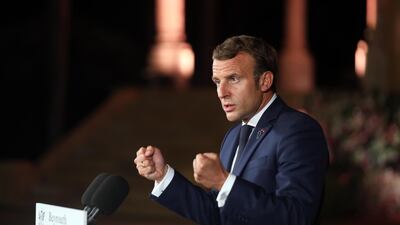
French President Emmanuel Macron speaks at a news conference in Beirut on September 1, 2020, during his second visit to Lebanon after the August 4 port explosion in the capital. Bloomberg -

Emmanuel Macron plants a cedar tree alongside members of the NGO Jouzour Loubnan during a ceremony marking Lebanon's centenary in Jaj Cedar Reserve Forest, north-east of Beirut, on September 1, 2020. AFP -
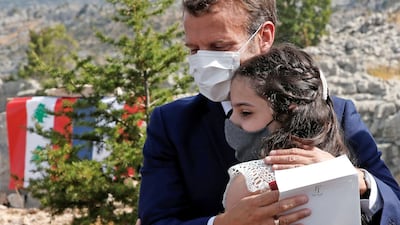
French President Emmanuel Macron hugs a blast victim while attending a ceremony to mark Lebanon's centenary in Jaj Cedars Reserve Forest on September 1, 2020. AFP -
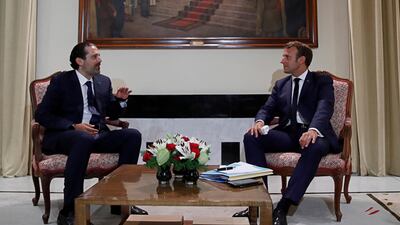
French President Emmanuel Macron meets former Lebanese prime minister Saad Hariri at the Pine Residence, the official residence of the French ambassador to Lebanon, in Beirut on August 31, 2020. Reuters -
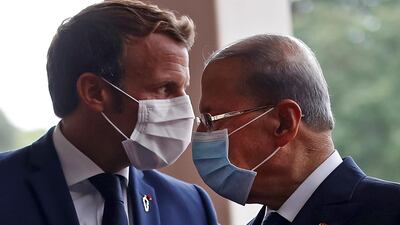
France's president with his Lebanese counterpart Michel Aoun at the Presidential palace in Baabda, east of Beirut, on September 1, 2020. AFP -
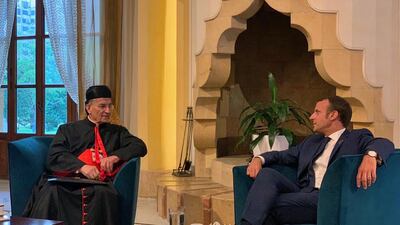
French President Emmanuel Macron meets Lebanese Maronite Patriarch Bechara Rai at the Pine Residence in Beirut. Bkerki Press Office / AFP -
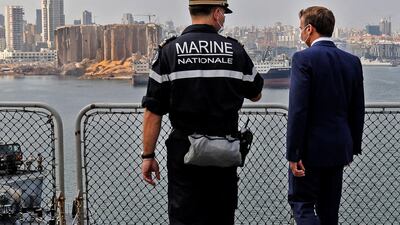
President Emmanuel Macron speak with speaks with Arnaud Tranchant, commander of the French helicopter carrier Tonnerre, off the port of Beirut on September 1, 2020. AFP -
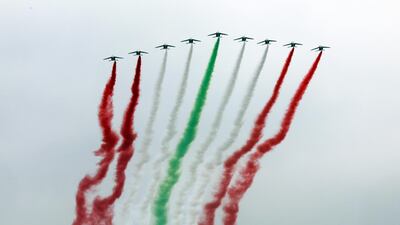
French jets perform a flypast over Beirut during Lebanon's centenary celebrations on September 1, 2020. Bloomberg -
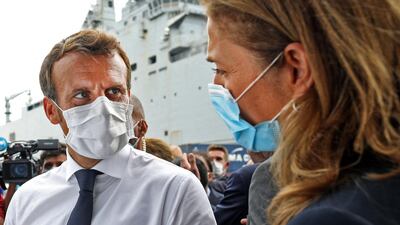
French President Emmanuel Macron meets UN representatives and NGOs at Beirut port. AFP -

Emmanuel Macron gestures toward a board as he meets the military mobilised to help to rebuild the Beirut port. via AP -
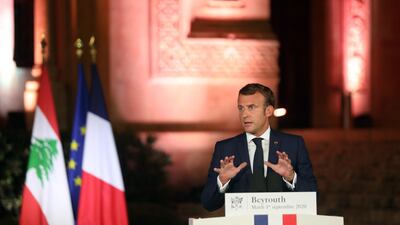
Emmanuel Macron speaks to the media outside the French ambassador's residence in Beirut. Bloomberg -

The French president poses for selfies after a news conference at the Pine Residence in Beirut on September 1, 2020. AFP -

French President Emmanuel Macron speaks to a patient during a visit to Rafik Hariri University Hospital in Beirut with French Health Minister Olivier Veran, right, on September 1, 2020. AFP


The head of France’s largest employer federation, Medef, said that French companies were ready to work alongside the Lebanese, but did not give names. A few days later, the president of one of the country’s largest construction companies, Bouygues, cautiously said it was “too early to know what’s happening, exactly”.
Experts say one important factor that could deter foreign investors is the corrupt inner workings of Beirut’s port. Several countries have clearly stated that they will not provide financing directly to the Lebanese government, which is deemed too dishonest.
“The question is: what kind of port does Lebanon want? A more modern, transparent port would bring in more tax revenue. But it would undermine the presence of political parties,” said a source involved in the post-blast reconstruction.
Like other specialists interviewed for this article, the source told The National that the damaged port was a microcosm of wider Lebanese corruption: political parties all jostle for influence in its opaque management system set up in the wake of the 1975-1990 civil war.
Little has changed since. The members of its “temporary” board of directors have been in place for 18 years. They work under the supervision of the Ministry of Public Works, although it does not have access to the port’s books. Unlike other public institutions that are subject to government scrutiny, the port cannot be fully audited by the Finance Ministry.
-

Greek rescue workers search amid the rubble three days after explosions that hit Beirut port. EPA -
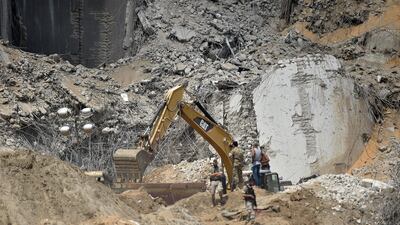
Workers and members of Lebanese civil defense search for bodies and survivors amid the rubble. EPA -
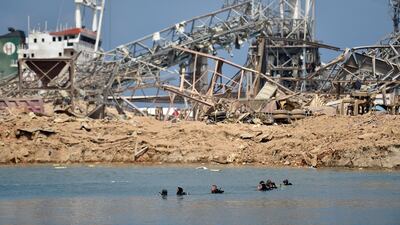
Divers inspect at the port waterfront. EPA -
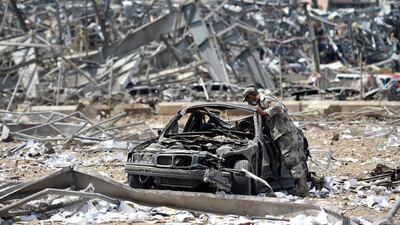
A Lebanese soldier looks at a damaged car. EPA -
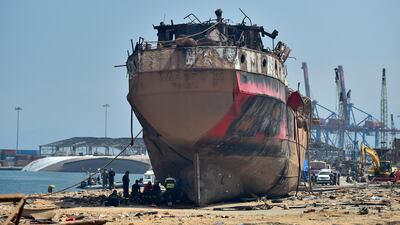
Workers and members of Lebanese civil defence rest next to a damaged vessel. EPA -
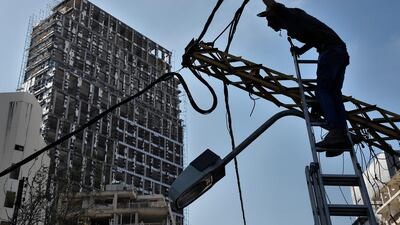
An electricity worker fixes power cables in front of a damaged building. AP Photo -
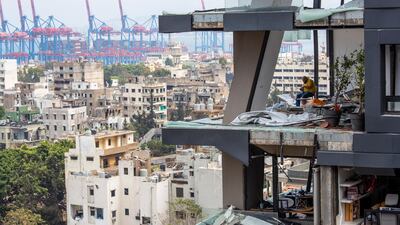
A man sits between debris inside his house damaged by Tuesday's explosion in the seaport of Beirut, Lebanon. AP Photo -

A man who sustained injuries to his legs looks at the rubble. AP Photo -
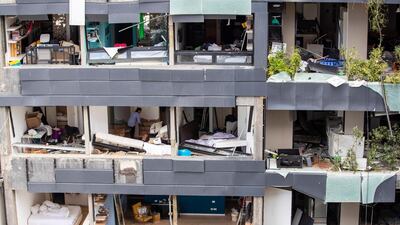
Workers remove debris from a house. AP Photo -
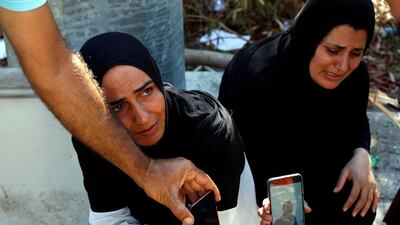
Zeinab Zer Eldin, left, and her sister-in-law shows a photo of her missing husband near the site of the explosion in the port of Beirut. AP Photo -
Residents fix windows in a house damaged by Tuesday's explosion that hit the port of Beirut. AP Photo


At the time of its creation, the prime minister Rafik Hariri wanted a “flexible” structure, “neither public, nor private”, to accelerate post-war reconstruction, said a source at the port. Since then, political bickering has hindered change.
Joseph Khoury, who works in Beirut’s free zone at the Lebanese franchise of ECU Worldwide, an international cargo company, said the status quo suits political parties.
“The problem is that if the port were under the direct control of a specific ministry, then the political party in charge of that ministry would control the port. But up to now, the port has been under the influence of all political parties, not just one. So nobody wants a single ministry to take over,” he said.
“The port is like Ali Baba’s cave. No political party wants a proper audit because they currently have the leeway to do what they want,” said Mr Khoury, who recently completed a master’s thesis at Beirut University Saint-Joseph on the port’s strategic regional position over the past three decades.
Fady Abboud, former tourism minister
Fady Abboud, a former tourism minister who says he has "waged a war against the port since 1993", described political interference in the port's management to The National.
“I scratch your back, you scratch mine. I keep quiet when it comes to the port, and you keep quiet about whatever I want,” he said.
"This is the way Lebanese politics works. Exactly like the Mafia."
Some parties are more involved than others. A source close to the investigation into the explosion said that the Shiite Muslim party Amal has the most influence in Beirut's port, where 70 per cent of all 3,000 employees are Shiite. Amal is an ally of Hezbollah, Lebanon's most powerful Shiite group.
The latest figures published by the port show its revenues in the first five months of 2020 to be $50m, a drop of 45 per cent from the same period last year. “I believe the port is much more profitable than that, but the lack of audit means there is no way of knowing by how much,” Mr Khoury said.
Neither France nor any other country or foreign business will invest significantly in the port without reforms in its management, he said. “I am nearly sure that they would want the temporary committee to be dismantled. It only exists to stop the port’s figures from being publicly known.”
French involvement in the port could increase if it also took over the management of Beirut’s container terminals. Though several sources praised the efficiency of British-Lebanese venture Beirut Container Terminal Consortium, which won the contract in 2005, questions remain regarding its profitability and structure.
As BCTC’s 15-year contract came to an end early this year, a public tender was supposed to be issued for a new contract. At the time, the first company to show interest was French shipping group CMA CGM, in partnership with Geneva-based MSC, followed by Gulftainer (UAE), Hutchison Ports (Hong Kong), and China Merchants Port, a source at the port said.
But the tender was pushed back and will probably not take place until the end of the year to give he port time to “get back on its feet”, said its director, Bassem Al Qaisi.
Another port source said the tender was delayed because Lebanon’s Central Inspection Bureau rejected it, and that amendments are currently being made. BCTC does not meet the specifications to participate in the tender, they said.
Official records show that BCTC was registered in 2004 with a capital of $3m, and that it is represented in Lebanon by people with close ties to politics.
According to the Justice Ministry's website, the majority shareholder in BCTC is Mersey Docks, a British company which was acquired in 2005 by Peel, described by The Financial Times at the time as "one of the UK's biggest private property companies".
Several corporate press releases show that its international arm, Portia Management Services, replaced Mersey in managing BCTC. Portia's chief executive, John Owens, owns a small personal share in BCTC.
BCTC's main partner is the Lebanese company International Port Management Beirut Holding, registered in 2008 with a capital of $1.5m. Its chief executive, Ammar Kanaan, did not respond to a request for comment via Twitter. An American company, Logistics and Port Management Americas, owns the smallest share of BCTC.
Lebanese records show that BCTC’s lawyer is former culture minister Raymond Araiji, a member of a Christian Lebanese political party called Marada, which has headed the Ministry of Public Works since 2016.
A glowing 2017 profile in local newspaper L'Orient-Le Jour describes Mr Araiji as a childhood friend of Marada President Suleiman Frangieh.
Mr Araiji referred The National to his colleague Gabriel Maalouli, who said the company's figures were not public.
Lebanese records show that Mr Maalouli is the lawyer of International Port Management Beirut Holding.
BCTC’s manager, Sara Haidar, did not respond to questions sent by email.
"It is difficult to tell the structure of most consortia operating ports or terminals because they usually are constructed in such a way as to make them very untransparent to anyone scrutinising," said Laleh Khalili, professor of international politics at Queen Mary University of London and author of Sinews of War and Trade: Shipping and Capitalism in the Arabian Peninsula.
Even before the Beirut catastrophe, several companies were interested in managing the container terminal for various reasons. Hutchison Ports wants smaller transhipment hubs across the Mediterranean, while CMA CGM maintains close ties to the country because it is run by a family with Lebanese and Syrian origins, Prof Khalili said.
Chinese companies are interested in Beirut port because of the complications of shipping through Haifa to Arab countries due to historic political tension, she said. The Shanghai International Port Group will be operating the port of Haifa for 25 years starting in 2021.
But Mr Khoury said the strongest candidate is CMA CGM “because of its links with both France and Lebanon. The Lebanese are now deciding whether they would rather be helped by the French or the Chinese.”
“If the Lebanese refuse reforms, then they might turn to the Chinese, who will rebuild the port cheap and fast, but with no vision,” said the source involved in the port’s reconstruction. “It would be a pity.”
But the source doubted that China would invest significantly in Lebanon.
“The Lebanese love to threaten the Europeans by saying that they can turn to the Chinese – who don’t ask for reforms – instead,” they said.
“They repeatedly said that the Chinese want to invest in the electricity sector or in Tripoli’s port [in the north of Lebanon]. But the Chinese haven’t lifted a finger up to now. Compared to other countries like Iraq and Syria, Lebanon is just too small for China.”

