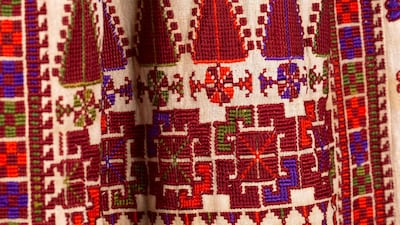
More than three decades ago, Jerusalemite Abed Al Samih Abu Omar, a collector and antiques dealer, arrived in the US with a collection of traditional embroidered Palestinian thobes and jewellery for a cultural exhibition.
Each one of the 80 garments told a different story of its homeland. The plan was to exhibit them at a gallery in Washington, DC, but the venue had closed when the four trunks containing the collection arrived in the US capital.
"He [Al Samih] was sitting at the hotel not knowing what to do. When we knew about it, we went to visit and look at [the collection]. We could not forget how beautiful and how unique the pieces were," Maha Rabie, who was one of a group of women who went to see the thobes in 1987, told The National.
Amid the confusion over what to do, the women decided to buy the collection, one of them even mortgaging her house to fund the purchase. They formed the non-profit Committee for the Preservation of Palestinian Heritage and began to host fund-raisers, find donors and dedicate their time to exhibiting the collection.
But the plan had always been to return the thobes home, and now, after more than 30 years, their journey back to Palestine has begun.
The curators learnt of the Palestinian Museum in Birzeit after watching an interview with its director on television two years ago and offered to return the collection.
The museum is “an independent institution dedicated to supporting an open and dynamic Palestinian culture nationally and internationally”.
But the journey has been far from straightforward – returning the thobes has a price tag of about $40,000. A crowdfunding campaign was launched to raise the money for the return.
The clothing items are decades old – most were made before the Nakba in 1948 – and many are in delicate condition. What drove the cost up is the insurance for the pieces, with experts saying the collection is worth more than $250,000, according to Samer Makhlouf, manager of resources mobilisation at the Palestinian Museum.
“For me, it’s a very emotional and a very interesting thing on a very personal level because this is part of my identity and this is my heritage,” he said.
Mr Makhlouf says the lasting image in his mind is of his grandmother, a farmer, wearing a thobe as she went about her day-to-day life.
“It’s part of my history, part of my identity, part of who I am and therefore it is important for us to protect, preserve and also present these thobes.”
He feels it is important to show them to his children, “because, you know, the whole concept of heritage is that you need to move it from one generation to another to protect it and keep it".
For Dr Adila Laidi-Hanieh, the personal connection to the thobes goes back to the early 1990s. The director general of the Palestinian Museum was at that time a master's student at Georgetown University's School of Foreign Service.
As part of the efforts to show the collection in the US, a few of the thobes were displayed at the university during the period.
Twice a week, on her way to class, Dr Laidi-Hanieh would pass through the corridor where the thobes were on display. But she understood their significance only many years later.
“The corridor, on the left-hand side, you had all these offices, and on the right-hand side you had a glass gallery with Palestinian dresses there. They were there for many years and I never understood what these dresses were doing there. Never,” she said.
“I completely forgot about the whole thing and lo and behold, after 30 years, I am responsible for bringing these dresses back to Palestine. Isn’t that crazy?”
The plan was always to return the dresses, but circumstances never allowed for it. In the US, Ms Rabie said the exhibition was quite popular, especially during the First Intifada in the late 80s and early 90s.
“It has been with us for a while and it is sad to see it go but we’re very excited that it’s going to go where it’s going to be appreciated and enhanced and preserved.”
With tensions over Palestinian statehood showing no signs of diminishing, she believes it is more important than ever to preserve cultural symbols.
“With the proper presentation, people can get an education about how those colours were mixed, how those materials were made, what stories the dresses tell.” According to the curators, it is possible to tell where a dress was made based solely on its colours.
For Mr Makhlouf, the driving force behind the campaign to return the thobes, the mission takes on an even greater meaning given the tumultuous events of 2020.
“I have to tell you, because despite all the negativity that is happening due to Covid, due to the political situation, this was the thing that pushed me to get out of bed, out of my house in the morning and go out and work enthusiastically in order to achieve something.”

MATCH INFO
Rugby World Cup (all times UAE)
Final: England v South Africa, Saturday, 1pm
COMPANY%20PROFILE
%3Cp%3E%3Cstrong%3EName%3A%3C%2Fstrong%3E%20PlanRadar%3Cbr%3E%3Cstrong%3EStarted%3A%20%3C%2Fstrong%3E2013%3Cbr%3E%3Cstrong%3ECo-founders%3A%20%3C%2Fstrong%3EIbrahim%20Imam%2C%20Sander%20van%20de%20Rijdt%2C%20Constantin%20K%C3%B6ck%2C%20Clemens%20Hammerl%2C%20Domagoj%20Dolinsek%3Cbr%3E%3Cstrong%3EBased%3A%20%3C%2Fstrong%3EVienna%2C%20Austria%3Cbr%3E%3Cstrong%3ESector%3A%20%3C%2Fstrong%3EConstruction%20and%20real%20estate%3Cbr%3E%3Cstrong%3ECurrent%20number%20of%20staff%3A%20%3C%2Fstrong%3E400%2B%3Cbr%3E%3Cstrong%3EInvestment%20stage%3A%20%3C%2Fstrong%3ESeries%20B%3Cbr%3E%3Cstrong%3EInvestors%3A%3C%2Fstrong%3E%20Headline%2C%20Berliner%20Volksbank%20Ventures%2C%20aws%20Gr%C3%BCnderfonds%2C%20Cavalry%20Ventures%2C%20Proptech1%2C%20Russmedia%2C%20GR%20Capital%3C%2Fp%3E%0A
Dengue%20fever%20symptoms
%3Cul%3E%0A%3Cli%3EHigh%20fever%3C%2Fli%3E%0A%3Cli%3EIntense%20pain%20behind%20your%20eyes%3C%2Fli%3E%0A%3Cli%3ESevere%20headache%3C%2Fli%3E%0A%3Cli%3EMuscle%20and%20joint%20pains%3C%2Fli%3E%0A%3Cli%3ENausea%3C%2Fli%3E%0A%3Cli%3EVomiting%3C%2Fli%3E%0A%3Cli%3ESwollen%20glands%3C%2Fli%3E%0A%3Cli%3ERash%3C%2Fli%3E%0A%3C%2Ful%3E%0A%3Cp%3EIf%20symptoms%20occur%2C%20they%20usually%20last%20for%20two-seven%20days%3C%2Fp%3E%0A
BRAZIL%20SQUAD
%3Cp%3EGoalkeepers%3A%20Alisson%2C%20Ederson%2C%20Weverton%3Cbr%3E%3Cbr%3EDefenders%3A%20Dani%20Alves%2C%20Marquinhos%2C%20Thiago%20Silva%2C%20Eder%20Militao%20%2C%20Danilo%2C%20Alex%20Sandro%2C%20Alex%20Telles%2C%20Bremer.%3Cbr%3E%3Cbr%3EMidfielders%3A%20Casemiro%2C%20Fred%2C%20Fabinho%2C%20Bruno%20Guimaraes%2C%20Lucas%20Paqueta%2C%20Everton%20Ribeiro.%3Cbr%3E%3Cbr%3EForwards%3A%20Neymar%2C%20Vinicius%20Junior%2C%20Richarlison%2C%20Raphinha%2C%20Antony%2C%20Gabriel%20Jesus%2C%20Gabriel%20Martinelli%2C%20Pedro%2C%20Rodrygo%3C%2Fp%3E%0A
How%20to%20avoid%20getting%20scammed
%3Cul%3E%0A%3Cli%3ENever%20click%20on%20links%20provided%20via%20app%20or%20SMS%2C%20even%20if%20they%20seem%20to%20come%20from%20authorised%20senders%20at%20first%20glance%3C%2Fli%3E%0A%3Cli%3EAlways%20double-check%20the%20authenticity%20of%20websites%3C%2Fli%3E%0A%3Cli%3EEnable%20Two-Factor%20Authentication%20(2FA)%20for%20all%20your%20working%20and%20personal%20services%3C%2Fli%3E%0A%3Cli%3EOnly%20use%20official%20links%20published%20by%20the%20respective%20entity%3C%2Fli%3E%0A%3Cli%3EDouble-check%20the%20web%20addresses%20to%20reduce%20exposure%20to%20fake%20sites%20created%20with%20domain%20names%20containing%20spelling%20errors%3C%2Fli%3E%0A%3C%2Ful%3E%0A
The%20specs
%3Cp%3E%3Cstrong%3EEngine%3A%3C%2Fstrong%3E%201.8-litre%204-cyl%20turbo%0D%3Cbr%3E%3Cstrong%3EPower%3A%20%3C%2Fstrong%3E190hp%20at%205%2C200rpm%0D%3Cbr%3E%3Cstrong%3ETorque%3A%3C%2Fstrong%3E%20320Nm%20from%201%2C800-5%2C000rpm%0D%3Cbr%3E%3Cstrong%3ETransmission%3A%20%3C%2Fstrong%3ESeven-speed%20dual-clutch%20auto%0D%3Cbr%3E%3Cstrong%3EFuel%20consumption%3A%3C%2Fstrong%3E%206.7L%2F100km%0D%3Cbr%3E%3Cstrong%3EPrice%3A%3C%2Fstrong%3E%20From%20Dh111%2C195%0D%3Cbr%3E%3Cstrong%3EOn%20sale%3A%20%3C%2Fstrong%3ENow%3C%2Fp%3E%0A
Mercer, the investment consulting arm of US services company Marsh & McLennan, expects its wealth division to at least double its assets under management (AUM) in the Middle East as wealth in the region continues to grow despite economic headwinds, a company official said.
Mercer Wealth, which globally has $160 billion in AUM, plans to boost its AUM in the region to $2-$3bn in the next 2-3 years from the present $1bn, said Yasir AbuShaban, a Dubai-based principal with Mercer Wealth.
“Within the next two to three years, we are looking at reaching $2 to $3 billion as a conservative estimate and we do see an opportunity to do so,” said Mr AbuShaban.
Mercer does not directly make investments, but allocates clients’ money they have discretion to, to professional asset managers. They also provide advice to clients.
“We have buying power. We can negotiate on their (client’s) behalf with asset managers to provide them lower fees than they otherwise would have to get on their own,” he added.
Mercer Wealth’s clients include sovereign wealth funds, family offices, and insurance companies among others.
From its office in Dubai, Mercer also looks after Africa, India and Turkey, where they also see opportunity for growth.
Wealth creation in Middle East and Africa (MEA) grew 8.5 per cent to $8.1 trillion last year from $7.5tn in 2015, higher than last year’s global average of 6 per cent and the second-highest growth in a region after Asia-Pacific which grew 9.9 per cent, according to consultancy Boston Consulting Group (BCG). In the region, where wealth grew just 1.9 per cent in 2015 compared with 2014, a pickup in oil prices has helped in wealth generation.
BCG is forecasting MEA wealth will rise to $12tn by 2021, growing at an annual average of 8 per cent.
Drivers of wealth generation in the region will be split evenly between new wealth creation and growth of performance of existing assets, according to BCG.
Another general trend in the region is clients’ looking for a comprehensive approach to investing, according to Mr AbuShaban.
“Institutional investors or some of the families are seeing a slowdown in the available capital they have to invest and in that sense they are looking at optimizing the way they manage their portfolios and making sure they are not investing haphazardly and different parts of their investment are working together,” said Mr AbuShaban.
Some clients also have a higher appetite for risk, given the low interest-rate environment that does not provide enough yield for some institutional investors. These clients are keen to invest in illiquid assets, such as private equity and infrastructure.
“What we have seen is a desire for higher returns in what has been a low-return environment specifically in various fixed income or bonds,” he said.
“In this environment, we have seen a de facto increase in the risk that clients are taking in things like illiquid investments, private equity investments, infrastructure and private debt, those kind of investments were higher illiquidity results in incrementally higher returns.”
The Abu Dhabi Investment Authority, one of the largest sovereign wealth funds, said in its 2016 report that has gradually increased its exposure in direct private equity and private credit transactions, mainly in Asian markets and especially in China and India. The authority’s private equity department focused on structured equities owing to “their defensive characteristics.”
