
Mohammed Nagy Wahdan dismissed the coronavirus pandemic as an international ruse in a video he posted online during the first week of April. A short time later, the 25-year-old posted another clip in which he pleaded for help.
“People, help me, please, I have a burning high temperature. I want to see a doctor,” the hotel worker from Egypt’s Nile Delta said from hospital after testing positive for Covid-19, the disease caused by the coronavirus.
Two video clips later posted, Wahdan was barely audible.
“I am dying, I am dying,” he told his Facebook followers shortly before he slipped into a coma.
He died on April 12. His father died three days later and one of his siblings, 30-year-old Bahaa, contracted the disease but has since made a full recovery.
Wahdan’s use of social media offered a rare and dramatic chronicle of the virus’ progression and turned a spotlight on the country’s extensive use of the medium to air everything related to the disease, from pleas for help, and tales of heroism by medical staff to agonising deaths, miraculous recoveries and grief.
“Facebook has become so depressing,” said Mohammed Yassin, a painter and one-time political activist whose brother contracted Covid-19 this week.
“It’s basically one post about someone who got it, followed by another about a relative who got it and then a third about someone who died. Every now and then, we get one about someone who made a full recovery and that cheers us up a little.”
Wahdan’s story also testifies to the place social media holds as an avenue for relatively free speech in Egypt, whose government has gained control of most media outlets. The government cites the need to unite and mobilise the nation in the face of what it sees as the threat posed by extremist influences and foreign plots to destabilise it. It has also blocked hundreds of independent, online news sites that don’t toe the official line.
-
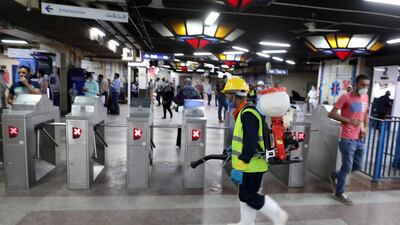
A worker sprays disinfectants at underground Al Shohadaa metro station in Cairo, Egypt. EPA -
Residents enjoy access to Kite Beach in Dubai's Jumeirah despite the Covid-19 safeguards that are in place. Antonie Robertson/The National -
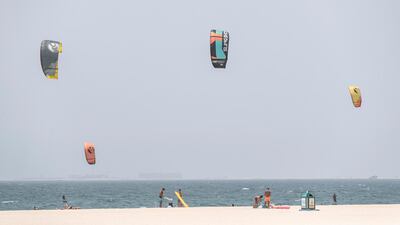
Residents enjoy opening of Kite Beach in Jumeirah, Dubai, with coronavirus precautions in place. Antonie Robertson / The National -

Operators at their desk at Dubai's Covid-19 Command and Control Centre at Mohammed bin Rashid University, in Dubai. AFP -
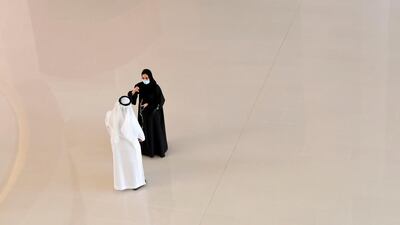
Emiratis wearing protective masks amid the Covid-19 pandemic chat in a hall at Mohammed bin Rashid University in Dubai. AFP -
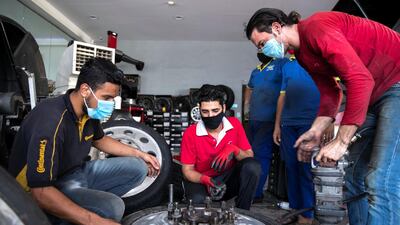
Epmloyees at Future Tyres Trading in Al Qouz, Dubai. Reem Mohammed / The National -
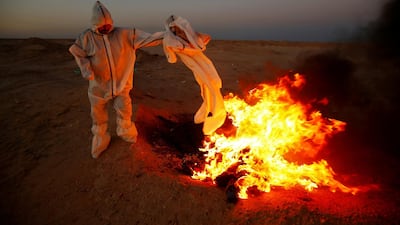
A member of the Popular Mobilisation Forces who volunteered to work in a cemetery wears a protective suit as he burns clothes they used for burial, near the new Wadi Al-Salam cemetery, which is dedicated to those who died of the coronavirus disease, on the outskirts of the city of Najaf, Iraq. Reuters -

A vendor, wearing a protective face mask against the spread of coronavirus, adjusts Turkish traditional-style lanterns, at the iconic 15th century Grand Bazaar in Istanbul as it reopens following weeks of closure due to the coronavirus pandemic. AP Photo -

Mannequins are seen placed between tables to make customers sit according to social-distancing rules in a bar that reopened after being closed for weeks, amid the spread of the coronavirus, in Istanbul, Turkey. Reuters -

A Palestinian graduate uses his laptop as he sits in a coffee shop amid the coronavirus crisis, in Gaza City. Reuters -
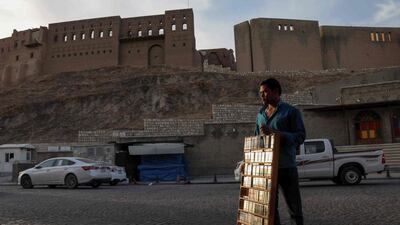
A man sells cigarettes on a street in Arbil, the capital of the northern Iraqi Kurdish autonomous region, amid a lockdown to combat the spread of the coronavirus. AFP -
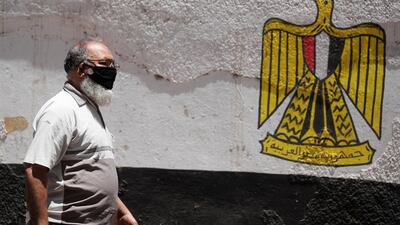
A man wearing a protective face mask to prevent the spread of the coronavirus walks next to a wall painted with the colorus of Egypt's flag, after the government made wearing masks mandatory in public places and public transport, in Cairo. Reuters -
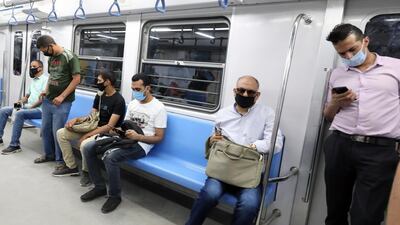
Egyptians wearing protective face masks at the underground Al Shohadaa metro station in Cairo. EPA -
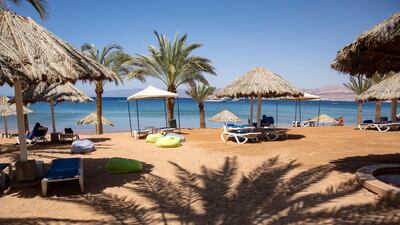
A view of an almost empty newly reopened hotel private beach in Aqaba, some 300km south of Amman, Jordan. Jordan government announced on 27 May that it will consider reopening tourist sites in the coming weeks after deciding on the required safety procedures. EPA -
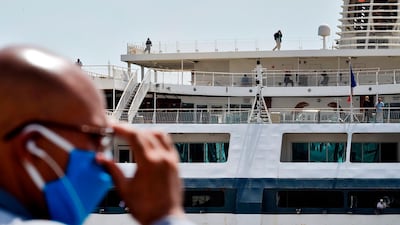
A man watches as passengers board a ship in the port of Algiers, the capital of Algeria, heading to the French port city of Marseille, in the first ferry between the two countries since the outbreak. AFP -
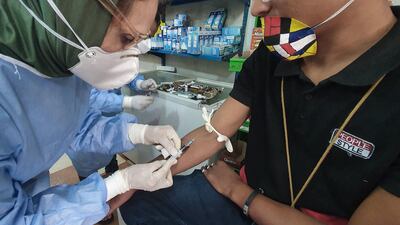
A Libyan doctor takes blood sample from a shopkeeper to test for the coronavirus in the Tajura area, a coastal suburb east of the capital Tripoli. AFP -
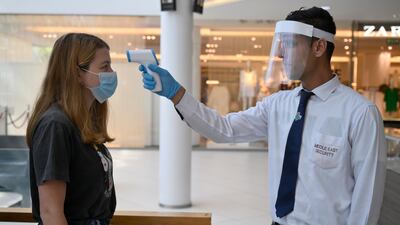
A security guard wearing a face mask checks the body temperature of a customer in a shopping mall in Dbayeh, northern Beirut, Lebanon. EPA -
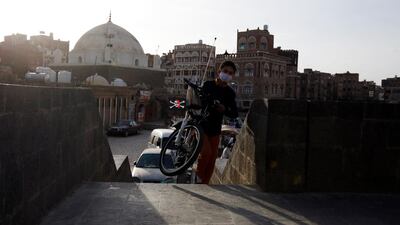
A Yemeni child wearing a protective face mask carries a bicycle on to a pedestrian bridge amid the ongoing coronavirus pandemic in Sanaa. EPA


Khaled Al Baramawy, a social media expert, said it was unsurprising that Egyptians took to social-media networks during the pandemic given the lockdown and panic that swept the country during the initial stages of the outbreak.
"There was a great deal of misinformation on the coronavirus at the beginning, but that kind of content became less and less as time went by and users started to look for reliable information on treatment," he told The National.
Of Egypt’s 100 million people, about 60 million have access to the Internet. Up to 85 per cent of those with access have social-media accounts. Facebook, by far the most popular platform in Egypt, has seen the steepest rise in usage since March, with the number of users surging to 40 million from 30 million before the pandemic, said Mr Al Baramawy.
"Egyptians are looking to social-media networks to offer help, while others are using them to post their analysis of official data on infections and suggest medication for those treating themselves at home," Shady Lewis Botros, a political analyst in London and author who is followed by nearly 25,000 on Facebook, told The National.
“Social media has replaced the old fashioned small social support groups, but the difference is that the former traffics massive information at a stunning speed.”
On Sunday, Egypt reported its fifth record high of consecutive daily Covid-19 infections, a clear indication that the peak of the pandemic is yet to pass, meaning many more likely infections and deaths. A government minister has acknowledged the number of infections was likely to be higher than government figures and warned that the number could shoot up to 100,000 or even one million if Egyptians did not diligently observe social distancing and use masks in public.
As numbers rise, Egyptians are beginning to be touched by the disease on a personal level.
On Tuesday night, the health ministry put the number of infections at 27,536, of which about 9,000 were recorded over the past week alone. The death toll stands at 1,052.
Ayman Wahdan said his cousin Mohammed Wahdan had left a pregnant wife whose first baby, a girl, was expected to be born in a month’s time. His mother, he said, was devastated by the loss of a son and a husband within three days. “Her condition is difficult. May God grant her strength.”
Wahdan’s home village of Taha Shoubra in the province of Minoufiyah north of Cairo was sealed down by authorities last month after several Covid-19 cases were discovered there. Ayman, a 40-year-old engineering designer, said nine people have so far succumbed to the disease in the village. Two of the nine died on Friday and Sunday, he said.
“It is not just the village where the situation is not reassuring, it’s the whole of Egypt.”
As the virus rampages through communities, some are using their social-media platforms to spread health messages, expressions of support or, in some cases, condolences on the loss of loved ones.
“The coronavirus has struck every home. Everyone now knows someone in his narrow circle who has it. We are all tense, afraid and worried,” wrote veteran human rights campaigner Ghada Shahbender on Facebook on Monday. “Calm down, wear masks anywhere you think you might meet someone you know and wash your hands frequently.”
Others use the power to reach thousands in a single click to bring help for their families.
Mr Mohammed, the painter, wrote on Facebook on Monday that his brother contracted Covid-19 and asked his friends to send him any material that would help, from doctors’ phone numbers to relevant medications.
“My timeline is packed with news of infections and deaths and my own brother has it,” he wrote. “I am living the worst phase of my life, please look after your families and friends … Stay home so you can stay alive.”
Mr Mohammed’s online plea for help worked. He was approached by many of his followers who provided him with doctors’ names and telephone numbers as well as suggestions for what to do. His initial post was shared nearly 60 times and read by hundreds. He complied all the information and tips he received and posted them as a guide for others.
"People's response was very, very good," he told The National on Tuesday. "I would have done the same if there was no social media, but I would not have received this kind of response."
Still more social-media users are seeking to reassure their followers and online friends.
“It will be alright, it will pass and be reduced to stories from the past,” one Facebook user wrote, seeking to inject a hopeful note amid the fear of illness and possible death.
For some, however, only seeing the disease up close made them take it seriously.
“I confess that I have fallen in the trap of turning coronavirus victims into stats, but that stopped when the virus began to harvest the lives of people that I personally know,” is how one Facebook user summed up the growing menace of the pandemic in Egypt.

