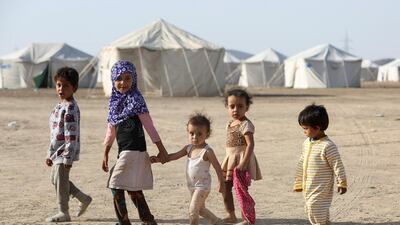
Yemeni children at a camp for families displaced by fighting between Houthi rebels and government forces in Jawf and Marib provinces in northern Yemen. Reuters

Civilians killed in Houthi attack on village community in Yemen


  • English
  • Arabic

Seven civilians were killed and 10 injured on Sunday after Houthi rebels bombarded a village in Al Durayhimi district in Yemen’s Hodeidah province.

Several of the wounded suffered serious injuries.

"At 11.30am on Sunday, the Houthi rebels deliberately targeted the populated village of Al Qazah in south-western Al Durayhimi using far-range artillery, killing seven civilians – five women and two children," a medical source told The National.

“Some of the injured were transferred to the field hospital in Al Khokhah city, and those who suffered fatal injuries were taken to a hospital affiliated with Medecins Sans Frontieres in Al Makha city, southern Hodeidah."

Pro-government joint forces fighting the Houthi rebels on Yemen’s west coast condemned the massacre and blamed the UN commission, which is monitoring the ceasefire in Hodeidah, for its silence regarding Houthi atrocities against residents in Hodeidah.

"The horrible massacre, which was committed by the Houthi rebels this morning against the residents of Al Qazah village in Al Durayhimi, is not the first and it won't be the last," Faris Al Hussam, deputy manager of Al Amalika media centre in Hodeidah, told The National.

"The UN commission monitoring the ceasefire in Hodeidah failed to clearly condemn the Houthi violations and the horrible crimes they have been committing against the civilians in areas of southern and western Hodeidah.

“In one week, from November 22 to November 29, about 35 civilians were either killed or injured by Houthi projectiles in different areas in Hodeidah. The majority of the victims are women and children."

The Houthi attack came four days after a similar incident in southern Hodeidah last Tuesday, when six civilians, including two children, died after their car drove over a Houthi mine on a dirt road linking the districts of Al Tuhaiyta and Al Khokha.


Email sent to Uber team from chief executive Dara Khosrowshahi

From: Dara

To: Team@

Date: March 25, 2019 at 11:45pm PT

Subj: Accelerating in the Middle East

Five years ago, Uber launched in the Middle East. It was the start of an incredible journey, with millions of riders and drivers finding new ways to move and work in a dynamic region that’s become so important to Uber. Now Pakistan is one of our fastest-growing markets in the world, women are driving with Uber across Saudi Arabia, and we chose Cairo to launch our first Uber Bus product late last year.

Today we are taking the next step in this journey—well, it’s more like a leap, and a big one: in a few minutes, we’ll announce that we’ve agreed to acquire Careem. Importantly, we intend to operate Careem independently, under the leadership of co-founder and current CEO Mudassir Sheikha. I’ve gotten to know both co-founders, Mudassir and Magnus Olsson, and what they have built is truly extraordinary. They are first-class entrepreneurs who share our platform vision and, like us, have launched a wide range of products—from digital payments to food delivery—to serve consumers.

I expect many of you will ask how we arrived at this structure, meaning allowing Careem to maintain an independent brand and operate separately. After careful consideration, we decided that this framework has the advantage of letting us build new products and try new ideas across not one, but two, strong brands, with strong operators within each. Over time, by integrating parts of our networks, we can operate more efficiently, achieve even lower wait times, expand new products like high-capacity vehicles and payments, and quicken the already remarkable pace of innovation in the region.

This acquisition is subject to regulatory approval in various countries, which we don’t expect before Q1 2020. Until then, nothing changes. And since both companies will continue to largely operate separately after the acquisition, very little will change in either teams’ day-to-day operations post-close. Today’s news is a testament to the incredible business our team has worked so hard to build.

It’s a great day for the Middle East, for the region’s thriving tech sector, for Careem, and for Uber.

Uber on,

Dara