

For Iran, Joe Biden's presidency presents an opportunity to end what officials have denounced as the scorched-earth policy of the previous administration.
But whether Mr Biden's administration revives the nuclear deal or re-negotiates it, close US regional security partners need to be part of the discussion.
That was the view of US and regional analysts who spoke to The National.
Without those two ingredients, diplomatic rapprochement will likely be short-lived and will not produce sustained results, in a region where minor confrontation risks snowballing into wider conflict.
“The Arab states were sidelined in the talks that preceded the [2015] nuclear deal with Iran, despite the fact that they should have been part and parcel of it,” said Dr Ebtesam Al Ketbi, president of the independent think tank, the Emirates Policy Centre.

“It’s high time Iran became disillusioned with the idea that it was superior to US partners in the region when it comes to international affairs.”
Former US president Donald Trump abandoned the nuclear deal in 2018 and Iran has since gradually breached the agreement's main limits, building up a stockpile of low enriched uranium, and later enriching uranium to higher levels of purity – approaching the threshold for a bomb.
The US then re-imposed sanctions on Tehran that significantly affected its economy.
Mr Biden, who took office on January 20, has said the US will re-join the pact, which includes restrictions on Iran's nuclear work, if Tehran resumes strict compliance.
-
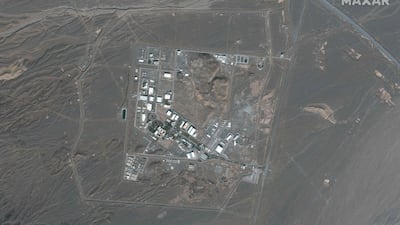
An overview of Iran's Natanz nuclear facility, south of the capital Tehran. Maxar Technologies / AFP -
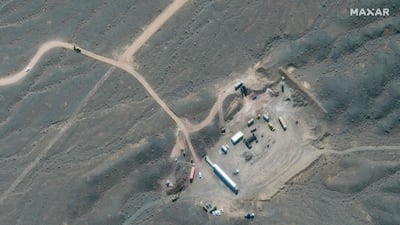
An overview of Iran's Natanz nuclear facility, south of the capital Tehran. Maxar Technologies / AFP -
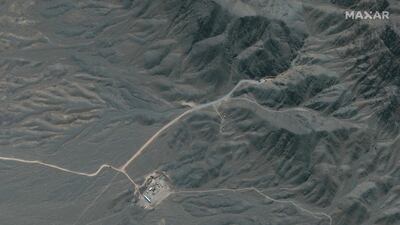
An overview of Iran's Natanz nuclear facility, south of the capital Tehran. Maxar Technologies / AFP -
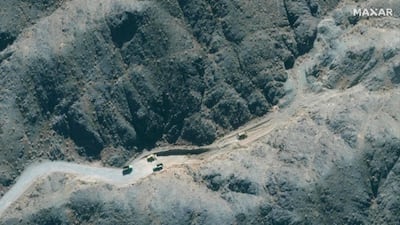
An overview of Iran's Natanz nuclear facility, south of the capital Tehran. Maxar Technologies / AFP


Iran, however, insists the US must drop sanctions before it returns to compliance – something complicated by American legal systems that Trump-era officials are confident will prevent the new administration from abandoning the network of measures.
In her first press briefing last week, White House spokeswoman Jen Psaki said that Mr Biden would also discuss a conditional US re-entry to the deal as part of his first round of phone calls with foreign leaders, including close American allies.
Mr Biden has also appointed Rob Malley, a key negotiator of the original nuclear deal in 2015, as an envoy for talks on Iran.
US allies under threat
Regional heavyweights, such as Saudi Arabia and Israel, are on the frontline of the threats that Iran has posed to the region for years.
Iran possesses a domestically produced military arsenal with long- and medium-range range missiles such as the Khorramshahr ballistic missile, which can fly as far as 2,000 kilometres with a warhead weighing 1,800kg. More advanced weapons, such as the Soumar cruise missile, require particular vigilance to defend against.
The ranges are far enough to reach Israel and US military bases in the region.
Iran has also displayed an interest in modernising its drone programme and purchasing the advanced Russian S-400 air defence system. The UN arms embargo from 2007 expired in October and the UN Security Council rejected Mr Trump’s attempt to expand the ban.
The Security Council restrictions expired in line with conditions agreed to under the 2015 nuclear deal. The objective was to keep Iran from developing nuclear capabilities in exchange for economic sanctions relief.
“Today, the missile file and the ideological regional expansion of Tehran are no less important to the world than the nuclear programme. Rather, they should be considered as the most important files from the perspective of the interests of the Gulf states,” said Dr Al Ketbi, who leads a team of senior researchers and analysts exploring current and future issues affecting the UAE and the region.

She suggests a proposal to establish a "missile demilitarised zone" on the shores of the Gulf.
“It is natural for regional and international calls to continue to place restrictions on the Iranian missile programme, including the number of missiles, the map of their deployment, their range and their destructive capacity, in a way that ensures that they do not threaten the fundamental interests of the countries of the region,” Dr Al Ketbi said.
-
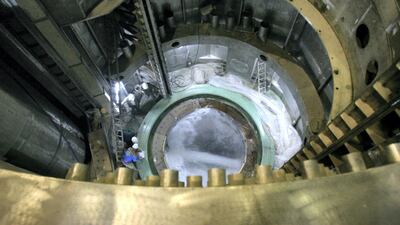
Russian contractors work at the Bushehr nuclear reactor site in 2007. The plant opened four years later. Bloomberg -
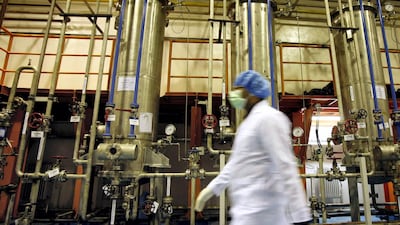
An Iranian technician at the International Atomic Energy Agency inspects the country's Isfahan plant in 2007. Tehran is no longer co-operating with the agency at nuclear sites across the country. EPA -

Workers wait to begin constructing a second reactor at the Bushehr nuclear power plant in 2019. AFP -
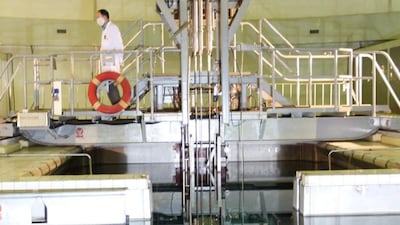
A metal-encased rod with 20 per cent enriched nuclear fuel is inserted into a reactor in Tehran in 2012. AFP -
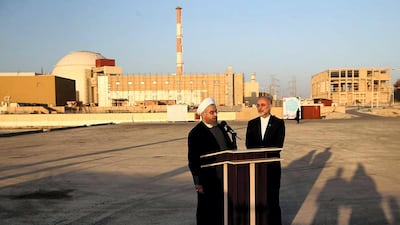
Fomer Iranian President Hassan Rouhani and the country's Atomic Energy Organisation chief Ali Akbar Salehi speak at the Bushehr nuclear site in 2015. AFP -
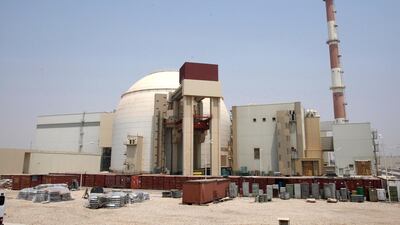
Iran's Bushehr nuclear plant has been restarted. EPA -
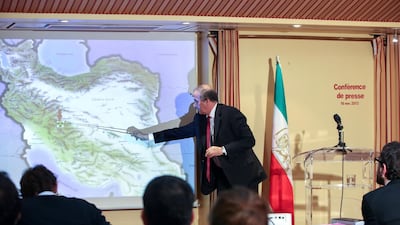
Mehdi Abrichamtchi, chairman of the Peace and Security Committee at the National Council of Resistance of Iran, shows journalists the location of a secret nuclear site in Iran in 2013. AFP -
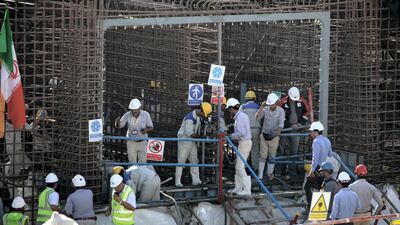
Workers prepare to begin the construction of a second reactor at the Bushehr site. AFP


Tehran has stayed on good terms with some neighbours, like Oman, and prefers to engage with its neighbours on a bilateral basis.
Oman, which is strategically located on the Strait of Hormuz – the narrow seaway through which about 20 per cent of the world's oil supply passes – maintains good relations with Tehran and fellow member states at the Gulf Co-operation Council in what has become known in foreign policy circles as ‘Iran’s bilateralism’ to de-escalate crises.
The sultanate’s diplomats are regularly involved in shuttle diplomacy with Iran, and mediated between Tehran and Washington for prisoner releases, including the freeing of three US hikers jailed in Iran on suspicion of being spies after they strayed across the border in 2009.
Brian Katulis, senior fellow at the Washington-based Centre for American Progress think tank, said the Biden team should learn from the mistakes of the last two US administrations.
“The Obama administration held a meeting in early 2015 with Gulf countries at Camp David and started a discussion about joint measures to deal with regional security issues, but that discussion did not result in a comprehensive strategy, but rather a piecemeal approach," he said.
"The Trump administration talked a lot about a regional security initiative, sometimes under the banner of an 'Arab Nato,' but this did not result in serious multilateral initiatives," Mr Katulis told The National.
Mr Katulis, who for more than a decade has advised senior US policymakers on foreign affairs and provided expert testimony to key congressional committees, added that Washington should consider encouraging co-ordination between regional allies alongside taking its own role.
“Republicans and Democrats alike in Congress – the mainstream in both parties – share a deep concern that Iran is no longer in compliance with the 2015 deal and that Iran continues to threaten close US security partners in the region,” Mr Katulis said.
“The Biden administration will likely seek to engage Congress more closely than the Obama administration did in 2014 and 2015 – it should do so in order to build confidence and support in Congress,” he added.
The nomination hearings of Mr Biden’s top national security nominees last week offered a preview of what could be to come – an ongoing discussion that will widen the range of issues that may be included in possible discussions with Iran.
His ultimate aim, according to his policy advisors, would be a deal that also limits Iran’s missile programme and support for regional proxies. But the team has made it clear that a swift return to the deal is unlikely.
Tehran, in return, has warned the Biden team that the new administration will not have an indefinite time period to rejoin the nuclear deal. The window of opportunity will not be open forever, it said.

