
Iran has turned on advanced uranium-enriching centrifuges installed underground at its Natanz site.
The act is the latest breach of Iran's nuclear deal with major powers, a report by the UN atomic watchdog obtained by Reuters on Wednesday showed.
Natanz is Iran's main uranium-enrichment site and the one that US President Donald Trump recently asked for options on attacking, according to a source who confirmed a report in The New York Times.
-
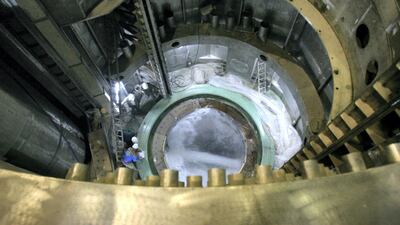
Russian contractors work at the Bushehr nuclear reactor site in 2007. The plant opened four years later. Bloomberg -
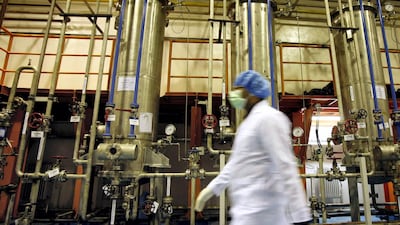
An Iranian technician at the International Atomic Energy Agency inspects the country's Isfahan plant in 2007. Tehran is no longer co-operating with the agency at nuclear sites across the country. EPA -

Workers wait to begin constructing a second reactor at the Bushehr nuclear power plant in 2019. AFP -
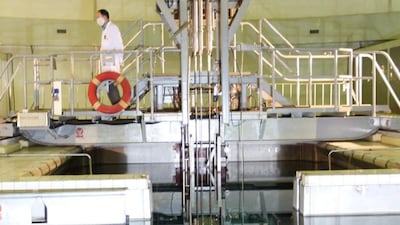
A metal-encased rod with 20 per cent enriched nuclear fuel is inserted into a reactor in Tehran in 2012. AFP -
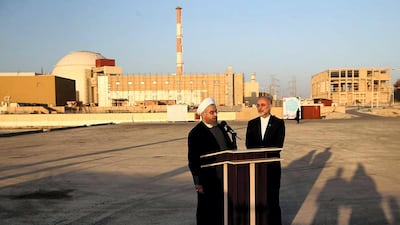
Fomer Iranian President Hassan Rouhani and the country's Atomic Energy Organisation chief Ali Akbar Salehi speak at the Bushehr nuclear site in 2015. AFP -
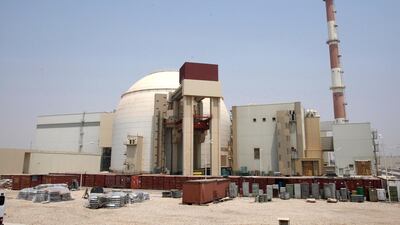
Iran's Bushehr nuclear plant has been restarted. EPA -
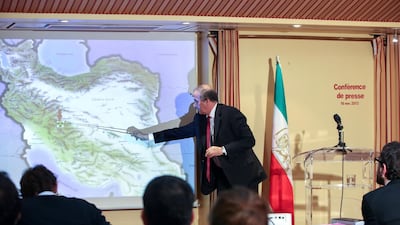
Mehdi Abrichamtchi, chairman of the Peace and Security Committee at the National Council of Resistance of Iran, shows journalists the location of a secret nuclear site in Iran in 2013. AFP -
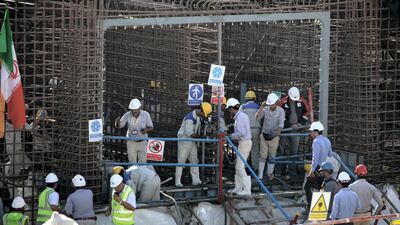
Workers prepare to begin the construction of a second reactor at the Bushehr site. AFP


The deal states that Iran can accumulate enriched uranium only with first-generation IR-1 machines and that those are the only centrifuges it can operate at its underground plant at Natanz, apparently built to withstand aerial bombardment.
An International Atomic Energy Agency report last week showed Tehran had installed a cascade, an interlinked cluster, of advanced IR-2m machines underground at Natanz, having moved them from an above-ground plant where it was already enriching uranium with advanced centrifuges in breach of the deal.
Last week's report said it had not fed uranium hexafluoride (UF6) gas, the feedstock for centrifuges, into that cascade.
"On 14 November 2020, the agency verified that Iran began feeding UF6 into the recently installed cascade of 174 IR-2m centrifuges at the fuel enrichment plant in Natanz," the IAEA report to member states on Tuesday said.
Iran has breached many restrictions on its atomic activities imposed by the 2015 deal, including on the purity to which it enriches uranium and its stock of enriched uranium. These breaches were in response to Mr Trump's withdrawal from the nuclear deal in 2018 and the reimposition of US sanctions against Tehran that had been lifted under the accord.
Last week's IAEA report said Iran had also begun installing a cascade of IR-4 centrifuges at the underground plant but not a planned third cascade of IR-6 machines. It is also operating 5,060 IR-1 machines at the underground plant
Unexplained particles
The revelations about accelerated uranium enrichment follow increased pressure on Iran from the US and the IAEA, to explain the origin of uranium particles found almost two years ago at an old but undeclared site that Israel described as a "secret atomic warehouse".
Israeli Prime Minister Benjamin Netanyahu drew attention to the Turqazabad site in Tehran in a speech to the UN in September 2018, urging the IAEA to visit it. Iran called it a carpet-cleaning facility.
IAEA inspectors went there in February 2019 and took environmental samples that showed traces of processed uranium. The Vienna-based UN watchdog has been seeking answers as to where those traces came from ever since; it says only part of Iran's explanations hold water.
"We believe they need to give us information which is credible. What they are telling us from a technical point of view doesn't add up, so they need to clarify this," IAEA director general Rafael Grossi said at a quarterly meeting of his agency's 35-nation board of governors.
The IAEA and US intelligence services have long believed Iran had a co-ordinated, clandestine nuclear weapons programme that it halted in 2003. Iran's 2015 nuclear deal with major powers effectively drew a line under much of its past.
But Mr Trump withdrew the US from the deal in 2018, unhappy with so-called sunset clauses that allowed Iran to increase uranium enrichment at a later date. Since then, the US has constrained Iran's economic activity, heavily limiting oil exports and imposing sanctions on thousands of individuals and organisations, some of which are allegedly linked to the nuclear programme.
Irrespective of the deal, the IAEA is in charge of accounting for all nuclear material in countries that have ratified the global Non-Proliferation Treaty to ensure none is being diverted to make nuclear weapons, even if evidence of previously unknown material is many years old.

