
Mohammed Hesham unloaded 14 packets of food from his white Nissan, put them in a wheelbarrow he found at the construction site and wheeled them inside a dilapidated wooden hut housing workers in Rumais, on the fringes of Muscat.
The labourers are a mix of Bangladeshis, Pakistanis and Indians. It is nearly the end of the month and the workers have already been told they will not be paid in time by the owner of the construction company.
"How can we buy food when there is no guarantee of payment? We now survive on the charity of the neighbourhood to feed us," Abdulkareem Omar, one of the labourers, told The National.
Mr Hesham, 27, a petroleum engineer, said he was taking turns with his neighbours to deliver food to three construction sites in his area.
“There are over 20 of us who have agreed to give them food every evening. If we don’t, they will starve and we cannot eat while watching them starve,” he said.
Some of Oman’s small to medium-sized construction companies have stopped paying their labourers, who are mostly from the Indian subcontinent, as work screeched to a halt because of the coronavirus outbreak.
Companies say the property owners they are building for have stopped paying them.
"Big construction companies can afford to pay workers in this coronavirus period. But smaller companies like ours cannot. We are too small," Hameed Al Hassani, owner of Hajar Aswad Construction Company, told The National.
Omani construction companies are divided into grades, with those that have capital amounting to 1 million Omani rials (Dh9.6m/US$2.6m) or more in grade one.
_____________
Coronavirus in the Middle East
-

A view of empty streets, in Kuwait City, Kuwait. EPA -
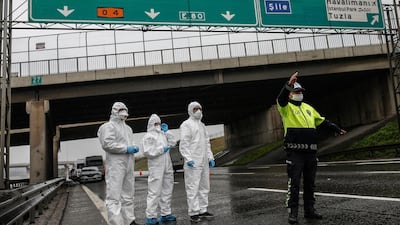
A police officer stops a bus so health officials could measure the body temperature of the passengers at a check point, on the Asian side of Istanbul. AP Photo -

Lebanese policemen salute government-run Rafik Hariri University Hospital workers, where most of the Lebanese coronavirus cases are treated, in support of Lebanese National Health Service workers who are treating coronavirus victims, as part of a nationwide salute to the doctors, nurses and staff in Beirut. AP Photo -
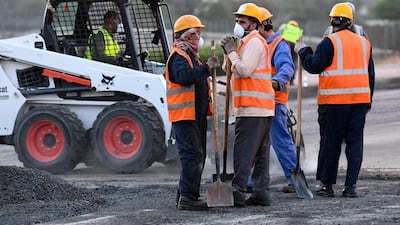
Laborers wearing protective face masks work on a street in Kuwait City. EPA -

A child wearing face mask walks in front of closed shops shortly before lockdown, in Cairo, Egypt. EPA -
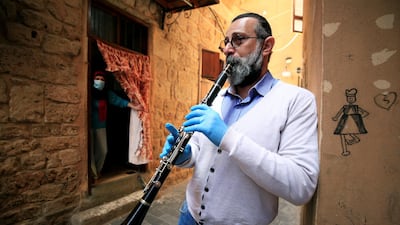
Tarek Bashasha, a 49 year-old artist, plays the clarinet to entertain people at their homes, during a countrywide lockdown in Sidon's old city, southern Lebanon. Reuters -
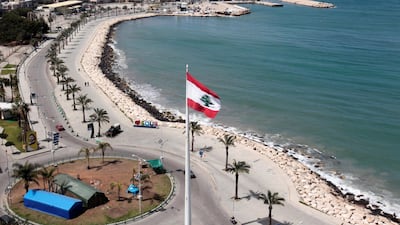
A national flag flutters at a nearly deserted corniche, during a countrywide lockdown in the southern city of Tyre, Lebanon. Reuters -
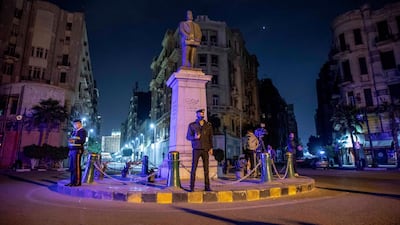
Egyptian security forces cordon off roads during curfew hours as prevention measures due to the coronavirus outbreak, in downtown Cairo, Egypt. AP Photo -

Neighbours have a conversation from their balconies during a health state of emergency and home confinement orders, in Rabat, Morocco. AP Photo -

Armed Afghan security personnel gurads officials fumigating disinfectant in public areas in Helmand, Afghanistan. EPA -
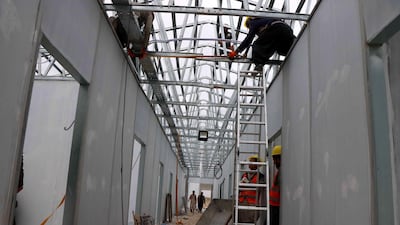
Afghan workers build a makeshift hospital comprising of 100 beds in Herat, Afghanistan. EPA -

The 'Cafe des Delices' empty after the nation-wide quarantine was declared as part of measures to halt the spread of the novel coronavirus pandemic in Sidi Bou Said town, near Tunis, Tunisia. EPA


_____________
But of the more than 8,000 construction companies registered in the country, more than 65 per cent are grade three or four.
On Sunday, the Majlis Al Shura Council, Oman’s elected legislative body, urged companies to ensure they paid workers.
“The council stressed there should be no compromise on the salaries of employees in the private sector," it said.
Mr Al Hassani said he was aware of the statement but was not sure what action to take if the funds were not there to pay the labourers.
Last week, the Omani Ministry of Health opened a special account for donations from people and private companies to help those hit hard by the coronavirus outbreak.
Oman’s Sultan Haitham bin Tariq donated 10 million Omani rials to the account.
“I applaud the Ministry of Health’s initiative to fund people and feed individuals who are experiencing hardship with this virus outbreak,” Ahmed Al Aisry, 31, a corporate banker who is part of a neighbourhood group giving food to construction labourers in Al Ansab area of Muscat, said.
"But it’s not enough, especially if you consider the foreign labourers no one usually seems to notice or care about."

