
As many one in six British workers were in jobs directly threatened by the coronavirus pandemic, before the Finance Minister promised economic measures last week to protect workers.
A new report by Britain’s Policy Exchange think tank found on Friday that as many as 5.3 million British workers were in vulnerable employment positions as a result of the crisis.
Last week, the Finance Minister, also known as the Chancellor, Rishi Sunak announced plans for 80 per cent wage subsidies for staff kept on by employers last week and Prime Minister Boris Johnson has said he wants similar protection for freelancers.
Under “the coronavirus job retention scheme” any British company will be able to apply for a grant from HMRC, the UK tax department, to cover the wages of people not working during the outbreak.
The think tank said more measures needed to be taken by the chancellor to combat the fast-moving crisis. It said that employee wages should be covered in full, not only to 80 per cent to avoid the risk of extensive layoffs where a company has to cease trading completely and has no revenues coming in.
The think tank also called for the capacity of UK’s universal credit administration system for benefits to be increased, as “it is already overwhelmed” with people who are trying to claim funds. It said a different way to reduce the need for administrative capacity would be to strip back conditions and checks associated with disbursing the payments.
Workers have described applying for universal credit as “impossible” after losing their jobs during the coronavirus pandemic. More than 500,000 people have applied for the vital payments in the last nine days, the Department for Work and Pensions said on Wednesday.
Policy Exchange suggested that in extreme circumstances, the government could apply the rule that sole condition for accessing the new Coronavirus Bridging Payment, is not being covered by the Job Retention Scheme.
“While expensive, this needs to be considered against the economic cost of not getting the funds out quickly enough,” the report said.
-

People wait in a queue to be screened at a fever clinic at Huanggang Zhongxin Hospital in Huanggang, in China's central Hubei province. AFP -

A security guard conducts a thermal check on a woman at a supermarket in Quezon City, Metro Manila, Philippines. EPA -
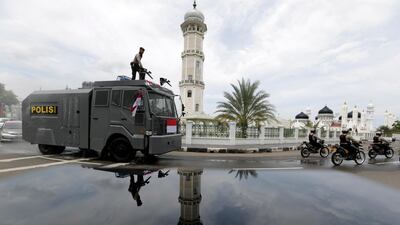
A police water cannon truck sprays disinfectant in the streets to curb the spread of coronavirus in Banda Aceh, Indonesia. EPA -

Two people sit alone in the empty arrivals area of the international terminal at Ngurah Rai International Airport near Denpasar on Indonesia's resort island of Bali. AFP -
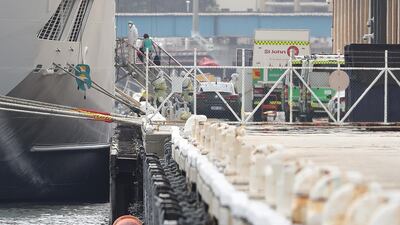
A passenger walks back onto the MV Artania after being attended by waiting paramedics on the wharf at the Fremantle Passenger Terminal in Fremantle, Australia. Getty Images -

Red Cross workers prepare emergency relief kits in Seoul, South Korea. Getty Images -

People stand on markings to maintain social distancing in Kathmandu, Nepal. Reuters -

A floor trader works in an off-site trading office built when the New York Stock Exchange closed. Reuters -

Gonzalo Acuna plays his accordion to lift his parents' spirits in Concepcion, Chile. Reuters -
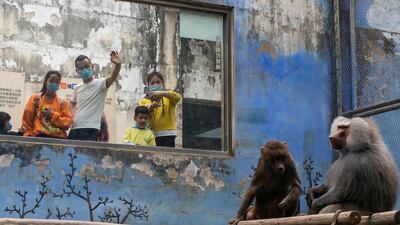
Visitors with face masks are seen at an enclosure for baboons at a zoo that reopened in Chengdu, Sichuan province, China. Reuters -

Resident Jillian Kislow makes face masks for her friends in her kitchen in Pasadena, California, USA. Reuters -
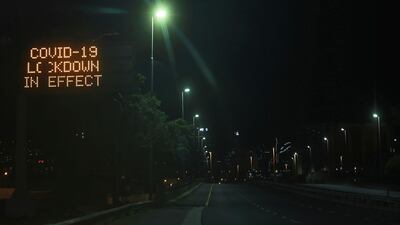
A deserted highway is seen in Cape Town after South Africa went into a nationwide lockdown for 21 days. AP Photo


Dr Gerard Lyons, a senior fellow at Policy Exchange and formerly Mr Johnson’s economic adviser when he was mayor of London, said: “The Chancellor called his latest policy scheme coherent, coordinated and comprehensive. It was also courageous and credible. The remaining challenge – especially for the self-employed – is the delay involved in getting access to funds, and whether the system can cope with those forced to claim welfare benefits in the meantime.
“Overall, the cost of the Chancellor's announcements is high but necessary. The UK faces an imminent recession, and Rishi Sunak is trying to ensure as much of the economy as possible survives it in hibernation."
There are 11,816 confirmed cases of Covid-19, the disease caused by the coronavirus, in Britain and 578 have died from it.

