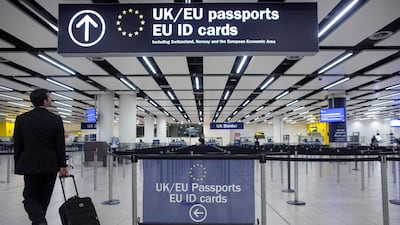
The UK’s Border Force officers check the passports of passengers arriving at Gatwick Airport, London, before freedom of movement with the EU ended. Getty

Two per cent of Britons have applied for EU passport since Brexit vote


Neil Murphy
  • English
  • Arabic

Two per cent of Britons have applied for an EU passport since the 2016 Brexit referendum, according to a new study.

Immigration experts Astons surveyed more than 2,000 UK citizens and asked them whether they had sought a passport for an EU state since the UK voted to leave the bloc. Only 2 per cent of those surveyed said they had.

But the study found that up to 8 per cent of respondents are now seeking alternative citizenship after Prime Minister Boris Johnson's trade deal with Brussels in December.

The number in Northern Ireland is far higher, with 13 per cent having applied for a second passport and 28 per cent planning to do so. People born in the province before 2005 can hold citizenship of Ireland, an EU member state.

Many respondents said they hoped to retain the benefits of EU membership, particularly for holidays.

Britons are entitled to 90 days’ visa-free travel over a 180-day period. Freedom of movement within the bloc ended on January 1.

Thirty-three per cent of those surveyed said they wanted a new passport to maintain ease when travelling for leisure, while 32 per cent wanted to continue to identify as British without losing the benefits of EU citizenship.

Fifteen per cent said they no longer wished to identify as a UK citizen, while 12 per cent who applied for another passport did so because they had the option to do so. Five per cent said a second passport would make business travel easier.

Union and EU flags outside the Houses of Parliament as lawmakers debated Britain's withdrawal from the EU. AFP.

Arthur Sarkisian, managing director of Astons, said Brexit prompted millions of British people to take on an EU nationality.

“The UK has certainly been divided by the EU referendum but it would seem as though while many have claimed or enquired about a second passport, those following through on acquiring one equate to a fairly small percentage of the population.

“Of course, with an estimated 67 million people living in the UK and about six million of those already having foreign nationality, these small percentages still represent quite a large number of those looking for a second passport.”


Islamophobia definition

A widely accepted definition was made by the All Party Parliamentary Group on British Muslims in 2019: “Islamophobia is rooted in racism and is a type of racism that targets expressions of Muslimness or perceived Muslimness.” It further defines it as “inciting hatred or violence against Muslims”.

The team

Videographer: Jear Velasquez 

Photography: Romeo Perez 

Fashion director: Sarah Maisey 

Make-up: Gulum Erzincan at Art Factory 

Models: Meti and Clinton at MMG 

Video assistant: Zanong Maget 

Social media: Fatima Al Mahmoud  

%20Ramez%20Gab%20Min%20El%20Akher
%3Cp%3E%3Cstrong%3ECreator%3A%3C%2Fstrong%3E%20Ramez%20Galal%3C%2Fp%3E%0A%3Cp%3E%3Cstrong%3EStarring%3A%3C%2Fstrong%3E%20Ramez%20Galal%3C%2Fp%3E%0A%3Cp%3E%3Cstrong%3EStreaming%20on%3A%20%3C%2Fstrong%3EMBC%20Shahid%3C%2Fp%3E%0A%3Cp%3E%3Cstrong%3ERating%3A%20%3C%2Fstrong%3E2.5%2F5%3C%2Fp%3E%0A
ETFs explained

Exhchange traded funds are bought and sold like shares, but operate as index-tracking funds, passively following their chosen indices, such as the S&P 500, FTSE 100 and the FTSE All World, plus a vast range of smaller exchanges and commodities, such as gold, silver, copper sugar, coffee and oil.

ETFs have zero upfront fees and annual charges as low as 0.07 per cent a year, which means you get to keep more of your returns, as actively managed funds can charge as much as 1.5 per cent a year.

There are thousands to choose from, with the five biggest providers BlackRock’s iShares range, Vanguard, State Street Global Advisors SPDR ETFs, Deutsche Bank AWM X-trackers and Invesco PowerShares.