

British Finance Minister Rishi Sunak said the City of London is set for a post-Brexit “Big Bang 2.0” with the priority to ensure it remains the world’s “most dynamic place to do financial services”.
The financial centre is already facing challenges post-Brexit, with about $6 billion in European share trading leaving the City for the continent on the first business day after the transition period.
However, Mr Sunak told City A.M. on Monday that the focus now needs to be on opportunities rather than threats.
He said: “There’s a whole range of things we can do slightly differently.”
The City has a perfect platform to build on “whether you want to call it Big Bang 2.0 or whatever”, he said.
Mr Sunak said many aspects of the existing deal "are good for financial services", referring to provision around the free flow of data, business travel and agreements centred on legal and professional services.
“There is strong language on future regulatory co-operation, and putting in place a Memorandum of Understanding in reasonably short order to have that structured regulatory dialogue,” Mr Sunak said. “And there’s a forum for future equivalence decisions as well. That’s a positive.”
The EU trade deal, which came into effect on January 1, did not cover financial services, although an extension was applied allowing companies in the sector to use platforms for swap trading until March.
Britain lost up to 7,000 financial services jobs because of its exit from the European Union, according to Bank of England governor Andrew Bailey.
He said last week that the job losses of between 5,000 and 7,000 were “substantially less” than the “sorts of numbers talked about” after the Brexit referendum in 2016.
-
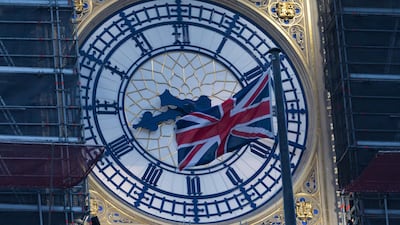
The Big Ben clock face with a Union Jack flag seen at dawn in Westminster, London. Britain left the European Union at 11pm on 31 December 2020. EPA -

A lorry driver's documents are scanned on a phone as he passes check-in for the train through the Eurotunnel in Folkstone. This is the first day after Britain's Brexit split with the European bloc's vast single market for people, goods and services. AP Photo -

A police car drives past an information sign at the entrance to the Port of Dover. Reuters -

French customs officials monitor haulage trucks disembarking from a cross channel ferry from the UK at the Port of Calais in France. Bloomberg -

The President of the harbour of Calais and Boulogne, Jean-Marc Puissesseau talks to media at the harbour of Calais, France. AFP -

Media do a live broadcast from outside the Houses of Parliament in central London. AFP -

A quiet No. 10 Downing Street this morning in Westminster, London. EPA -

A P&O ferry departs the Port of Dover. AFP -

A DFDS ferry carrying freight lorries arrives at the Port of Dover. AFP -

A lorry arrives at the Port of Dover following the end of the Brexit transition period. Reuters


Negotiations, set to start soon, will determine regulatory co-operation between the UK and EU, with equivalence, an arrangement governing cross-border financial services, top of the agenda.
Mr Bailey said last week that equivalence should be based on Britain having financial regulation that achieves similar outcomes to those in the EU, rather than following it to the letter.
The EU's broader approach to financial services’ trade with Britain appeared focused on boosting some less competitive financial businesses in the eurozone, rather than seeking the best value financial services for EU businesses, he said.
To replicate the existing relationship between the City and the EU would take at least 59 separate agreements, according to the law firm Clifford Chance.
While the City is still able to clear transactions for now, an extension allowing companies to use platforms for swap trading will expire in March.
Stephane Monier, chief investment officer at Swiss Bank Lombard Odier, said many areas of the UK-EU relationship need further talks.
“If the trade relationship follows the experience of Switzerland over the past five decades, the EU and UK will find themselves in almost constant negotiations,” Mr Monier said.
“Brexit may now trigger a decline of 22 per cent over the next 10 years … This has implications for the UK’s ability to finance its current account deficit, which stood at 2.9 per cent of the UK’s gross domestic product at the end of September 2020.”
Mr Monier said securing an accord on equivalence is key for the industry to allow each side to recognise the other’s regulatory standards.
Financial services accounted for 6.9 per cent of the country’s economy in 2018 and 3.1 per cent of jobs, he said, quoting UK government figures.
“Switzerland lost its ‘equivalent’ status when the European Commission let its recognition of Swiss stock markets expire in 2019,” he said.

However, Mr Sunak said the City’s long history will help it adapt to its post-Brexit future.
“If you look at the history of the City stretching even further back than that, it has always constantly innovated, adapted and evolved to changing circumstances and thrived and prospered as a result. And I think it will continue to do that,” he said.
Mr Sunak’s positive outlook for the City is set against a bleak economic backdrop, with England currently enduring its third national lockdown and economic forecasts becoming increasingly gloomy.
At least 250,000 small companies in the UK are set to close in 2021 unless the government provides more assistance, according to the Federation of Small Businesses, a further blow to an economy already heading for a double-dip recession.
The FSB’s quarterly survey found confidence at the second-lowest level in its 10-year history, and about 5 per cent of the 1,400 firms questioned expect to close. There are about 5.9 million small businesses in the UK, according to the government.
Lobby groups have also said the £4.6 billion ($6.2bn) in emergency funding unveiled at the start of the third lockdown does not go far enough.

