
The UK is on track for a “deep contraction” in output of 3.4 per cent in the first quarter of this year and an interest rate cut in February after England’s third lockdown forced the closure of non-essential businesses.
US investment bank Morgan Stanley said a surge in UK Covid-19 cases along with tightening of border controls following Britain’s exit from the European Union, forced its gross domestic product (GDP) revision from a previous forecast of a “robust” 1.6 per cent expansion.
Morgan Stanley also expects the Bank of England to slash interest rates to 0 per cent in February, from their current record low of 0.1 per cent, signalling an “openness for negative rates”.
“With the UK entering a more stringent lockdown and immediate implementation of the Brexit deal, we see a deep first-quarter contraction, partially offset by a more resilient fourth quarter and a stronger third quarter rebound,” Morgan Stanley said.
“Further fiscal support with the £4.7 billion ($6.41bn) in grants to support business and the likely higher take-up of furlough in the first quarter of 2021 pushes up the full-year 2020 deficit to 19.8 per cent of GDP.”
The UK economy was hammered by the effects of Covid-19 last year, with lockdowns almost grinding business activity to a complete halt for some sectors. However, the economy fared better than expected in the fourth quarter thanks to strong trade and manufacturing ahead of Brexit, along with a robust housing market and increased consumer activity.
The December IHS Markit/CIPS composite Purchasing Managers' Index (PMI) rose to 50.4 last month from 49.0 in November, with a reading above 50 indicating an expansion, and below reflecting contraction.
The services PMI, which makes up the largest part of the composite index, remained below the 50 mark at 49.4. This was up from November's five-month low of 47.6 but also below the flash reading.
While the final month of 2020 brought some optimism for British businesses with the distribution of coronavirus vaccines, the third lockdown in England is expected to the tip the country back into recession.
"Service providers will be braced for a sustained period of subdued UK economic conditions and deferred client spending in the first quarter of this year," IHS Markit economics director Tim Moore said.
Morgan Stanley lowered its 2021 GDP forecast to 2.1 per cent from 5.3 per cent on the back of the latest lockdown, although it expects a robust recovery from the middle of next year.
“We continue to expect the UK to lag developed markets peers in the recovery on a larger hit from Covid-19 and Brexit, with activity, much as in our previous forecast, still around 5 per cent below normal at end-2021, and only back to pre-Covid levels of output in the first half of 2023,” Morgan Stanley said.
“The extent of the 2021 first quarter contraction – and the subsequent rebound – will depend on the length of the lockdown, which will likely depend on the pace of vaccination as well. Thus far, the UK has vaccinated a little under one million people over three weeks.”
The British Chambers of Commerce (BCC) said businesses not directly affected by lockdown restrictions reported a drop in sales during November's lockdown as their clients suffered cash flow difficulties. This indicates that firms were already struggling, leaving many in a precarious position as they enter the new restrictions.
Four in 10 firms said their cash flow deteriorated in the fourth quarter, according to the November poll of 6,203 businesses, while almost eight in 10 hospitality firms reported a drop in sales in that period, the BCC said.
The findings add pressure to UK Finance Minister Rishi Sunak to extend support to companies beyond the £9,000 one-time grants he offered retail, hospitality and leisure businesses earlier this week.
“Cash is the major problem facing companies right now,” Adam Marshall, director general of the BCC, told Bloomberg Television.
-
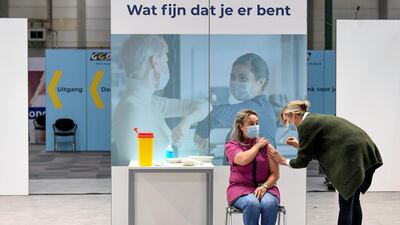
39 year old nursing home worker Sanna Elkadiri receives the first Pfizer-BioNTech vaccine in the Netherlands, in Veghel. Reuters -
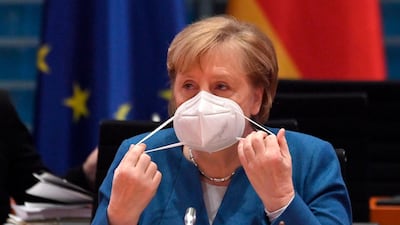
German Chancellor Angela Merkel takes off her face mask as she prepares to lead the weekly cabinet meeting at the Chancellery in Berlin. AFP -
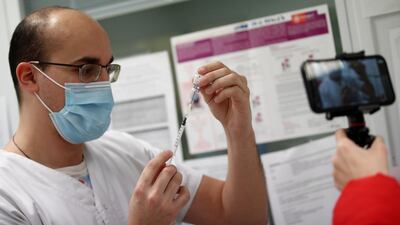
A journalist films a medical worker drawing the Pfizer-BioNTech vaccine from a vial at the Max Fourastier hospital in Nanterre, France. Reuters -
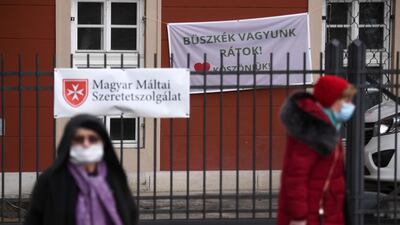
Women wearing face masks walk in front of a hospital with a banner reading 'We are proud of you! Thanks to all of you!', expressing thanks to the medical staff in Budapest, Hungary. AFP -
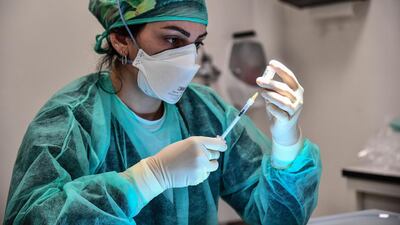
A healthcare worker prepares a syringe with a dose of the Pfizer-BioNTech vaccine at the Villa Scassi Hospital in Genoa, Italy. EPA -

A pedestrian passes by a closed shop in Berlin, Germany. EPA -

A nurse talks to a resident after administering a Pfizer-BioNTech vaccine at the Ange-Raymond Gilles care home in Jemeppe-sur-Meuse, near Liege, Belgium. AP Photo -
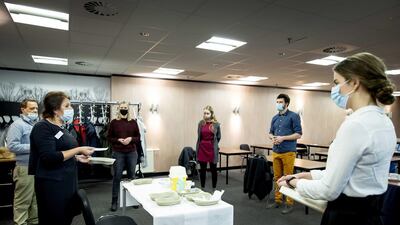
Staff are briefed on how to administer Covid-19 vaccine doses at the Expo Houten event complex in Houten, the Netherlands. EPA -

‘Tres Reyes Magos’ prepare to meet children at Aranjuez's bullring in Spain. The traditional Three Wise Men parades have been cancelled or modified this year across Spain. Getty Images -

French policemen stand on a deserted street in Metz, eastern France, as a new curfew comes into effect. AFP


Meanwhile, economist activity in the eurozone contracted more sharply than expected at the end of 2020 and could get worse this month as renewed restrictions to contain Covid-19 hit the bloc's dominant service industry, IHS Markit said.
With infection rates soaring across Europe, countries have clamped down on public life with Germany, the largest economy, set to extend its strict lockdown until the end of January.
IHS Markit's PMI rose to 49.1 from November's 45.3 but was still below the 50 mark, which indicates contraction. With many businesses closed, unemployment surging and debt hitting record highs, the European Central Bank unveiled more stimulus measures last month to lift the currency bloc out of a double-dip recession.
“With restrictions being extended and tightened in many countries, the economy will make a weak start to 2021, even if the vaccine rollout offers hope for a recovery from Q2 onwards,” said Jessica Hinds, Europe economist at Capital Economics.
The small rise in the manufacturing output index and a larger rise in the service component, particularly in France where restrictions were lifted, helped to push the index up slightly.
Ms Hinds said the only “silver lining” for eurozone economies was that the future output Composite PMI increased, suggesting that firms were becoming more optimistic that widespread vaccination would boost activity.
“With the rollout only just under way in most eurozone countries, it will be the second quarter before we see restrictions lifted and an associated boost to economic activity,” she said.

