• Libyan Prime Minister Abdul Hamid Dbeibah and Turkish Foreign Minister Mevlut Cavusoglu attend the second international Libya conference in Berlin, Germany. EPA
    Libyan Prime Minister Abdul Hamid Dbeibah and Turkish Foreign Minister Mevlut Cavusoglu attend the second international Libya conference in Berlin, Germany. EPA
  • The conference ha brought together representatives from the UN Security Council, the Libyan unity government and Turkey, as well as various countries in the Mena region. Getty
    The conference ha brought together representatives from the UN Security Council, the Libyan unity government and Turkey, as well as various countries in the Mena region. Getty
  • Russian deputy minister of foreign affairs Sergey Vershinin attends the conference. EPA
    Russian deputy minister of foreign affairs Sergey Vershinin attends the conference. EPA
  • The conference has been held to assess and promote progress towards definitively ending the conflict in Libya. Getty
    The conference has been held to assess and promote progress towards definitively ending the conflict in Libya. Getty
  • US Secretary of State Antony Blinken, German Foreign Minister Heiko Maas and British Minister of State for the Middle East and North Africa James Cleverly were among those who attended. EPA
    US Secretary of State Antony Blinken, German Foreign Minister Heiko Maas and British Minister of State for the Middle East and North Africa James Cleverly were among those who attended. EPA
  • It was the second conference on Libya to be held in Berlin in 18 months. EPA
    It was the second conference on Libya to be held in Berlin in 18 months. EPA
  • Mr Blinken represented the government of US President Joe Biden at the talks. AP
    Mr Blinken represented the government of US President Joe Biden at the talks. AP
  • Senior officials gather for the conference. EPA
    Senior officials gather for the conference. EPA

Second Berlin conference brings progress on ending foreign interference in Libya


  • English
  • Arabic

Libya is moving closer to ejecting foreign mercenaries and military groups from its soil, the country's foreign minister said on Wednesday.

Progress towards ending outside interference in Libya was made at a gathering of Libyan representatives and international powers in Berlin, the second conference on the conflict to take place in the German capital.

"We have progress in terms of mercenaries," Najla Mangoush told reporters at the close of the UN and German-led conference.

"Hopefully within the coming days, mercenaries from both sides are going to be withdrawing, and I think this is going to be encouraging.

"We've built the trust measurement from both sides and then other steps will follow," she added.

German Foreign Minister Heiko Maas said that although progress had been made, the withdrawals would likely proceed gradually.

"I believe that between the Turkish and the Russian sides, there was also an understanding that if you stop, this will not mean that everybody will take their mercenaries back overnight," he said.

Mr Maas said Germany "will not falter" in its pursuit of ridding Libya of foreign mercenaries but warned that a military imbalance could be created if one side withdrew its mercenaries faster than the other.

Earlier in the day, Libyan Prime Minister Abdul Hamid Dbeibeh called on the international community to take Libya seriously and to respect its sovereignty.

He also promised to stop at nothing to ensure national elections, set for December 24, go ahead.

We must put an end to all foreign interference, including the full withdrawal of all foreign forces and mercenaries from Libya

"I will not shy away from any efforts to make sure we overcome any obstacles in the way of sticking to the national elections and to make it possible for the people of Libya to elect officials," he told representatives from the US, UAE, UK and other countries.

The unity government took office in March with the backing of the UN and Western powers.

It replaced two warring governments that had ruled different parts of Libya, which had been in turmoil since the fall of Muammar Qaddafi in 2011.

UN Secretary-General Antonio Guterres called for free participation in the elections, which many see as key to securing a lasting peace in the country, as well as in a community-led reconciliation programme.

“We must put an end to all foreign interference, including the full withdrawal of all foreign forces and mercenaries from Libya," he said.

"I urge Libyan and and external parties to agree on a comprehensive plan with clear timelines to achieve this goal, which UNSMIL stands ready to support.”

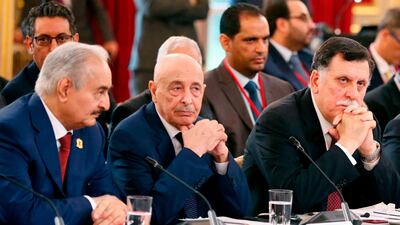
  • Libyan Field Marshal Khalifa Haftar, House of Representatives speaker Aguila Saleh, and GNA Prime Minister Fayez Al Sarraj attend a peace conference hosted by France in May 2018. AFP
    Libyan Field Marshal Khalifa Haftar, House of Representatives speaker Aguila Saleh, and GNA Prime Minister Fayez Al Sarraj attend a peace conference hosted by France in May 2018. AFP
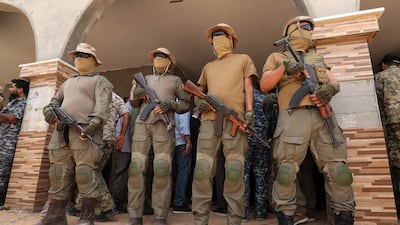
  • Fighters from the Libyan Government of National Accord (GNA) stand guard on June 20, 2021, in the town of Buwairat Al Hassoun. AFP
    Fighters from the Libyan Government of National Accord (GNA) stand guard on June 20, 2021, in the town of Buwairat Al Hassoun. AFP
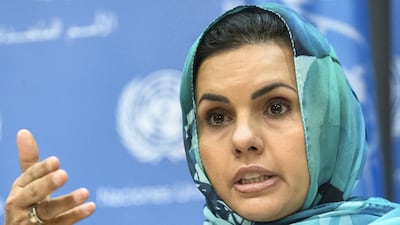
  • Zahra Langhi and other women have called for changes to the UN Libya peace process. Getty
    Zahra Langhi and other women have called for changes to the UN Libya peace process. Getty
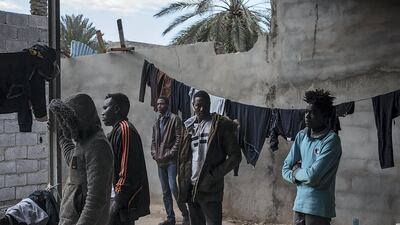
  • Refugees mostly from Darfur, Sudan are gathered in the courtyard of the place where they live in Gorgi district, south of Tripoli. Migrants and refugees are often living in dire conditions, in dilapidated buildings or small unfinished houses deprived of basic services.
    Refugees mostly from Darfur, Sudan are gathered in the courtyard of the place where they live in Gorgi district, south of Tripoli. Migrants and refugees are often living in dire conditions, in dilapidated buildings or small unfinished houses deprived of basic services.
  • Turkish President Recep Tayyip Erdogan and Italian Prime Minister Giuseppe Conte speak on the sideline of the conference on Libya at the Chancellery in Berlin in January. ,AP
    Turkish President Recep Tayyip Erdogan and Italian Prime Minister Giuseppe Conte speak on the sideline of the conference on Libya at the Chancellery in Berlin in January. ,AP
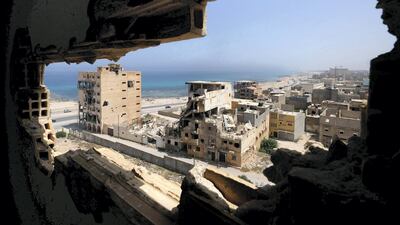
  • Destroyed buildings are seen through a hole in Benghazi lighthouse after it was severely damaged by years of armed conflict in 2019. Reuters
    Destroyed buildings are seen through a hole in Benghazi lighthouse after it was severely damaged by years of armed conflict in 2019. Reuters
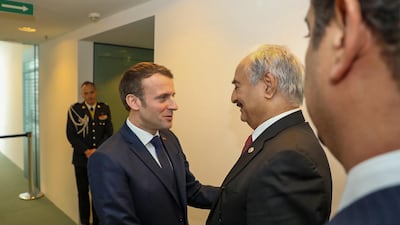
  • Field Marshal Khalifa Haftar's Haftar greets French President Emmanuel Macron in Berlin in January. AFP
    Field Marshal Khalifa Haftar's Haftar greets French President Emmanuel Macron in Berlin in January. AFP
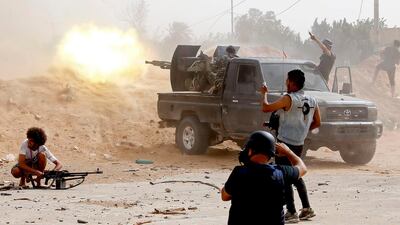
  • A fighter loyal to the Libyan internationally-recognised Government of National Accord fires a heavy machine gun as a press photographer take pictures of the scene during clashes against forces loyal to Field Marshal Khalifa Haftar. AFP
    A fighter loyal to the Libyan internationally-recognised Government of National Accord fires a heavy machine gun as a press photographer take pictures of the scene during clashes against forces loyal to Field Marshal Khalifa Haftar. AFP
  • Conflict in and around Tripoli continues. Reuters
    Conflict in and around Tripoli continues. Reuters
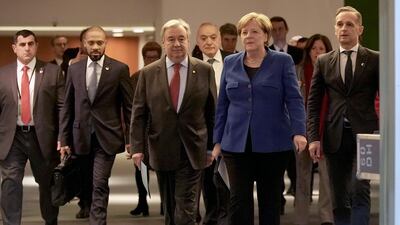
  • German Chancellor Angela Merkel, German Foreign Minister Heiko Maas and Secretary-General of the United Nations Antonio Guterres leave after a press conference at the end of a Peace summit on Libya at the Chancellery in Berlin on January. AFP
    German Chancellor Angela Merkel, German Foreign Minister Heiko Maas and Secretary-General of the United Nations Antonio Guterres leave after a press conference at the end of a Peace summit on Libya at the Chancellery in Berlin on January. AFP
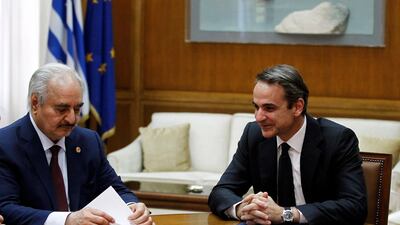
  • Greek Prime Minister Mitsotakis talks with Commander of the Libyan National Army Khalifa Haftar during their meeting in Parliament, in Athens, Greece in January 2020. EPA
    Greek Prime Minister Mitsotakis talks with Commander of the Libyan National Army Khalifa Haftar during their meeting in Parliament, in Athens, Greece in January 2020. EPA
  • Field Marshal Khalifa Haftar speaking in a video published by the War Information Division of the Libyan National Army on April 28, 2020. AFP PHOTO / LNA WAR INFORMATION DIVISION
    Field Marshal Khalifa Haftar speaking in a video published by the War Information Division of the Libyan National Army on April 28, 2020. AFP PHOTO / LNA WAR INFORMATION DIVISION

Some $189m had been requested to meet humanitarian needs in Libya, he said, adding that the first group of UN peacekeeping monitors would be deployed to the North African country "soon".

Khalifa Shaheen Al Marar, UAE Minister of State and head of the UAE's delegation to the talks called on Libyan and international parties to "commit themselves to the political process and provide all factors to its success in order to realise security, stability and unity of Libyan institutions to fulfil the aspirations of the Libyan people for a more prosperous future,"

US Secretary of State Antony Blinken said Libya had its best opportunity in years to move forward as a safe and sovereign country.

“We share the goal of a sovereign, stable, unified, secure Libya, free from foreign interference,” he said. “It’s what the people of Libya deserve, it’s critical to regional security as well."

But Mr Dbeibeh raised a number of concerns over Libya's progress towards becoming a peaceful, democratic state.

The prime minister said Libya's legislature had not made "serious efforts" to create electoral laws and a functioning constitution.

One of the issues at hand is exactly what Libyans will vote for, particularly if the president should be directly elected.

Libya's High National Election Commission (HNEC) has said a decision on the constitution should be made by July 1 to prevent a delay to the December 24 election.

Mr Dbeibah told the conference that the continued presence of mercenaries and foreign military personnel in the country could jeopardise the political process.

“There are security concerns over the political process based on the direct and armed control of mercenaries in some areas, the presence of military forces with political dimensions… and the presence of some terrorists,” he said.

The meeting at the foreign ministry in Berlin followed a conference in January 2020 at which leaders agreed to respect a UN arms embargo and to push Libya's warring parties to agree to a full ceasefire.

For the further stabilisation of the country, it is crucial that elections take place as planned and that foreign fighters and mercenaries really do leave Libya

Germany is acting as an intermediary.

Countriesinvolved in the process include the five permanent members of the UN Security Council, along with the UAE, Italy and Turkey.

Before the conference, German Foreign Minister Heiko Maas said that much has been achieved in the past two years.

An October ceasefire agreement included a demand that all foreign fighters and mercenaries leave Libya within 90 days and a transitional government took office in February.

But “many challenges still lie ahead of us”, said Mr Maas.

“For the further stabilisation of the country, it is crucial that elections take place as planned and that foreign fighters and mercenaries really do leave Libya.”

He said that Wednesday’s conference launches a new phase “in which we no longer only talk about Libya, but in which we are now speaking with Libyan men and women about the future of their country”.

Ms Mangoush, the Libyan foreign minister, said: "It’s time for actions because my people have heard enough."


Springtime in a Broken Mirror,
Mario Benedetti, Penguin Modern Classics


The biog

Siblings: five brothers and one sister

Education: Bachelors in Political Science at the University of Minnesota

Interests: Swimming, tennis and the gym

Favourite place: UAE

Favourite packet food on the trip: pasta primavera

What he did to pass the time during the trip: listen to audio books

What is Folia?

Prince Khaled bin Alwaleed bin Talal's new plant-based menu will launch at Four Seasons hotels in Dubai this November. A desire to cater to people looking for clean, healthy meals beyond green salad is what inspired Prince Khaled and American celebrity chef Matthew Kenney to create Folia. The word means "from the leaves" in Latin, and the exclusive menu offers fine plant-based cuisine across Four Seasons properties in Los Angeles, Bahrain and, soon, Dubai.

Kenney specialises in vegan cuisine and is the founder of Plant Food Wine and 20 other restaurants worldwide. "I’ve always appreciated Matthew’s work," says the Saudi royal. "He has a singular culinary talent and his approach to plant-based dining is prescient and unrivalled. I was a fan of his long before we established our professional relationship."

Folia first launched at The Four Seasons Hotel Los Angeles at Beverly Hills in July 2018. It is available at the poolside Cabana Restaurant and for in-room dining across the property, as well as in its private event space. The food is vibrant and colourful, full of fresh dishes such as the hearts of palm ceviche with California fruit, vegetables and edible flowers; green hearb tacos filled with roasted squash and king oyster barbacoa; and a savoury coconut cream pie with macadamia crust.

In March 2019, the Folia menu reached Gulf shores, as it was introduced at the Four Seasons Hotel Bahrain Bay, where it is served at the Bay View Lounge. Next, on Tuesday, November 1 – also known as World Vegan Day – it will come to the UAE, to the Four Seasons Resort Dubai at Jumeirah Beach and the Four Seasons DIFC, both properties Prince Khaled has spent "considerable time at and love". 

There are also plans to take Folia to several more locations throughout the Middle East and Europe.

While health-conscious diners will be attracted to the concept, Prince Khaled is careful to stress Folia is "not meant for a specific subset of customers. It is meant for everyone who wants a culinary experience without the negative impact that eating out so often comes with."

Company profile

Date started: December 24, 2018

Founders: Omer Gurel, chief executive and co-founder and Edebali Sener, co-founder and chief technology officer

Based: Dubai Media City

Number of employees: 42 (34 in Dubai and a tech team of eight in Ankara, Turkey)

Sector: ConsumerTech and FinTech

Cashflow: Almost $1 million a year

Funding: Series A funding of $2.5m with Series B plans for May 2020

Mercer, the investment consulting arm of US services company Marsh & McLennan, expects its wealth division to at least double its assets under management (AUM) in the Middle East as wealth in the region continues to grow despite economic headwinds, a company official said.

Mercer Wealth, which globally has $160 billion in AUM, plans to boost its AUM in the region to $2-$3bn in the next 2-3 years from the present $1bn, said Yasir AbuShaban, a Dubai-based principal with Mercer Wealth.

Within the next two to three years, we are looking at reaching $2 to $3 billion as a conservative estimate and we do see an opportunity to do so,” said Mr AbuShaban.

Mercer does not directly make investments, but allocates clients’ money they have discretion to, to professional asset managers. They also provide advice to clients.

“We have buying power. We can negotiate on their (client’s) behalf with asset managers to provide them lower fees than they otherwise would have to get on their own,” he added.

Mercer Wealth’s clients include sovereign wealth funds, family offices, and insurance companies among others.

From its office in Dubai, Mercer also looks after Africa, India and Turkey, where they also see opportunity for growth.

Wealth creation in Middle East and Africa (MEA) grew 8.5 per cent to $8.1 trillion last year from $7.5tn in 2015, higher than last year’s global average of 6 per cent and the second-highest growth in a region after Asia-Pacific which grew 9.9 per cent, according to consultancy Boston Consulting Group (BCG). In the region, where wealth grew just 1.9 per cent in 2015 compared with 2014, a pickup in oil prices has helped in wealth generation.

BCG is forecasting MEA wealth will rise to $12tn by 2021, growing at an annual average of 8 per cent.

Drivers of wealth generation in the region will be split evenly between new wealth creation and growth of performance of existing assets, according to BCG.

Another general trend in the region is clients’ looking for a comprehensive approach to investing, according to Mr AbuShaban.

“Institutional investors or some of the families are seeing a slowdown in the available capital they have to invest and in that sense they are looking at optimizing the way they manage their portfolios and making sure they are not investing haphazardly and different parts of their investment are working together,” said Mr AbuShaban.

Some clients also have a higher appetite for risk, given the low interest-rate environment that does not provide enough yield for some institutional investors. These clients are keen to invest in illiquid assets, such as private equity and infrastructure.

“What we have seen is a desire for higher returns in what has been a low-return environment specifically in various fixed income or bonds,” he said.

“In this environment, we have seen a de facto increase in the risk that clients are taking in things like illiquid investments, private equity investments, infrastructure and private debt, those kind of investments were higher illiquidity results in incrementally higher returns.”

The Abu Dhabi Investment Authority, one of the largest sovereign wealth funds, said in its 2016 report that has gradually increased its exposure in direct private equity and private credit transactions, mainly in Asian markets and especially in China and India. The authority’s private equity department focused on structured equities owing to “their defensive characteristics.”