UK hospitals are on the verge of being overwhelmed but vaccines provide a spark of hope, the head of the Oxford Vaccine Group said on Monday.
Prof Andrew Pollard made the remarks after becoming the third person in the world to receive the Oxford/AstraZeneca vaccine outside trial conditions.
Six hospitals in England will this week administer the first of about 530,000 doses Britain has currently.
The drug will arrive at hundreds of sites in the coming days and the government hopes to deliver tens of millions of doses within months, provided AstraZeneca can increase supply.
Prof Pollard said the vaccine was being distributed at a critical moment for the country. "We are at the point of being overwhelmed by this disease," he told BBC Breakfast.
The UK has ordered about 100 million doses of the Oxford/AstraZeneca vaccine – enough to immunise 50 million people with the two shots required.
Last month, Britain became the first country to use the vaccine produced by Pfizer and BioNTech, which has to be stored at ultra-low temperatures.
The Oxford/AstraZeneca vaccine is considered easier to distribute as it can be kept in a normal fridge, and costs less than $5 a dose.
It was also developed in record time, taking less than 12 months from conception to approval, a process that typically takes five to 10 years.
Regulators say the vaccine is on average 70 per cent effective in protecting against Covid-19 when taken as two full doses eight to 12 weeks apart.
“So far the evidence indicates there shouldn’t be a problem against this new variant,” Prof Pollard told Sky News when asked of its efficacy against the more infectious variant.
Prof Pollard, a paediatrician, received the shot because health workers are prioritised under the UK government’s staggered vaccination programme.
He assured people the shot was safe and urged people to take it when they are called.
“We are only going to make an impact when vaccines are in people’s arms,” he said. “They do nothing in the glass vial.”
-
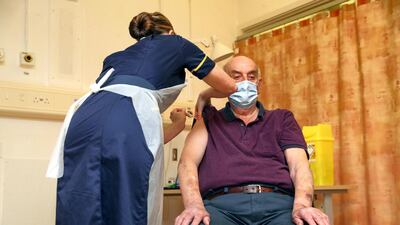
82-year-old Brian Pinker receives the Oxford University/AstraZeneca vaccine from nurse Sam Foster at the Churchill Hospital in Oxford. AP Photo -

88-year-old Trevor Cowlett receives the Oxford University/AstraZeneca vaccine at the Churchill Hospital in Oxford. AP Photo -
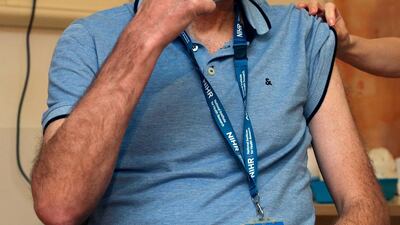
Professor Andrew Pollard, Director of the Oxford Vaccine Group, receives the Oxford University/AstraZeneca vaccine from nurse Sam Foster, at the Churchill Hospital in Oxford. AP Photo -
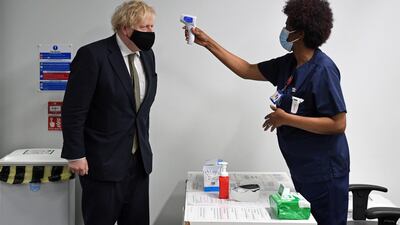
Prime Minister Boris Johnson has his temperature checked during a visit to Chase Farm Hospital on the day that the NHS ramps up its vaccination programme. Getty Images -

Chief nurse nurse Sam Foster holds a vial of the Oxford University/AstraZeneca vaccine, at the Churchill Hospital in Oxford. AP Photo -

Assistant Technical Officer Lukasz Najdrowski handles doses of the Oxford University/AstraZeneca vaccine as they arrive at the Princess Royal Hospital in Haywards Heath. Reuters -

Doses of the Oxford University/AstraZeneca vaccine arrive at the Princess Royal Hospital in Haywards Heath. Getty Images -

Assistant Technical Officer Lukasz Najdrowski unpacks doses of the Oxford University/AstraZeneca vaccine. Getty Images -

The Princess Royal Hospital in Haywards Heath, West Sussex, where doses of the Oxford University/AstraZeneca were delivered today. Getty Images
Living in...
This article is part of a guide on where to live in the UAE. Our reporters will profile some of the country’s most desirable districts, provide an estimate of rental prices and introduce you to some of the residents who call each area home.
COMPANY%20PROFILE
Ten tax points to be aware of in 2026
1. Domestic VAT refund amendments: request your refund within five years
If a business does not apply for the refund on time, they lose their credit.
2. E-invoicing in the UAE
Businesses should continue preparing for the implementation of e-invoicing in the UAE, with 2026 a preparation and transition period ahead of phased mandatory adoption.
3. More tax audits
Tax authorities are increasingly using data already available across multiple filings to identify audit risks.
4. More beneficial VAT and excise tax penalty regime
Tax disputes are expected to become more frequent and more structured, with clearer administrative objection and appeal processes. The UAE has adopted a new penalty regime for VAT and excise disputes, which now mirrors the penalty regime for corporate tax.
5. Greater emphasis on statutory audit
There is a greater need for the accuracy of financial statements. The International Financial Reporting Standards standards need to be strictly adhered to and, as a result, the quality of the audits will need to increase.
6. Further transfer pricing enforcement
Transfer pricing enforcement, which refers to the practice of establishing prices for internal transactions between related entities, is expected to broaden in scope. The UAE will shortly open the possibility to negotiate advance pricing agreements, or essentially rulings for transfer pricing purposes.
7. Limited time periods for audits
Recent amendments also introduce a default five-year limitation period for tax audits and assessments, subject to specific statutory exceptions. While the standard audit and assessment period is five years, this may be extended to up to 15 years in cases involving fraud or tax evasion.
8. Pillar 2 implementation
Many multinational groups will begin to feel the practical effect of the Domestic Minimum Top-Up Tax (DMTT), the UAE's implementation of the OECD’s global minimum tax under Pillar 2. While the rules apply for financial years starting on or after January 1, 2025, it is 2026 that marks the transition to an operational phase.
9. Reduced compliance obligations for imported goods and services
Businesses that apply the reverse-charge mechanism for VAT purposes in the UAE may benefit from reduced compliance obligations.
10. Substance and CbC reporting focus
Tax authorities are expected to continue strengthening the enforcement of economic substance and Country-by-Country (CbC) reporting frameworks. In the UAE, these regimes are increasingly being used as risk-assessment tools, providing tax authorities with a comprehensive view of multinational groups’ global footprints and enabling them to assess whether profits are aligned with real economic activity.
Contributed by Thomas Vanhee and Hend Rashwan, Aurifer
Karwaan
Producer: Ronnie Screwvala
Director: Akarsh Khurana
Starring: Irrfan Khan, Dulquer Salmaan, Mithila Palkar
Rating: 4/5
A%20Little%20to%20the%20Left
IF YOU GO
The flights
FlyDubai flies direct from Dubai to Skopje in five hours from Dh1,314 return including taxes. Hourly buses from Skopje to Ohrid take three hours.
The tours
English-speaking guided tours of Ohrid town and the surrounding area are organised by Cultura 365; these cost €90 (Dh386) for a one-day trip including driver and guide and €100 a day (Dh429) for two people.
The hotels
Villa St Sofija in the old town of Ohrid, twin room from $54 (Dh198) a night.
St Naum Monastery, on the lake 30km south of Ohrid town, has updated its pilgrims' quarters into a modern 3-star hotel, with rooms overlooking the monastery courtyard and lake. Double room from $60 (Dh 220) a night.
Story%20behind%20the%20UAE%20flag
The Perfect Couple
Starring: Nicole Kidman, Liev Schreiber, Jack Reynor
Creator: Jenna Lamia
Rating: 3/5
Our legal columnist
Name: Yousef Al Bahar
Advocate at Al Bahar & Associate Advocates and Legal Consultants, established in 1994
Education: Mr Al Bahar was born in 1979 and graduated in 2008 from the Judicial Institute. He took after his father, who was one of the first Emirati lawyers
Comment on Coronavirus
Law%2041.9.4%20of%20men%E2%80%99s%20T20I%20playing%20conditions
Mercer, the investment consulting arm of US services company Marsh & McLennan, expects its wealth division to at least double its assets under management (AUM) in the Middle East as wealth in the region continues to grow despite economic headwinds, a company official said.
Mercer Wealth, which globally has $160 billion in AUM, plans to boost its AUM in the region to $2-$3bn in the next 2-3 years from the present $1bn, said Yasir AbuShaban, a Dubai-based principal with Mercer Wealth.
“Within the next two to three years, we are looking at reaching $2 to $3 billion as a conservative estimate and we do see an opportunity to do so,” said Mr AbuShaban.
Mercer does not directly make investments, but allocates clients’ money they have discretion to, to professional asset managers. They also provide advice to clients.
“We have buying power. We can negotiate on their (client’s) behalf with asset managers to provide them lower fees than they otherwise would have to get on their own,” he added.
Mercer Wealth’s clients include sovereign wealth funds, family offices, and insurance companies among others.
From its office in Dubai, Mercer also looks after Africa, India and Turkey, where they also see opportunity for growth.
Wealth creation in Middle East and Africa (MEA) grew 8.5 per cent to $8.1 trillion last year from $7.5tn in 2015, higher than last year’s global average of 6 per cent and the second-highest growth in a region after Asia-Pacific which grew 9.9 per cent, according to consultancy Boston Consulting Group (BCG). In the region, where wealth grew just 1.9 per cent in 2015 compared with 2014, a pickup in oil prices has helped in wealth generation.
BCG is forecasting MEA wealth will rise to $12tn by 2021, growing at an annual average of 8 per cent.
Drivers of wealth generation in the region will be split evenly between new wealth creation and growth of performance of existing assets, according to BCG.
Another general trend in the region is clients’ looking for a comprehensive approach to investing, according to Mr AbuShaban.
“Institutional investors or some of the families are seeing a slowdown in the available capital they have to invest and in that sense they are looking at optimizing the way they manage their portfolios and making sure they are not investing haphazardly and different parts of their investment are working together,” said Mr AbuShaban.
Some clients also have a higher appetite for risk, given the low interest-rate environment that does not provide enough yield for some institutional investors. These clients are keen to invest in illiquid assets, such as private equity and infrastructure.
“What we have seen is a desire for higher returns in what has been a low-return environment specifically in various fixed income or bonds,” he said.
“In this environment, we have seen a de facto increase in the risk that clients are taking in things like illiquid investments, private equity investments, infrastructure and private debt, those kind of investments were higher illiquidity results in incrementally higher returns.”
The Abu Dhabi Investment Authority, one of the largest sovereign wealth funds, said in its 2016 report that has gradually increased its exposure in direct private equity and private credit transactions, mainly in Asian markets and especially in China and India. The authority’s private equity department focused on structured equities owing to “their defensive characteristics.”
While you're here
On Women's Day
Shelina Janmohamed: Why shouldn't a spouse be compensated fairly for housework?
Samar Elmnhrawy: How companies in the Middle East can catch up on gender equality
The National Editorial: Is there much to celebrate on International Women's Day 2021?
Justin Thomas: Challenge the notion that 'men are from Mars, women are from Venus'
The biog
Hobby: "It is not really a hobby but I am very curious person. I love reading and spend hours on research."
Favourite author: Malcom Gladwell
Favourite travel destination: "Antigua in the Caribbean because I have emotional attachment to it. It is where I got married."
Managing the separation process
- Choose your nursery carefully in the first place
- Relax – and hopefully your child will follow suit
- Inform the staff in advance of your child’s likes and dislikes.
- If you need some extra time to talk to the teachers, make an appointment a few days in advance, rather than attempting to chat on your child’s first day
- The longer you stay, the more upset your child will become. As difficult as it is, walk away. Say a proper goodbye and reassure your child that you will be back
- Be patient. Your child might love it one day and hate it the next
- Stick at it. Don’t give up after the first day or week. It takes time for children to settle into a new routine.And, finally, don’t feel guilty.


