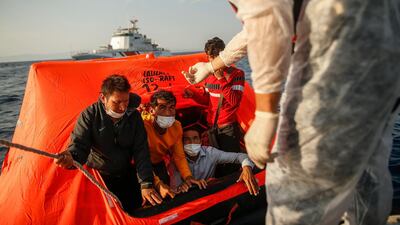
A group of Afghan migrants say their hopes for a new life in Europe were cut short when Greek authorities rounded them up, shoved them into life rafts and abandoned them at sea shortly after they had reached the Greek island of Lesbos.
Associated Press journalists on a Turkish government-organised coast guard ride-along were aboard the patrol boat that picked up the 37 migrants, including 18 children, from two orange life rafts in the Aegean Sea on September 12. Two other media organisations on similar government-organised trips in the same week witnessed similar scenes.
“They took our phones and said a bus will come and take you to the camp,” Omid Hussain Nabizada said in Turkish. “But they took us and put us on a ship. They left us on the water in a very bad way on these boats.”
Turkey, which hosts about 4 million refugees, accuses Greece of large-scale pushbacks — summary deportations without access to asylum procedures, in violation of international law. It also accuses the European Union of turning a blind eye to what it says is a blatant abuse of human rights.
The Turkish coast guard says it rescued over 300 migrants “pushed back by Greek elements to Turkish waters” this month alone. Citing what they say are credible reports, international rights groups have called repeatedly for investigations.
Greece, which lies on the EU’s south-eastern border and has borne the brunt of migration flows from Turkey, denies the allegations and in turn accuses Ankara of weaponising migrants.
In March, Turkey made good on threats to send migrants to Europe, declaring its borders with the EU open. In what appeared to be a government-organised campaign, thousands headed to the Greek border, leading to scenes of chaos and violence. Turkey's border with EU member Bulgaria was largely unaffected. Greece shut its frontier and controversially suspended asylum applications for a month.
Greece’s coast guard says Turkey’s coast guard frequently escorts migrant smuggling boats toward Greece, and has provided videos to back its claims. It says under a 2016 EU-Turkey deal to stem migration flows, Turkey has an obligation to stop people clandestinely entering Greece.
Greek coast guard spokesman Lt Cmdr Nikolaos Kokkalas said its patrols regularly detect boats and dinghies carrying migrants trying to enter Greece illegally, and “among them many times there are also inflatable rafts such as those described” by the AP.
The life rafts are standard safety equipment on recreational boats, designed to keep passengers safe if they must abandon ship. They generally have no means of propulsion or steering.
“It must be underlined that in most of the cases, the presence of the Turkish coast guard has been observed-ascertained near the dinghies incoming from the Turkish coast, but without it intervening, while in some cases the dinghies are clearly being accompanied by (Turkish coast guard) vessels,” Lt Cmdr Kokkalas said in a written response to an AP query.
Migrants caught up in geopolitical struggle
Uneasy neighbours Greece and Turkey have been at loggerheads for decades over several territorial issues, and asylum-seekers have found themselves caught up in the geopolitical conflict.
Tension between the two countries rose dramatically this summer over eastern Mediterranean maritime boundaries.
Both sides deployed warships as Turkish survey ships prospected for gas in waters where Greece and Cyprus claim exclusive economic rights. EU leaders are to discuss imposing sanctions on Turkey for its actions, in a summit at the beginning of October. Turkey has repeated its threat to send migrants into the EU if sanctions are imposed.
The persistent allegations of pushbacks of migrants are the latest manifestations of these tensions.
Human Rights Watch has accused Greece of summarily returning migrants across land and sea borders with Turkey, citing interviews with asylum-seekers.
Other rights groups and refugee organisations, including the UN refugee agency, have repeatedly called on Greece to investigate what they say are credible reports and testimony of such expulsions occurring.
“UNHCR is particularly concerned about the increasing reports, since March 2020, of alleged informal returns by sea of persons who, according to their own attestations or those of third persons, have disembarked on Greek shores and have thereafter been towed back to sea,” the agency said in August.
UNHCR Assistant High Commissioner for Protection Gillian Triggs, reiterating the call for an investigation, said that “with our own eyes on Lesbos, it was quite clear no boats were coming through” recently.
Earlier this month, Greece’s Shipping Minister Giannis Plakiotakis said Greek authorities prevented more than 10,000 people from entering Greece by sea this year. He would not elaborate on how.
Former Migration Minister Ioannis Mouzalas pressed for details from the current minister, Notis Mitarachi, in parliament September 21, saying this appeared to violate Greek and international law. He asked directly whether the government carries out pushbacks.
'People don't do this to animals. The Greek police did it to us'
The four Afghans on the life rafts seen by AP said they reached Lesbos from Turkey’s western Canakkale province on the night of September 11, and were caught by Greek law enforcement during daylight.
One of them, Nabizada, said police hit him while forcing him into the raft.
“They didn’t say, ‘there are children, there are families, there are women.’ … People don’t do this to animals. The Greek police did it to us,” said the 22-year-old. He said he left Kabul in 2017 and crossed to Turkey via Iran, aiming for Europe.
Zohra Alizada, 14, said police took their phones and money, put them in the rafts and left. She was traveling with her parents and two siblings after living in Kars, in eastern Turkey, for over four years. She said the migrants called the Turkish coast guard for help.
Her father, Mohammad Reza Alizada, said Greek authorities inflated the rafts “and they threw us like animals inside”.
The AP was not able to independently verify their accounts.
The Turkish coast guard, clad in protective equipment against Covid-19, took them aboard after checking them for fever. Another Turkish coast guard vessel was already in the area when the patrol boat carrying the AP crew arrived.
Turkish Foreign Minister Mevlut Cavusoglu raised the allegations against Greece in an August news conference with his German counterpart.
He said Turkey has shown through government and media reports that Greece is pushing back refugees at sea, adding that “there have been numerous articles published”.
“How do sinking boats in the middle of the Aegean Sea or sending them to Turkey by pushbacks fit international rights and universal values?” Mr Cavusoglu said.
Greece denies sinking smuggling boats. Lt Cmdr Kokkalas noted the Greek coast guard had rescued 3,150 migrants in about 100 incidents this year.
An independent Norway-based watchdog says it has documented at least 50 cases since March of migrants being put into life rafts and left adrift.
“They are not going into these life rafts willingly. They are forced,” said Tommy Olsen of the Aegean Boat Report, which monitors arrivals and rights abuses in the Aegean.
He said his group had no information about the rafts the AP saw, but that it was consistent with similar reports.
“Usually you save people from life rafts,” Mr Olsen said. “You don’t put them on life rafts and leave them.”

Ten tax points to be aware of in 2026
1. Domestic VAT refund amendments: request your refund within five years
If a business does not apply for the refund on time, they lose their credit.
2. E-invoicing in the UAE
Businesses should continue preparing for the implementation of e-invoicing in the UAE, with 2026 a preparation and transition period ahead of phased mandatory adoption.
3. More tax audits
Tax authorities are increasingly using data already available across multiple filings to identify audit risks.
4. More beneficial VAT and excise tax penalty regime
Tax disputes are expected to become more frequent and more structured, with clearer administrative objection and appeal processes. The UAE has adopted a new penalty regime for VAT and excise disputes, which now mirrors the penalty regime for corporate tax.
5. Greater emphasis on statutory audit
There is a greater need for the accuracy of financial statements. The International Financial Reporting Standards standards need to be strictly adhered to and, as a result, the quality of the audits will need to increase.
6. Further transfer pricing enforcement
Transfer pricing enforcement, which refers to the practice of establishing prices for internal transactions between related entities, is expected to broaden in scope. The UAE will shortly open the possibility to negotiate advance pricing agreements, or essentially rulings for transfer pricing purposes.
7. Limited time periods for audits
Recent amendments also introduce a default five-year limitation period for tax audits and assessments, subject to specific statutory exceptions. While the standard audit and assessment period is five years, this may be extended to up to 15 years in cases involving fraud or tax evasion.
8. Pillar 2 implementation
Many multinational groups will begin to feel the practical effect of the Domestic Minimum Top-Up Tax (DMTT), the UAE's implementation of the OECD’s global minimum tax under Pillar 2. While the rules apply for financial years starting on or after January 1, 2025, it is 2026 that marks the transition to an operational phase.
9. Reduced compliance obligations for imported goods and services
Businesses that apply the reverse-charge mechanism for VAT purposes in the UAE may benefit from reduced compliance obligations.
10. Substance and CbC reporting focus
Tax authorities are expected to continue strengthening the enforcement of economic substance and Country-by-Country (CbC) reporting frameworks. In the UAE, these regimes are increasingly being used as risk-assessment tools, providing tax authorities with a comprehensive view of multinational groups’ global footprints and enabling them to assess whether profits are aligned with real economic activity.
Contributed by Thomas Vanhee and Hend Rashwan, Aurifer
What are the influencer academy modules?
- Mastery of audio-visual content creation.
- Cinematography, shots and movement.
- All aspects of post-production.
- Emerging technologies and VFX with AI and CGI.
- Understanding of marketing objectives and audience engagement.
- Tourism industry knowledge.
- Professional ethics.
COMPANY PROFILE
Founders: Sebastian Stefan, Sebastian Morar and Claudia Pacurar
Based: Dubai, UAE
Founded: 2014
Number of employees: 36
Sector: Logistics
Raised: $2.5 million
Investors: DP World, Prime Venture Partners and family offices in Saudi Arabia and the UAE
How to help
Call the hotline on 0502955999 or send "thenational" to the following numbers:
2289 - Dh10
2252 - Dh50
6025 - Dh20
6027 - Dh100
6026 - Dh200
Director: Laxman Utekar
Cast: Vicky Kaushal, Akshaye Khanna, Diana Penty, Vineet Kumar Singh, Rashmika Mandanna
Rating: 1/5
Key facilities
- Olympic-size swimming pool with a split bulkhead for multi-use configurations, including water polo and 50m/25m training lanes
- Premier League-standard football pitch
- 400m Olympic running track
- NBA-spec basketball court with auditorium
- 600-seat auditorium
- Spaces for historical and cultural exploration
- An elevated football field that doubles as a helipad
- Specialist robotics and science laboratories
- AR and VR-enabled learning centres
- Disruption Lab and Research Centre for developing entrepreneurial skills
Killing of Qassem Suleimani
Various Artists
Habibi Funk: An Eclectic Selection Of Music From The Arab World (Habibi Funk)
Living in...
This article is part of a guide on where to live in the UAE. Our reporters will profile some of the country’s most desirable districts, provide an estimate of rental prices and introduce you to some of the residents who call each area home.
2020 Oscars winners: in numbers
- Parasite – 4
- 1917– 3
- Ford v Ferrari – 2
- Joker – 2
- Once Upon a Time ... in Hollywood – 2
- American Factory – 1
- Bombshell – 1
- Hair Love – 1
- Jojo Rabbit – 1
- Judy – 1
- Little Women – 1
- Learning to Skateboard in a Warzone (If You're a Girl) – 1
- Marriage Story – 1
- Rocketman – 1
- The Neighbors' Window – 1
- Toy Story 4 – 1
At Eternity’s Gate
Director: Julian Schnabel
Starring: Willem Dafoe, Oscar Isaacs, Mads Mikkelsen
Three stars
WITHIN%20SAND
%3Cp%3EDirector%3A%20Moe%20Alatawi%3C%2Fp%3E%0A%3Cp%3EStarring%3A%20Ra%E2%80%99ed%20Alshammari%2C%20Adwa%20Fahd%2C%20Muhand%20Alsaleh%3C%2Fp%3E%0A%3Cp%3ERating%3A%203%2F5%3C%2Fp%3E%0A
EMERGENCY PHONE NUMBERS
Estijaba – 8001717 – number to call to request coronavirus testing
Ministry of Health and Prevention – 80011111
Dubai Health Authority – 800342 – The number to book a free video or voice consultation with a doctor or connect to a local health centre
Emirates airline – 600555555
Etihad Airways – 600555666
Ambulance – 998
Knowledge and Human Development Authority – 8005432 ext. 4 for Covid-19 queries
How to watch Ireland v Pakistan in UAE
When: The one-off Test starts on Friday, May 11
What time: Each day’s play is scheduled to start at 2pm UAE time.
TV: The match will be broadcast on OSN Sports Cricket HD. Subscribers to the channel can also stream the action live on OSN Play.
Tips on buying property during a pandemic
Islay Robinson, group chief executive of mortgage broker Enness Global, offers his advice on buying property in today's market.
While many have been quick to call a market collapse, this simply isn’t what we’re seeing on the ground. Many pockets of the global property market, including London and the UAE, continue to be compelling locations to invest in real estate.
While an air of uncertainty remains, the outlook is far better than anyone could have predicted. However, it is still important to consider the wider threat posed by Covid-19 when buying bricks and mortar.
Anything with outside space, gardens and private entrances is a must and these property features will see your investment keep its value should the pandemic drag on. In contrast, flats and particularly high-rise developments are falling in popularity and investors should avoid them at all costs.
Attractive investment property can be hard to find amid strong demand and heightened buyer activity. When you do find one, be prepared to move hard and fast to secure it. If you have your finances in order, this shouldn’t be an issue.
Lenders continue to lend and rates remain at an all-time low, so utilise this. There is no point in tying up cash when you can keep this liquidity to maximise other opportunities.
Keep your head and, as always when investing, take the long-term view. External factors such as coronavirus or Brexit will present challenges in the short-term, but the long-term outlook remains strong.
Finally, keep an eye on your currency. Whenever currency fluctuations favour foreign buyers, you can bet that demand will increase, as they act to secure what is essentially a discounted property.
