A police officer who was less than two years from retirement was killed in England on Friday by suspect in handcuffs who later shot himself in the neck with a hidden revolver.
Sergeant Matiu Ratana, 54, originally from New Zealand, was shot in the chest at about 2.15am at Croydon Custody Centre in south London.
He was taken to hospital but died.
Ratana, known as Matt, was the first officer to be killed by a suspect inside a police station. He had served in the force for almost 30 years.
Metropolitan Police Commissioner Cressida Dick said: “The suspect, a 23-year-old man, was arrested by regular patrolling local officers for possession of ammunition and possession of class B drugs with intent to supply in Pollards Hill, SW16, after a stop and search. He remains in hospital in a critical but stable condition.
“Our investigation is led by homicide investigators from the Specialist Crime Command. We are not treating it as a counterterrorism incident. We are doing all we can to establish a motive for the murder.”
-

A police officer walks outside the Croydon Custody Centre in south London on September 25, 2020, following the shooting of a British police officer by a 23-year-old man being detained at the centre. A British police officer was shot dead in the early hours of Friday morning, Scotland Yard said, the first officer to be killed by gunfire while on duty in over eight years. / AFP / DANIEL LEAL-OLIVAS -
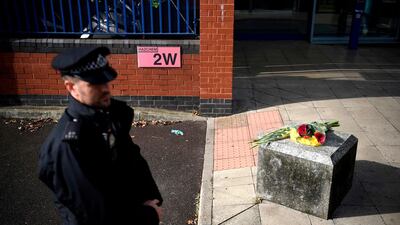
A police officer stands near flowers placed outside the Croydon Custody Centre in south London on September 25, 2020, following the shooting of a British police officer by a 23-year-old man being detained at the centre. A British police officer was shot dead in the early hours of Friday morning, Scotland Yard said, the first officer to be killed by gunfire while on duty in over eight years. / AFP / DANIEL LEAL-OLIVAS -
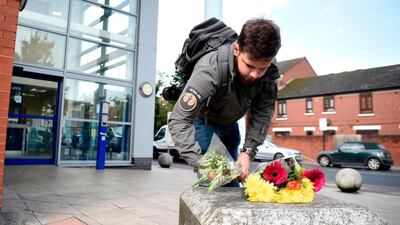
A well-wisher places flowers outside the Croydon Custody Centre in south London on September 25, 2020, following the shooting of a British police officer by a 23-year-old man being detained at the centre. A British police officer was shot dead in the early hours of Friday morning, Scotland Yard said, the first officer to be killed by gunfire while on duty in over eight years. / AFP / DANIEL LEAL-OLIVAS -
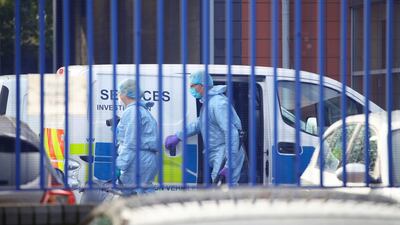
Forensic officers at the scene, at Croydon Custody Centre where a police officer was shot in the early hours of Friday, Sept. 25, 2020, in Croydon, England. A British police officer has been shot dead inside a London police station while detaining a suspect. London’s Metropolitan Police force said the officer was shot at the Croydon Custody Center in the south of the city early Friday. (Aaron Chown/PA via AP) -

A police officer stands outside Croydon Custody Centre where a police officer was shot in the early hours of Friday, Sept. 25, 2020, in Croydon, England. A British police officer has been shot dead inside a London police station while detaining a suspect. London’s Metropolitan Police force said the officer was shot at the Croydon Custody Center in the south of the city early Friday. (Aaron Chown/PA via AP) -
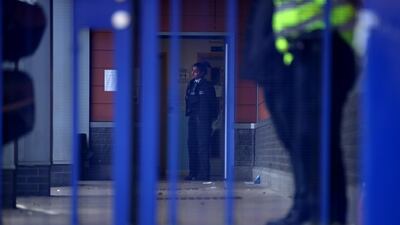
LONDON, ENGLAND - SEPTEMBER 25: Police officers stand guard at Croydon Custody Centre on September 25, 2020 in the Croydon area of London, England. A murder investigation has been launched following the death of a police officer at the Croydon Custody Centre in south London. He was shot by a 23-year-old man who was also treated for a gunshot wound. The officer died later in hospital. The death will be investigated by the Independent Office for Police Conduct. (Photo by Dan Kitwood/Getty Images) -
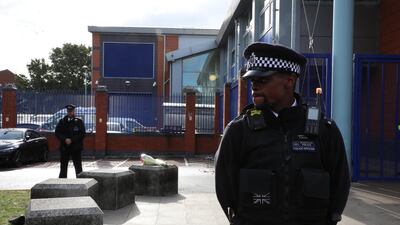
LONDON, ENGLAND - SEPTEMBER 25: A police officer stands guard at Croydon Custody Centre on September 25, 2020 in the Croydon area of London, England. A murder investigation has been launched following the death of a police officer at the Croydon Custody Centre in south London. He was shot by a 23-year-old man who was also treated for a gunshot wound. The officer died later in hospital. The death will be investigated by the Independent Office for Police Conduct. (Photo by Dan Kitwood/Getty Images) -
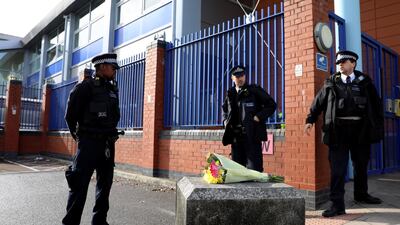
LONDON, ENGLAND - SEPTEMBER 25: Flowers are left at Croydon Custody Centre after a police officer was shot dead on September 25, 2020 in the Croydon area of London, England. A murder investigation has been launched following the death of a police officer at the Croydon Custody Centre in south London. He was shot by a 23-year-old man who was also treated for a gunshot wound. The officer died later in hospital. The death will be investigated by the Independent Office for Police Conduct. (Photo by Dan Kitwood/Getty Images) -
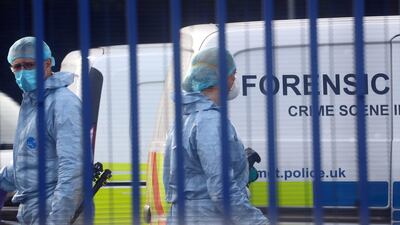
Forensic specialists are seen at the custody centre where a British police officer has been shot dead in Croydon, south London, Britain, September 25, 2020. REUTERS/Hannah McKay -
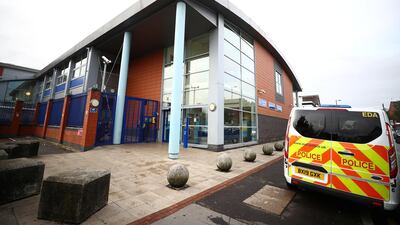
A general view of the custody centre where a British police officer has been shot dead in Croydon, south London, Britain, 25 September 2020. REUTERS/Hannah McKay


No police firearms were discharged during the attack, Scotland Yard said.
Police said the shooting has been referred to the Independent Office for Police Conduct, which will hold an investigation.
Commissioner Dick said investigators were examining several crime scenes.
“This is a truly shocking incident in which one of our colleagues has lost his life in the most tragic circumstances,” she said.
“When a colleague dies in the line of duty the shockwaves and sadness reverberates throughout the Met and our communities.”
Prime Minister Boris Johnson said: “My deepest condolences go to the family, friends and colleagues of the police officer who was killed in Croydon last night.
“We owe a huge debt to those who risk their own lives to keep us safe.”
Ratana is the first British police officer killed in the line of duty after Andrew Harper last year.
Harper was dragged to his death after becoming caught in a tow rope while responding to reports of a stolen quad bike.
Debbie Adam, Harper’s mother, said of the latest tragedy: “My feelings on hearing the news of this poor officer just stirs up the experience you will only know if you have been through it.
“I can identify with how this poor officer’s family, friends and colleagues will feel, the disbelief, shock and total loss.
“I just wish I could take that pain away.”
Home secretary Priti Patel said it is “a sad day for our country” when a police officer is killed in the line of duty.
She said: “I’m deeply shocked and saddened by the tragic killing of the officer in Croydon overnight.
“All our thoughts are with the officer’s family, friends and colleagues across the Metropolitan Police force, but also police officers across the country.”
London Mayor Sadiq Khan added that the officer had “paid the ultimate price for helping keep Londoners safe”.
Police officers killed in the line of duty
Andrew Harper – 2019
Killed after responding to a quad bike theft in Berkshire
Keith Palmer – 2017
Stabbed to death outside parliament during the Westminster terrorist attack
David Phillips – 2015
Killed during a police pursuit in Merseyside after the suspect ran him over
Nicola Hughes – 2012
Died in a gun and grenade attack while investigating a hoax burglary in Manchester
Fiona Bone – 2012
Died in a gun and grenade attack while investigating a hoax burglary in Manchester
Ian Dibell – 2012
Shot and killed in Essex while intervening in a dispute near his home while off-duty

