
Italy and Spain are expected to be the greatest beneficiaries of a proposed €750bn (Dh3 trillion) Covid-19 bailout, each eligible for around €170bn and €140bn respectively.
News of the fund, which is aimed at staving off the 27-member bloc’s deepest ever recession, has provoked reactions ranging from praise to quiet dissent among European nations.
EU members have wrangled for weeks over the terms of the financial recovery with southern countries like Spain and Italy, the two nations hardest hit by the pandemic, also the most vocally in favour of a speedy and comprehensive bailout.
Rome is expected to take the lion’s share of the fund, with €82bn in grants and another €90bn in loans. Madrid is expected to receive more than €77bn in grants and over €63bn in loans.
The principal point of friction in discussions over the recovery fund has related to conditions attached to the €500bn in grants, proposed by Germany and France, which essentially pool EU debt for the first time.
The grants will not just be handed over. Applying countries will have to outline their aims for the money and what reforms they intend to undertake to ensure their economies are more resilient in the future.
-
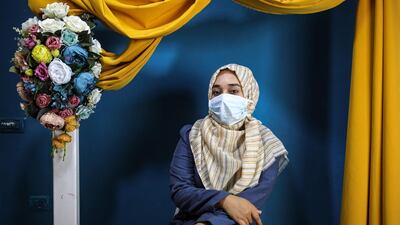
A woman poses for a commemorative picture at Palestinian photoghrapher Faten Issa's studio in Rafah in the southern Gaza Strip. AFP -
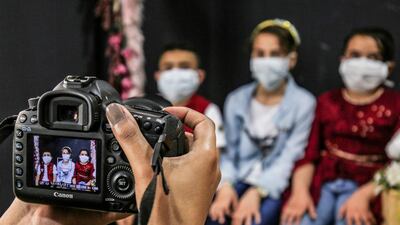
Children pose for a picture at Palestinian photoghrapher Faten Issa's studio in Rafah in the southern Gaza Strip. AFP -
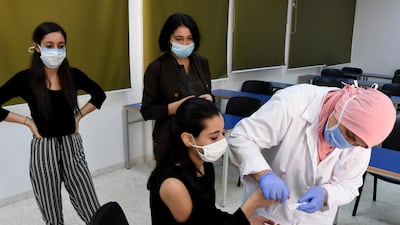
An employee of the Tunisian Health ministry takes a blood sample to test a student for Covid-19 in a school of Tunis. AP Photo -
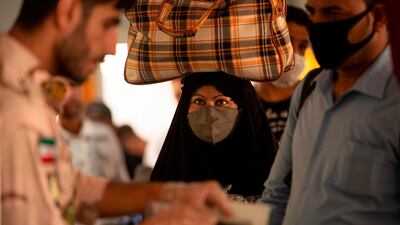
An Iraqi woman who had been stranded in Iran due to the pandemic, looks on as a soldier questions another man upon her arrival at the Al-Shalamija border crossing, west of Basra. AFP -
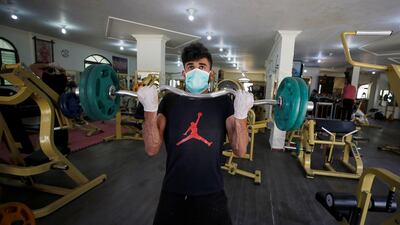
A man lifting weights trains in a gym as Palestinians ease coronavirus restrictions, in Gaza City. Reuters -
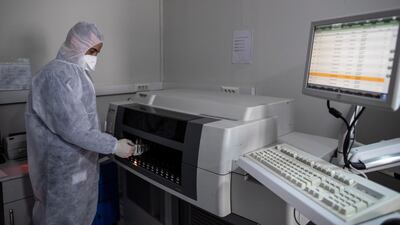
A health worker works on blood specimen to test for the coronavirus at the Istanbul University hospital in Turkey. EPA -
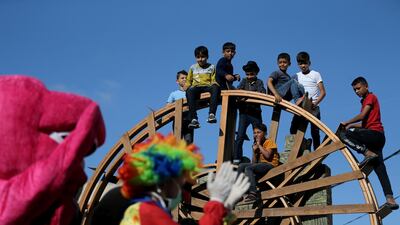
Children watch as a clown and men wearing costumes ride in a classic car to entertain Palestinians in the southern Gaza Strip. Reuters -
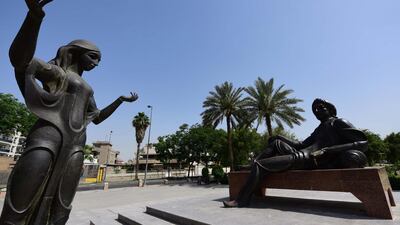
The Shahrazad and Prince Shahrayar statue in the deserted Abu Nawas park in Baghdad, Iraq. EPA -
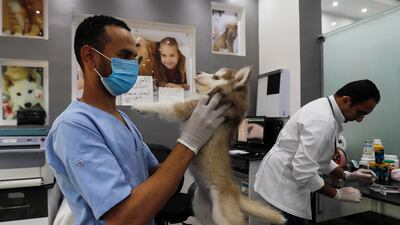
A veterinary assistant holds a three-month-old female Siberian Husky at the Animalia Veterinary Clinic in Cairo, Egypt. Reuters -

The streets are crowded with cars and people a day after the government's decision to lift the nightly curfew completely in Damascus, Syria. EPA -
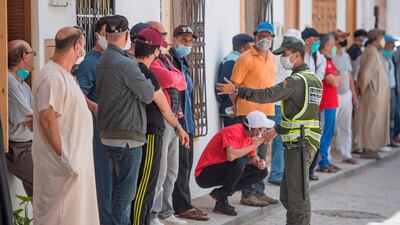
A member of Morocco interior ministry's auxiliary forces assists taxi drivers as they queue for coronavirus testing in the capital Rabat. AFP -
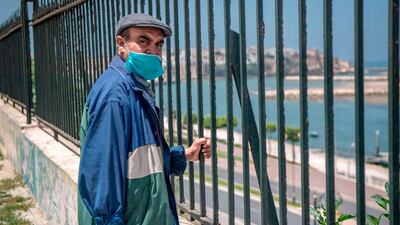
A taxi driver looks on before getting tested for the coronavirus in Morocco's capital Rabat. AFP -
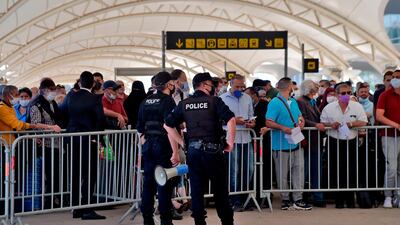
Passengers waiting to board a repatriation flight from the Algerian capital Algiers to France listen to instructions at the entrance of the terminal. AFP -
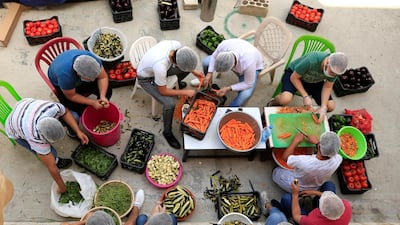
Volunteers prepare food for distribution to people in need in the port city of Sidon, Lebanon. Reuters -

Worshippers pray outside a closed mosque in the port city of Sidon, Lebanon. Reuters -
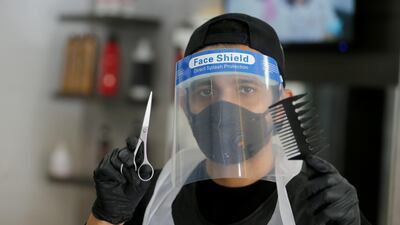
A barber poses for the camera at his shop after its reopening in Isa Town, Bahrain. Reuters


Speaking on Thursday, EU Economics Commissioner Paolo Gentiloni explained the money provided to Italy would tackle the economic crisis caused by coronavirus but, in the medium term, the government would have to reduce its high public debt.
"Now Italy has to spend [the money] but in the medium to long term the country needs to return to a more manageable debt path because otherwise it risks ending up in difficulty in the next years," Mr Gentiloni told Italian radio.
Fears by bore fiscally conservative northern nations in the EU, such as the Netherlands, Sweden, Denmark and Austria that that they will have to foot the bill for southern countries like Spain and Italy that are perceived as being financially more profligate has been one of the major stumbling blocks in recent negotiations.
The four nations have been critical of the recovery fund proposed by European Commission President Ursula Von der Leyen on Wednsday. Swedish Prime Minister Stefan Lovfen has questioned the distribution of grants without repayment, saying the sums remained “too large”.

Austrian Chancellor Sebastian Kurz has indicated he might be willing to negotiate further on the fund, calling it a “starting point”.
The proposal appears largely in line with a plan unveiled earlier this month by Germany and France, the two most dominant powers in the EU. Their agreement on the one-time €500 billion fund, was seen as a major political breakthrough due to Berlin's acceptance of shared debt between member countries.
French President Emmanuel Macron tweeted that the unveiling of the fund marked an “essential day for Europe,” adding that “the Franco-German agreement allowed this advance”.
German Chancellor Angela Merkel, by contrast, declined to offer an early verdict on the plan’s chances of success.
As she unveiled the plan, Ms Von der Leyen told EU lawmakers the proposal signified a new direction for the bloc.
"Our unique model built over 70 years is being challenged like never before in our history," she said.
"We either all go alone, leaving countries, regions and people behind, and accepting a Union of haves and have nots. Or we take that road together, we take that leap forward. For me, the choice is simple. I want us to take a new bold step together," the commission head added.

