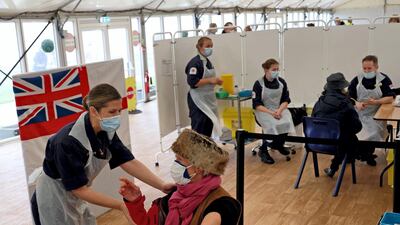
Germany has recommended the Oxford/AstraZeneca vaccine should only be given to people aged under 65.
The country’s vaccine committee said there was insufficient data to prove the medicine was effective among older people.
The European Medicines Agency is expected to make a decision on whether to approve AstraZeneca's Covid-19 vaccine on Friday.
Germany's surprise recommendation came a day after AstraZeneca's factory in Belgium was raided by investigators.
The EU's executive branch requested the investigation due to doubts over AstraZeneca's explanation of an expected shortfall in vaccine deliveries to the bloc.
The pharmaceutical company blamed production issues at the Brussels plant for the shortages.
The Belgian federal medicines agency took samples and records from the plant on Wednesday and a further inspection of the facility is expected in the coming days.
The EU requested some British-manufactured AstraZeneca vaccines be redirected to Europe but the company declined.
In a move that could prevent millions of doses from entering Britain, the EU said on Thursday it would give national regulators the power to block vaccine exports if they are not "legitimate".
European Council President Charles Michel welcomed the move, saying: "The EU needs to take robust action to secure its supply of vaccines and demonstrate concretely that the protection of its citizens remains our absolute priority."
The criteria for blocking exports is set to be published on Friday. UK ministers earlier insisted there would be no interruption to vaccine supplies.
"It is the case that the supplies that have been planned, paid for and scheduled should continue," UK Cabinet Office minister Michael Gove said.
The shot is currently being delivered to people in the UK aged 18 and over.
But the German health ministry said: "There are currently insufficient data available to assess the vaccine efficacy from 65 years of age.
"The AstraZeneca vaccine, unlike the mRNA vaccines, should only be offered to people aged 18-64 years at each stage."
AstraZeneca disputed the German regulator's findings said the latest clinical trial data for its vaccine "support efficacy in the over 65 years age group".
Prime Minister Boris Johnson said the UK's regulators had concluded that the AstraZeneca/Oxford shot was "very good and efficacious".
"It gives a high degree of protection after just one dose, even more after two doses. And the evidence that they've seen, that they've supplied, is that they think it is effective across all age groups, providing a good immune response across all age groups," he said.
"So I don't agree with that."
German media reports this week said officials feared the vaccine may not be approved in the EU for use in the elderly.
The same media reports also suggested German officials believed the efficacy rate among over-65s could be as low as 8 per cent.
The claim was refuted by AstraZeneca and the German government, which suggested the efficacy rate could have been confused with the number of participants aged 56 to 69 in clinical trials, which was about 8 per cent.
The German health ministry said of the 341 people vaccinated in the group aged 65 and over in Oxford's clinical trials only one became infected with coronavirus, meaning the vaccine committee had not been able to derive a statistically significant statement.
AstraZeneca chief executive Pascal Soriot said the company had less data than other drug makers on the elderly because it started vaccinating older people later.
"But we have strong data showing very strong antibody production against the virus in the elderly, similar to what we see in younger people," he told Die Welt newspaper this week.
Meanwhile, police arrested a 53-year-old man from Kent, in southern England, over a suspicious package that was sent to a factory that manufactures doses of the AstraZeneca vaccine.
The factory in Wales was evacuated but workers were able to return to the site after police cleared the package.
"There is no evidence to suggest there is an ongoing threat," police said.
In pictures - coronavirus around the world
-
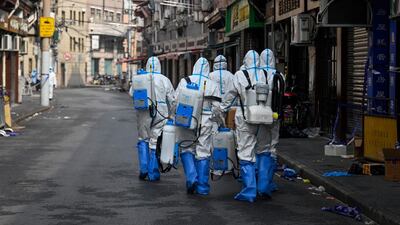
Health workers in protective gear prepare to spray disinfectant in a blocked off area in Shanghai's Huangpu district, after residents were evacuated following the detection of a few cases of COVID-19 coronavirus in the neighbourhood. AFP -
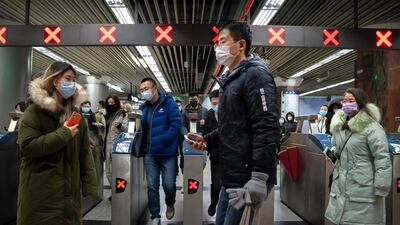
People wearing face masks to protect against the spread of the coronavirus walk through a subway station in Beijing. China has given more than 22 million COVID vaccine shots to date as it carries out a drive ahead of next month's Lunar New Year holiday, health authorities said Wednesday. AP -

A health officer checks a woman temperature body as they evacuated villagers to a temporary evacuation center after mount Merapi spew pyroclastic smoke in Yogyakarta, Indonesia. Getty Images -

People wait to refill oxygen tanks for relatives sick with COVID-19 in the Iztapalapa district of Mexico City. The city is offering free oxygen refills for patients with COVID-19. AP -

Around 20 members of the Thurgau Civil Defence are converting the MS Thurgau, a Lake Constance ship, into a vaccination ship, in Romanshorn, Switzerland. From 02 February onward, up to 170 people per day will be vaccinated here by the Hirslanden private hospital group at the ports of Kreuzlingen, Romanshorn and Arbon. EPA -

Tunisian medical staff attend coronavirus patients at the intensive care unit of the Ariana Abderrahmen Mami hospital in the city of Ariana near the Tunisian capital Tunis, during the Covid-19 pandemic crisis. AFP -
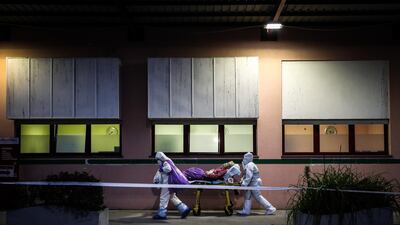
Paramedics transport COVID-19 patients from Amadora Sintra Hospital to Luz Hospital in Lisbon, in Amadora, Portugal, due to the rising of hospitalizations. The Amadora-Sintra Hospital moved a team of doctors, nurses and auxiliaries to accompany the 19 patients who are being transferred to the infirmary that will open at Hospital da Luz in Lisbon. EPA -

Pallbearers stand next to coffins of three top government officials at their burial at the National Heroes acre in Harare. Zimbabwe on Wednesday buried three top officials who succumbed to COVID-19, in a single ceremony at a shrine reserved almost exclusively for the ruling elite as a virulent second wave of the coronavirus takes a devastating toll on the country. AP -
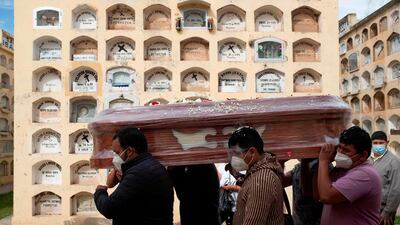
Relatives of a Covid-19 victim carry a coffin at the General Cemetery in the central city of Huanuco, 370 kilometers northeast of Lima. Sixteen million Peruvians will enter a two-week coronavirus lockdown covering a third of the country at the end of January, Peru's interim president said Tuesday. The South American nation's healthcare system has been overwhelmed by the Covid-19 pandemic, with only 500 intensive care beds for a population of 32 million, with authorities reporting a spike in deaths as infections increase. AFP



