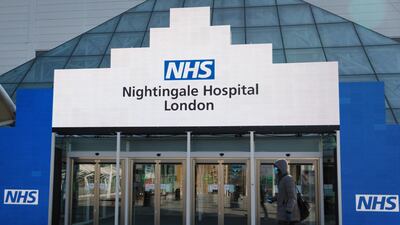
Unregistered refugee doctors living in Britain, many from the Middle East, can now play a part in fighting the Covid-19 pandemic as medical support workers in the UK.
RefuAid, which supports refugees in Britain, said it knew of 514 medics who fled conflict or persecution abroad to settle in the UK, but were not permitted to work.
Although these people are qualified medics in their home countries, some cannot register to work as doctors in the UK because they have not taken a final exam, which was cancelled after the coronavirus outbreak.
The General Medical Council, which represents doctors in the UK, said on Thursday that qualified doctors who were refugees in the UK could now sign up to be medical support workers in Britain’s National Health Service (NHS).
More than 100 refugee doctors have signed up for the scheme and will start work in the next 10 days, Anna Jones, the founder of RefuAid, told The National.
Many of the healthcare professionals are surgeons, from countries including Syria, Sudan, Iran, Iraq, and Turkey. On average, they have 7.5 years of medical experience.
“We've got at least four anaesthetists … which is what the hospitals need right now. Our medical workers have worked in conflict settings where there is a lack of resources and they're under a lot of pressure,” Ms Jones said.
The scheme allows doctors who passed English tests to do some clinical tasks under supervision. Forty-eight refugee doctors have opted to take intensive English language courses so they can apply for the NHS role within three months, Ms Jones said.
Medical support workers will undertake a range of essential routine clinical tasks under supervision, according to NHS England’s website.
“This role may be used to support medical staff in GP practices, critical care units or in other secondary or community care settings,” NHS England said.
Although the new role falls short of allowing refugees to work officially as doctors, RefuAid is pushing for alternative ways for them to pass their final exams and be able to work in the UK.
Dr Ahmad Al Qassab, 45, a surgeon from Baghdad, arrived in the UK in May 2015 before getting refugee status later that year. He has passed all his medical exams except the final one - PLAB 2 exam - which the UK government cancelled amid the coronavirus crisis.
He graduated from the medical school in 1999 and has worked his way up from junior doctor to specialising as an orthopaedic surgeon. He has worked in A&E departments in war zones.
-

Sailors move a patient aboard the hospital ship USNS Mercy in Los Angeles, California. Reuters -

Young boys walk through a pile of garbage looking for plastic waste in the Mathare slum in Nairobi, Kenya. EPA -

An aerial photo shows people in vehicles lined up to receive iPads and Chromebook laptop computers for students to use in remote learning at Indian Hills Elementary School in Round Lake Heights, Illinois. EPA -

A view shows the deserted Place Vendome in Paris. Reuters -

91-year-old twins Jackie Voskamp and Joyce Kriesmer,, wave from their balcony at the Vi at La Jolla Village senior complex in San Diego, California. Reuters -

A food delivery courier wearing a face mask and protective gloves takes a nap while riding on a metro train in Moscow. AFP -

A staff member is seen inside a convention centre that was used as a makeshift hospital to treat patients in Wuhan, Hubei province, China. Reuters -

People wearing face masks exercise on a street in Wuhan, Hubei province. Reuters -

Bed frames are seen inside a convention centre that was used as a temporary hospital in Wuhan. Reuters -

An aerial view showing the almost empty coastline avenue of Montevideo, known as La Rambla, and the Uruguay Golf Club. AFP -

A priest wearing a face mask gives confession to a believer in a car park in Warsaw. AFP -

Lily Haines, left, celebrates her sixteenth birthday on her apartment balcony in Los Angeles, California. Reuters -

Hospital beds are seen in a chapel inside the Cathedral Church of St. John the Divine for what will be a temporary field hospital in New York City. Reuters -

Policemen detain a man for violating a curfew in El Callao, on the outskirts of Lima, Peru. AP Photo -

Soldiers carry boxes with food to deliver to the poor at the Santa Rosita neighborhood on the outskirts of Guatemala City. AP Photo -

A video screen displays a message urging people to stay home in a nearly deserted Piccadilly Circus in London. AP Photo -

Drivers wait at a drive-through testing station in Westminster, California. EPA


"I am ready to help in any way the NHS asks me to," he told The National. "The GMC recently started to register final year students months before their graduation, so why are refugees being treated differently?"
Many refugee doctors are able to work in other countries but the UK has been more hesitant.
“GMC and UK decision-makers should use what they have on UK soil, and refugee doctors like us would make a change at least by helping the tired NHS workers,” he said.
“I got news that 100 doctors died in Italy alone, so it is an important time for them to find a way to acknowledge what we can do.”

