
Countries that are considering lifting social restrictions after the coronavirus appeared to have peaked must do so slowly to avoid risk of resurgence, the head of the World Health Organisation warned on Monday.
“While Covid-19 accelerates very fast, it decelerates much more slowly,” said Dr Tedros Adhanom Ghebreyesus, director general of the WHO.
"In other words, the way down is much slower than the way up. That means control measures must be lifted slowly and with control. It cannot happen all at once.”
Dr Tedros said they should only be lifted if the right public health measures were in place, including significant ability for contact tracing.
He said that in poor countries, orders to stay at home and other restrictions used in richer countries might not be practical.
Many poor people, including migrants and refugees, are already living in overcrowded conditions with few resources and not much access to health care.
Dr Tedros said that human rights should not be abandoned by countries when implementing Covid-19 social restrictions.
-
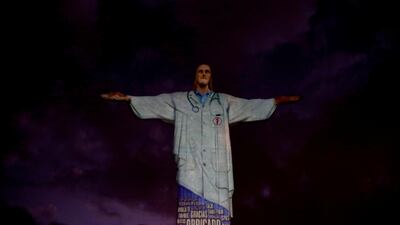
The statue of Christ the Redeemer is lit up with the image of a medical scrub and the word "thank you" in different languages during an Easter Sunday event in Rio de Janeiro, Brazil. Reuters -

People cross a makeshift barrier in Las Pinas, south of Manila, Philippines. EPA -
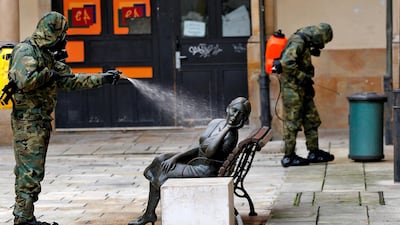
A soldier desinfects the sculpture 'La Bella Lola' in Oviedo, northern Spain. EPA -
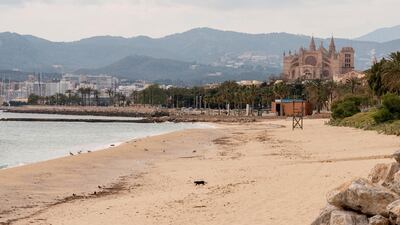
The Can Pere beach is empty in Palma de Mallorca, Balearic Islands, Spain. EPA -
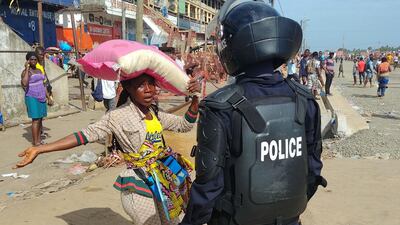
A police officer chases shoppers to clear the streets on the first day of lockdown in Monrovia, Liberia. Reuters -

Italian tenor and opera singer Andrea Bocelli sings during a rehearsal on a deserted Piazza del Duomo in central Milan. AFP -
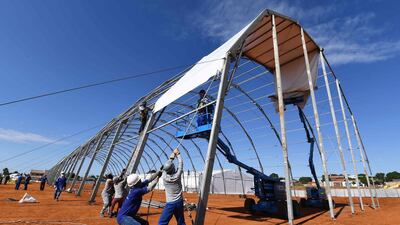
Labourers work at the construction site of a field hospital for people infected with the new coronavirus in Aguas Lindas, Goias State, Brazil. AFP -
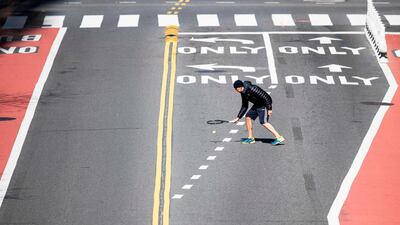
A man plays tennis on 42nd Street in New York City. AFP -
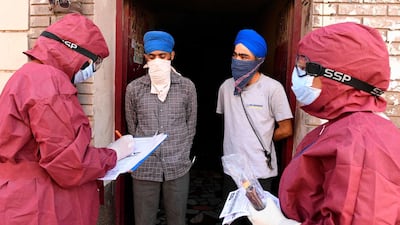
Medical staff wearing protective gears visit a residential area to screen residents in the wake of COVID-19 coronavirus outbreak, during a government-imposed nationwide lockdown as a preventive measure against the COVID-19 coronavirus in Amritsar. AFP -
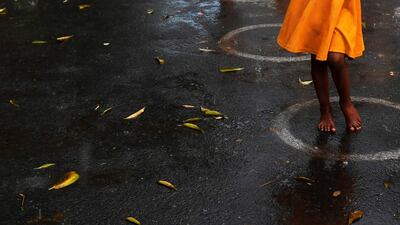
A young girl stands in queue to collect food in the rain in Kolkata. AFP -
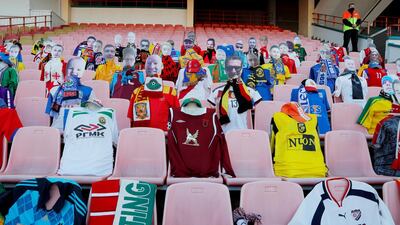
Dummies replace spectators during Dynamo Brest v Isloch Minsk in the Belarus football league. Reuters -
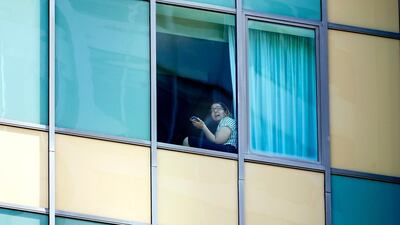
A quarantined traveller looks from a window at the Voco Hotel in Surfers Paradise, Queensland, Australia. EPA -
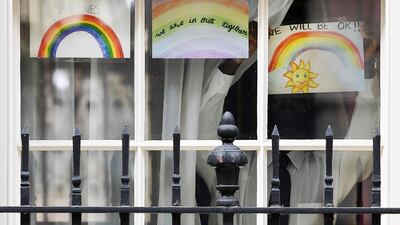
A child places a rainbow drawing in the window of No 10 Downing Street in London, Britain. EPA -
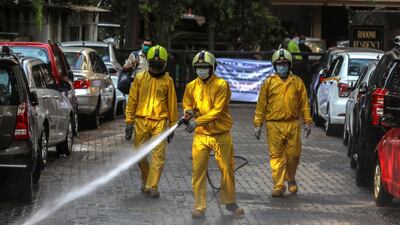
Members of a municipal fire brigade spray disinfectant in Mumbai, India. EPA


“Each government must assess their situation while protecting all of their citizens, and especially the most vulnerable,” he said.
To support these countries, the WHO will publish its latest coronavirus advice on Tuesday.
Dr Tedros said that to life restrictions, virus transmission must be controlled, and the health system must be able to detect, test, isolate and treat every case and trace every contact.
Outbreak risks must also be minimised in special settings such as health facilities and nursing homes, he said.
Preventive measures must be enforced in workplaces, schools and other necessary places for people, where the risk of bringing in the coronavirus can be managed.
Communities also need to be fully educated, engaged and empowered to adjust to the “new norm”, Dr Tedros said.
Our global connectedness means the risk of reintroduction and resurgence of the disease will continue,” he said.
“Ultimately, the development and delivery of a safe and effective vaccine will be needed to fully interrupt transmission,” Dr Tedros said.
As part of the WHO’s response to the outbreak, a research blueprint has been introduced to more quickly develop diagnostics, vaccines and therapies for the virus.
Under the WHO’s co-ordination, a group of experts from all over the world will work on a vaccine.
"We will continue efforts to strengthen the unprecedented worldwide collaboration, co-operation and sharing of data already under way," the experts said.
"We believe these efforts will help to reduce inefficiencies and duplication of effort, and we will work tenaciously to increase the likelihood that one or more safe and effective vaccines will soon be made available to all."
Dr Tedros thanked the UK for its contribution of £200 million (Dh919.8m/US$250.4m) to the global response to Covid-19.
“The way forward is solidarity: solidarity at the national level, and solidarity at the global level,” Dr Tedros said.
US President Donald Trump has criticised the UN agency’s handling of the pandemic and threatened to cut off funding for it.
US Secretary of State Mike Pompeo is due to make recommendations this week for Mr Trump to sanction the organisation, which he accuses of knowing about the pandemic months before it broke.
Despite this, Dr Tedros on Monday voiced confidence that the US would continue to fund the WHO.
"What I know is that he is supportive and I hope that the funding to WHO will continue," he said.
"The relationship we have is very good and we hope that this will continue."

