
Germany plans to loosen quarantine restrictions for travellers arriving from the European Union and Britain, the country’s Interior Ministry has said.
In the future, the spokesman said, the government will only recommend travellers go into quarantine if they arrive from countries with elevated numbers of infections in the EU.
A mandatory two-week quarantine still applies for travellers from countries outside the EU with the exception of Britain, which formally left the 27-member bloc earlier this year.
Germany’s move on relaxing travel restrictions comes as nations across Europe make plans for greater internal movement.
French Prime Minister Edouard Philippe has promised the French public that they will be able to go on holiday in France from July as he announced a comprehensive recovery plan for the tourist sector.

Mr Philippe emphasised that the plans could be subject to some localised restrictions. At present, travel is limited in France to within 100 km of people’s homes.
In areas where the spread of coronavirus is low, authorities in France also said bars, cafes and restaurants would reopen on June 2. Further announcements are expected on May 25 for details about the easing of lockdown restrictions.
All travel into France is currently heavily restricted, with only essential travel allowed and everyone needing an international travel certificate to cross the border. These restrictions will stay in place until at least June 15th, the French government announced last week.
In Italy, free travel across the country is due to begin on June 3. According to a draft decree all movement within separate regions will be allowed from May 18, with inter-regional travel bans due to be lifted at the beginning of June date.
The end to travel limitations will represent a major milestone on Italy's road to recovery, with the government hoping to salvage the forthcoming holiday season, when Italians traditionally escape the cities for their annual summer breaks.
-
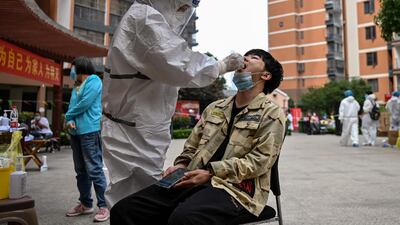
A medical worker takes a swab sample from a man in a neighborhood in Wuhan, in China’s central Hubei province. AFP -

Pupils observe social distancing rules in the playground in Edegem, near Antwerp. AFP -
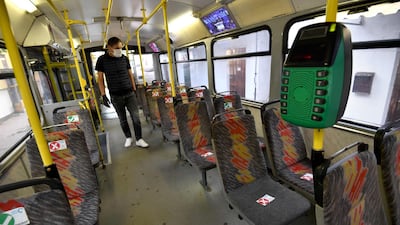
A driver checks social distancing markers on the seats of his tram, before leaving the garage in Sarajevo, Bosia. AFP -
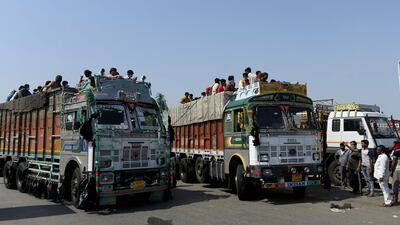
Migrant workers on the outskirts of Hyderabad travel on a lorry to return to their hometowns. AFP -
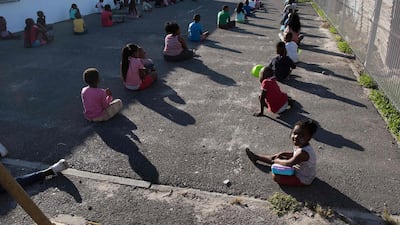
Children wait in lines at a crèche in Langa, near Cape Town. AFP -

Men wearing protective overalls and mask sanitise St Peter's Basilica in The Vatican. AFP -
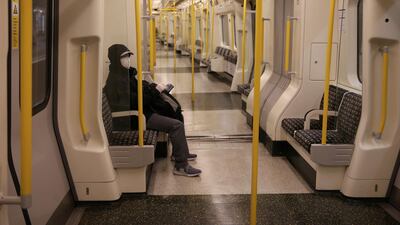
Tube commuters wearing PPE travel during the evening 'rush hour' on the Circle Line, in central London. AFP -
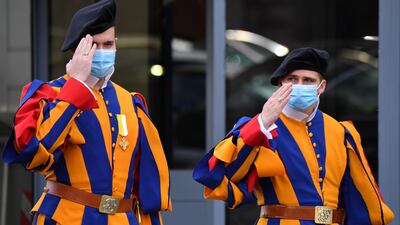
Swiss Guards wearing a face mask give a salute as they stand guard at an entrance of The Vatican. AFP -
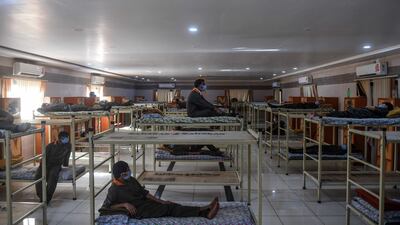
Labourers take a break in their quarters maintaining social distancing at DH Cube Industries, a heavy manufacturing factory, at Vasna Buzarg village, some 40km from Ahmedabad. AFP -
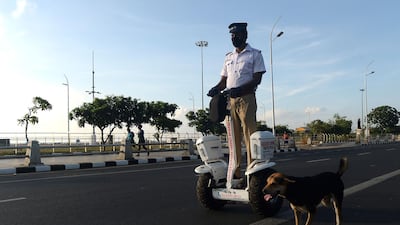
A traffic police officer rides a self-balancing scooter in Chennai. AFP -
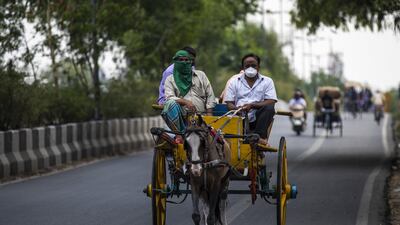
A horse drawn carriage takes passengers along a road during a partial lockdown imposed due to the coronavirus in New Delhi, India. Bloomberg -
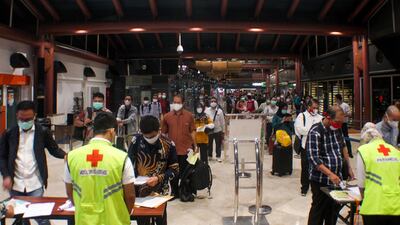
Airport health officials at a check point at Soekarno-Hatta Jakarta International airport in Tangerang. AFP -
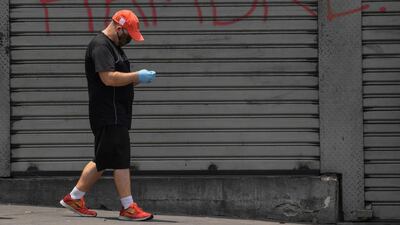
A man wearing a face masks, as a preventive measure against the spread of the new coronavirus, COVID-19, walks by a graffiti reading "Hunger", in Caracas. AFP -
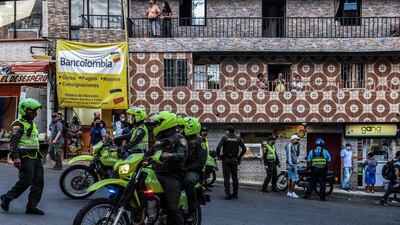
Police officers are seen during a raid at Santo Domingo neighborhood amid the new COVID-19, coronavirus pandemic, in Medellin, Colombia. AFP


The country's factories were allowed to start up on May 4 and shops are scheduled to reopen on Monday.
The European Union has pushed for a gradual reopening of borders within the 27-member bloc.
On Wednesday Chancellor Angela Merkel said it was her goal to reopen borders across the Shengen area from June 15.
"The goal is, if the occurrence of infections allows it -- I want to say that again -- that from June 15, border controls in the Schengen area can be completely eliminated," Ms Merkel said.
However, different European nations have been resistant to opening borders. Austria, for instance has resisted reopening borders with Italy while saying it would allow for its borders with Germany, Switzerland, Liechtenstein and its eastern neighbours.
Britain, which announced it would place a 14-day quarantine on travellers arriving to the country last week, is working out details for an exemption for travellers from France. British Prime Minister Boris Johnson and French President Emmanuel Macron discussed the possibility of a mutual agreement on from quarantine measures last week.

