



Elite Russian airborne troops have been lured into fighting around the town of Bakhmut, allowing Ukraine to break through the front line elsewhere, a leading military think tank has reported.
Moscow’s “irrational fixation” with the north-eastern Ukrainian town it seized at immense cost in May has led to its best troops being concentrated and killed around Bakhmut, the Institute for the Study of War report said.
This has allowed Ukrainians to break through the southern front, most notably around the settlement of Robotyne, with Russia’s VDV airborne troops belatedly rushed in to hold the line last month.
VDV commanders are also becoming increasingly frustrated by Moscow’s decision to use their paratroopers as standard infantry in trenches around Robotyne to hold up the advance, Britain’s Ministry of Defence said.
“The current situation is likely to be seen as highly unsatisfactory by the VDV hierarchy,” it wrote on X, formerly Twitter.
“Throughout the war Russian commanders have attempted to regenerate the airborne forces as a highly mobile, striking force for offensive operations. Once again, they are being used as line infantry to augment overstretched ground forces.”
It also reported that at least five VDV regiments had now been sent to Robotyne. But while this would normally number “10,000 elite paratroopers”, given their losses in nearly 19 months of fighting, “all units are highly likely dramatically under strength”.

Irrational fixation
The ISW special report commended Kyiv’s decision to focus on Bakhmut, saying that it had been subjected to “much unwarranted criticism” and opposition from some western advisers.
Instead the decision had “fixed a large portion” of Russia’s airborne forces and thus “increased Ukraine’s chances of operational success”, it said.
“The Ukrainians took advantage of Russia’s irrational fixation with the operationally insignificant town of Bakhmut to draw the highest-quality mobile Russian reserves there,” the Washington think tank stated.
The Bakhmut decision had held down a large amount of Russian combat power that could have been used in the Robotyne area and reflected “sound campaign design principles”.
“This significant Ukrainian achievement has helped prevent Russia from creating a large mobile VDV [airborne] operational reserve that could have been used to stop the main Ukrainian counter-offensive effort in Zaporizhzhia Oblast,” the report said.

Airborne casualties
Bakhmut was finally taken by the Wagner group of mercenaries following months of attritional fighting with the loss of 20,000 of its troops, many of them convicts.
But once the town was taken Wagner precipitately pulled out and were replaced by VDV members, who were forced to hold the line against Kyiv’s counter-offensive.
There is now a suggestion that Russia is “running out” of elite paratroopers killed in action around Bakhmut after reinforcement of the southern sector by the 41st Combined Arms Army that was “notably not a VDV formation”.
“This lateral redeployment of regular motorised rifle units likely reflects the fact that Russian forces are running out of VDV units to move,” ISW said.
The decision to defend Bakhmut last year and then counter-attack its flanks since the June counter-offensive had tied down two of Russia’s four VDV divisions.
“This is a significant achievement,” the ISW said. “The VDV is Russia’s principal expeditionary force and Russia’s highest mobility combat force.”
Ukraine’s aggressive tactics had caused significant airborne casualties and deprived them of the opportunity not only to regroup and refit but also to be a “high mobility operational” reserve to defend the southern front.

Southern breakthrough
The concentration of any significant proportion of these VDV units in the Robotyne area would likely have made Ukrainian penetration of the lines extremely difficult.
Kyiv’s troops are still battling to get beyond the second and third lines of defence that could get them close enough to cut off Russia’s main line of communication with annexed Crimea.
The lack of any decent reserve has “likely given Ukraine its chance to make significant gains in the south”, the report said.
Russia’s limited mobile combat reserve being committed to Bakhmut meant “more favourable conditions” for Ukraine’s counter-offensive in the south.
But Ukraine will have to continue to “press hard” on Bakhmut to keep the VDV forces pinned down there to prevent them stopping “the decisive Ukrainian effort” around Robotyne.
Pro-Kyiv military bloggers have suggested that Ukraine’s 3rd Storm Brigade encircled and routed the VDV 72nd Brigade, killing three battalion commanders and an intelligence officer when it retook the village of Andriivka, near Bakhmut, at the weekend.
On Monday it was reported that the Ukrainians had also taken Klishchiivka, a village 4km to the north of Andriivka.
One hundred days of the Ukraine counteroffensive - in pictures
-
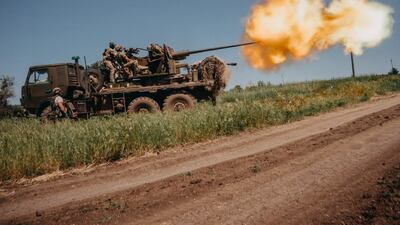
This week marks 100 days of the Ukrainian counteroffensive, which began in the early hours of Sunday, June 4. Getty Images -
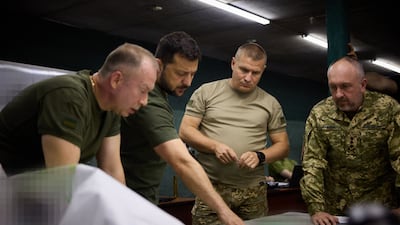
Ukraine's President Volodymyr Zelenskyy visiting brigades engaged in offensive operations in the Bakhmut sector, eastern Ukraine, in Donetsk region, in September. AFP -
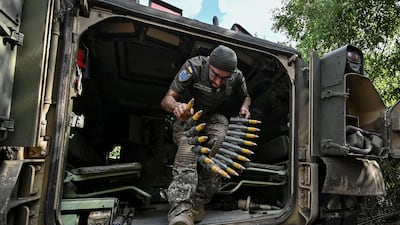
A Ukrainian serviceman of the 47th Magura Separate Mechanised Brigade prepares a M2 Bradley infantry fighting vehicle for combat in Zaporizhzhia region, south-east Ukraine, in September. Reuters -
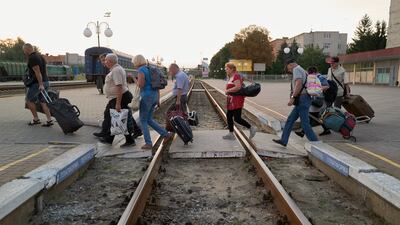
Displaced Ukrainian citizens from Russian-occupied territories board a train to Kyiv from Sumy, north-east Ukraine, in September. Getty Images -
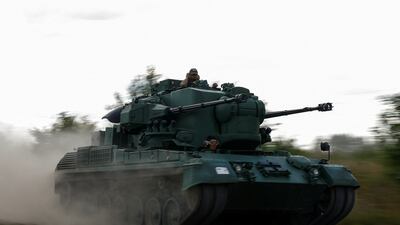
Ukrainian servicemen in a Gepard self-propelled anti-aircraft gun in Zhytomyr region, northern Ukraine, in September. Reuters -
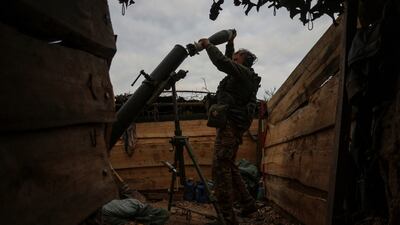
A Ukrainian serviceman loads a shell into a mortar, in Zaporizhzhia region, in September. Reuters -
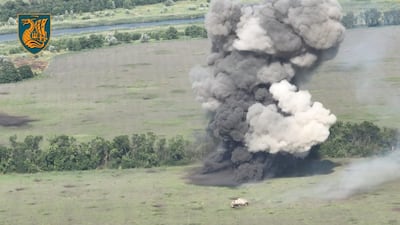
A Ukrainian unit breaches mine defences, near Hulyaipole, in Zaporizhzhia region, in August. Reuters -
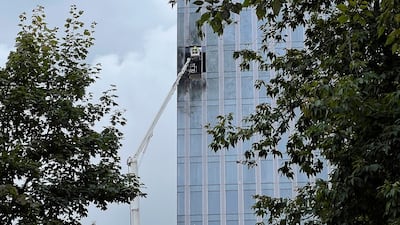
A damaged high-rise in Moscow, following an alleged Ukrainian drone attack, in August. Reuters -
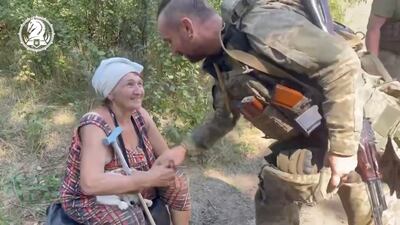
A member of the 47th Magura Separate Mechanised Brigade greets a civilian, in Robotyne, Zaporizhiza region, in August. Reuters -
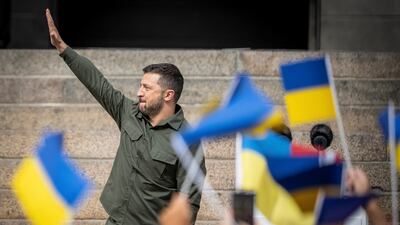
Mr Zelenskyy greets a crowd in front of the Danish Parliament, in Copenhagen, in August. Reuters -
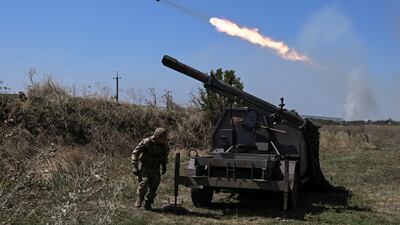
FILE PHOTO: Ukrainian servicemen of the 108th Separate Brigade of Territorial Defence fire small multiple launch rocket systems toward Russian troops, amid Russia's attack on Ukraine, near a front line in Zaporizhzhia region, Ukraine August 19, 2023. REUTERS / Viacheslav Ratynskyi / File Photo -
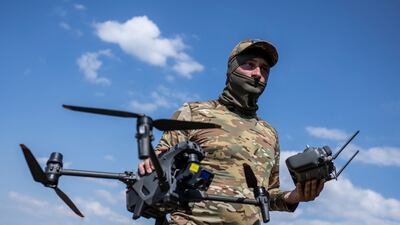
A Ukrainian serviceman carries a drone during training in Zaporizhzhia region, in August. Reuters -
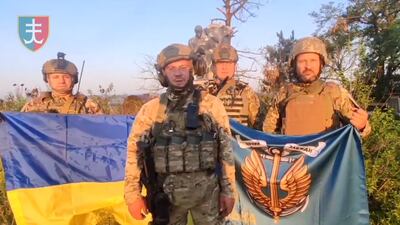
Ukrainian soldiers stand with Ukrainian flag in Urozhaine, Donetsk Region, eastern Ukraine, in August. Reuters -
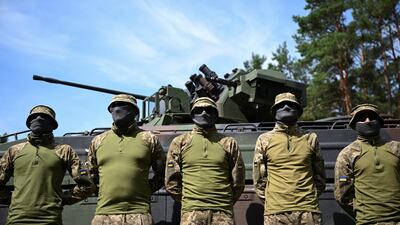
Ukrainian soldiers with a Marder 1A3 armoured fighting vehicle, during a media day of the EU Military Assistance Mission in support of Ukraine in Germany, in August. Reuters -
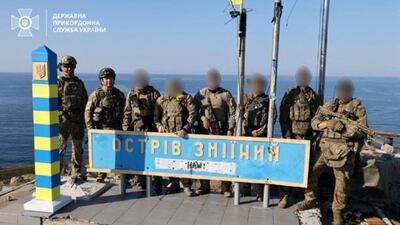
Ukrainian border guards stand next to a border sign on Snake Island in the Black Sea, in August. Reuters -
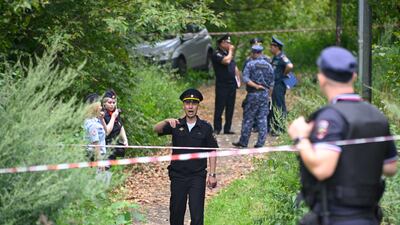
Police at the site where a Ukrainian drone targeting the Russian capital was downed by an air defence system, in western Moscow, in August. AFP -

Ukrainian soldiers with a rocket launcher in Donetsk region, eastern Ukraine, in August. Getty Images -
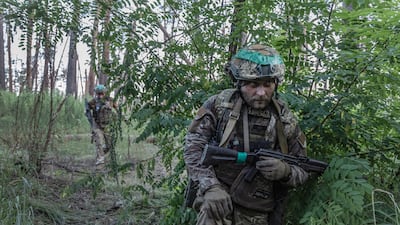
Ukrainian soldiers in Serebryansky Forest, Luhansk region, in eastern Ukraine, in July. Getty Images -
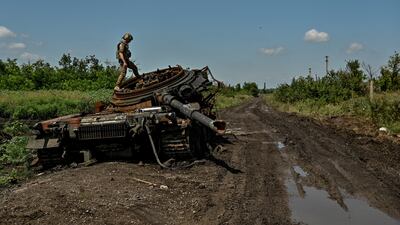
A Ukrainian soldier inspects a destroyed Russian tank in the village of Novodarivka, Luhansk region, in July. Reuters -
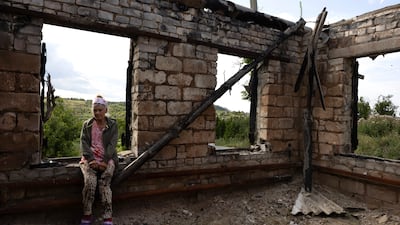
Widow Lubov Doroshenko, 67, returns to her destroyed home in Bohorodychne, Donetsk region, eastern Ukraine, in July. Getty Images -
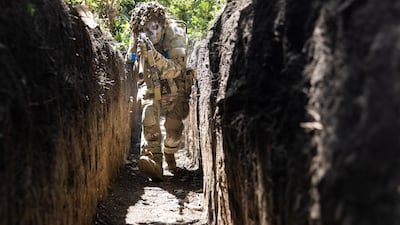
A Ukrainian soldier with the 110th Brigade demonstrates tactical movements in a trench, in Novodarivka, Luhansk region, in July. Getty Images -

A Ukrainian serviceman of the 57th Kost Hordiienko Separate Motorised Infantry Brigade fires a 2S22 Bohdana self-propelled howitzer near the city of Bakhmut, in July. Reuters -

Mr Zelenskyy visits a frontline position in Berdyansk, Zaporizhzhia region, in June. EPA -
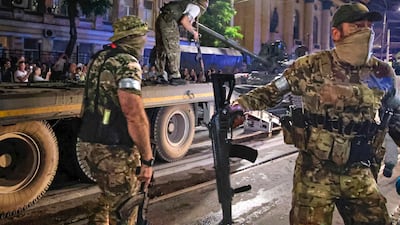
Russian Wagner Group mercenaries on a street in Rostov-on-Don, southern Russia, during a short-lived mutiny in June. AP



