


Nato has extended Secretary General Jens Stoltenberg’s term by a further year, the alliance announced on Tuesday.
As the war in Ukraine continues to rage, the transatlantic military bloc opted to stick with an experienced leader rather than trying to agree on a successor.
Mr Stoltenberg, 64, had been due to step down this year but will now remain in the position until October 1, 2024.
The former prime minister of Norway has been Nato's leader since 2014 and had his tenure extended on three previous occasions.
He said on Tuesday that he was "honoured" by Nato members' decision to offer him more time to lead the alliance.
"Honoured by Nato Allies' decision to extend my term as Secretary General until 1 October 2024," Mr Stoltenberg wrote on Twitter.
"The transatlantic bond between Europe and North America has ensured our freedom and security for nearly 75 years, and in a more dangerous world, our Alliance is more important than ever."
The decision ensures there is continuity at the top of the 31-member alliance as members grapple with a range of challenges.
Under Mr Stoltenberg's stewardship, Nato has walked a careful line between staunch backing for Ukraine and preventing tensions with Russia from spiralling into a nuclear war.
US President Joe Biden welcomed the announcement that Mr Stoltenberg would be staying on, calling the military alliance "stronger, more united and purposeful than it has ever been."
"With his steady leadership, experience, and judgement, Secretary General Stoltenberg has brought our Alliance through the most significant challenges in European security since World War II," Mr Biden said.
Mr Biden is among the Nato heads of state expected to attend the alliance's summit in Vilnius next week. The bloc's response to Russia's war in Ukraine is set to dominate the agenda.
British Prime Minister Rishi Sunak welcomed the news and hailed Mr Stoltenberg's leadership skills.
"Under Jens Stoltenberg's leadership, Nato has evolved to meet new threats, continued to protect our people and has been steadfast in support of Ukraine," Mr Sunak tweeted, adding: "Looking forward to continuing that work together, Jens."
The Prime Minister told his cabinet that Defence Secretary Ben Wallace had been an “outstanding candidate” for the role of Nato secretary-general.
He noted that Mr Wallace was “widely respected among world leaders and the only person at non-leader level to be considered” for the job of leading the alliance.
Mr Stoltenberg secured another 12 months in office after potential successors, including Mr Wallace, failed to gather enough support.
Nato through the years - in pictures
-

British Foreign Secretary Ernest Bevin signs the North Atlantic Treaty in Washington on April 4, 1949. All photos: Getty -
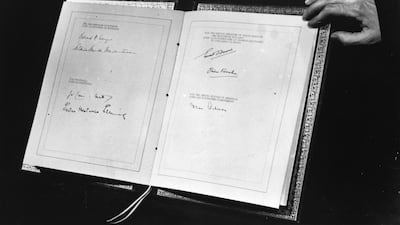
The North Atlantic Treaty showing the signatures of the foreign secretaries and ambassadors of the original signing nations - Belgium, Britain, Canada, Denmark, France, Iceland, Italy, Luxembourg, the Netherlands, Norway, Portugal and the US -
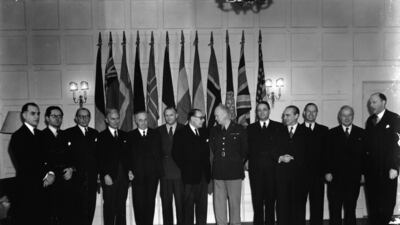
A meeting of the North Atlantic Council deputies in 1951 in London, attended by Gen Dwight D Eisenhower, centre -
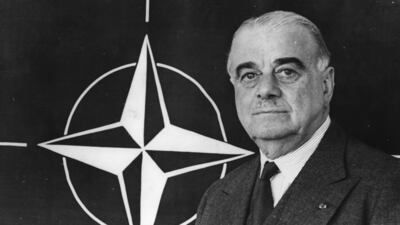
Lord Hastings Lionel Ismay, Secretary General of Nato, with the newly adopted Nato emblem in 1952 -
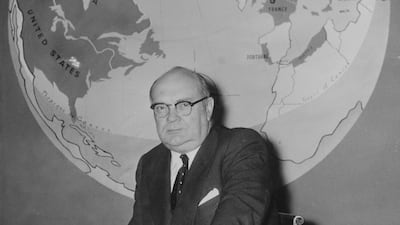
Belgian Foreign Minister Paul-Henri Spaak holds a press conference in Paris after taking over from Hastings Ismay as Nato chief in 1956 -
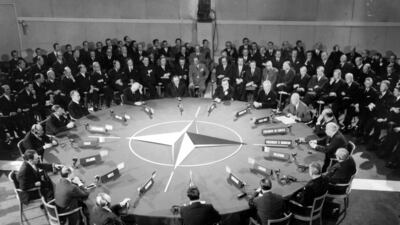
The opening speech at the Nato summit in Paris in 1957 -
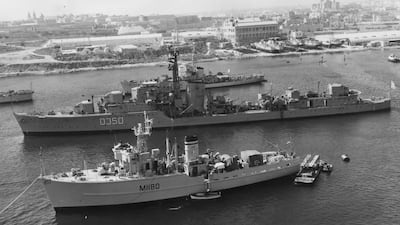
Some of the Nato vessels gathered for Exercise Medflex Invicta in Malta in 1961 -

A McDonnell Douglas F-4 Phantom II fighter-bomber of the Royal Navy is launched from HMS Ark Royal during a Nato exercise in 1972 -

German Nato troops on manoeuvres in 1980 -
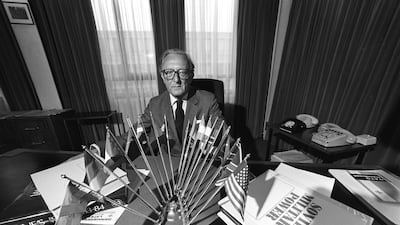
Lord Carrington, the new Secretary General of Nato, sits behind his desk in Brussels, Belgium, in 1984 -
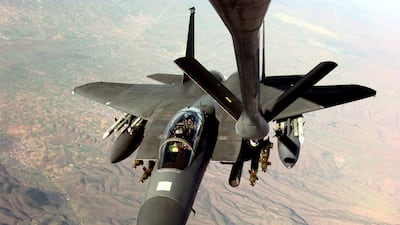
A US Air Force F-15E Strike Eagle refuels in the skies over Macedonia in 1999, as it flies missions in support of Nato Operation Allied Force -

Frigates, part of the Nato permanent fleet based in the Mediterranean Sea, enter the port of Piraeus, Greece, in 2003 -
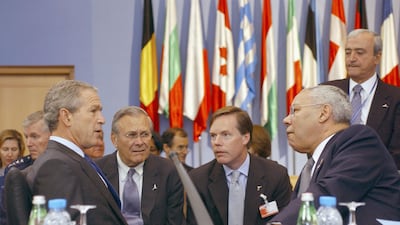
US President George W Bush, US Secretary of Defence Donald Rumsfeld, ambassador R Nicholas Burns and US Secretary of State Colin Powell attend the Nato summit in 2004 in Istanbul, Turkey -
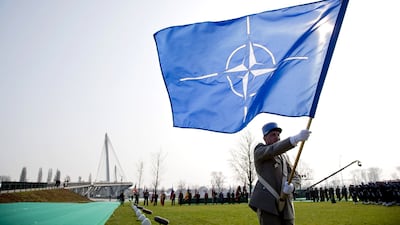
Members of the military attend a commemoration for Nato soldiers during the 2009 summit in Kehl, Germany -
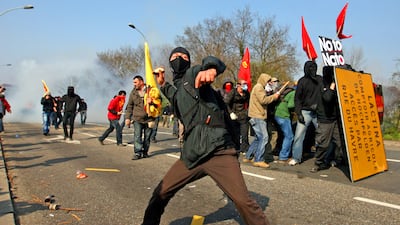
A protester throws a stone during clashes at the Nato summit in 2009 in Strasbourg, France -
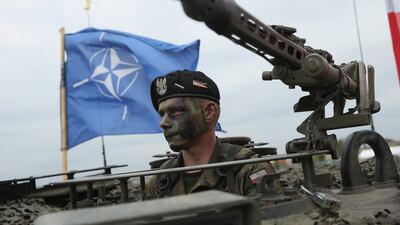
A Polish soldier sits in a tank as a Nato flag flies behind during military exercises in Zagan, Poland, in 2015 -
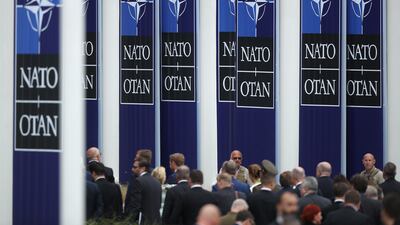
Guests depart after attending the opening ceremony at the 2018 Nato summit in Brussels -
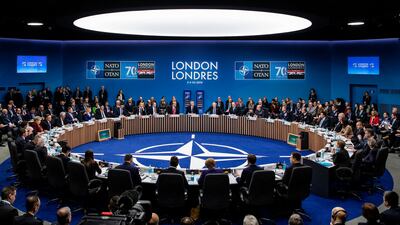
Nato leaders listen to British Prime Minister Boris Johnson while attending the summit in 2019 in Watford, England -
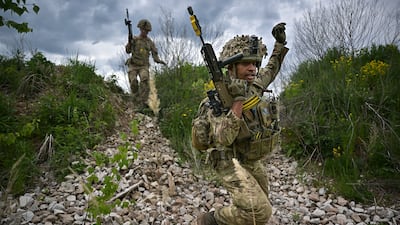
Soldiers from the Royal Welsh Battlegroup take part in manoeuvres during a Nato exercise on the Estonian-Latvian border in 2022 in Voru, Estonia -
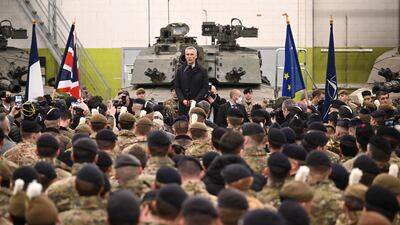
Secretary General of Nato Jens Stoltenberg meets troops at the Tapa Army Base in 2022 in Tallinn, Estonia -
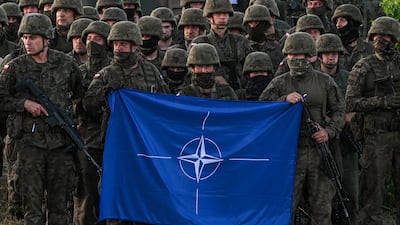
Polish soldiers hold a Nato flag in 2022 at a training ground in Orzysz, Poland -
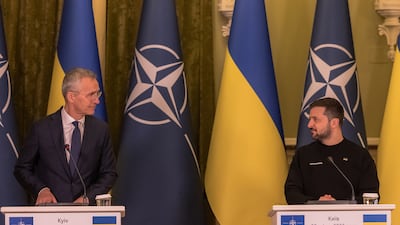
Ukrainian President Volodymyr Zelenskyy and Mr Stoltenberg attend a joint press conference in Kyiv, Ukraine, in April 2023


The US – the largest military power in Nato – is believed to have been sceptical of the idea of Mr Wallace at the helm.
Mr Wallace revealed in June that he was out of the race, telling The Economist: "It’s not going to happen." He added that there were “a lot of unresolved issues in Nato”.
Many Nato members had been pushing for a woman to be chosen to replace Mr Stoltenberg. Danish Prime Minister Mette Frederiksen was thought to be a favourite after a meeting with Mr Biden last month.
European Commission President Ursula von der Leyen was also reportedly in the running, but ruled out her candidacy last month.
Other figures whose candidacy was mooted, but never officially announced, include Dutch Prime Minister Mark Rutte and Spanish Prime Minister Pedro Sanchez.
Ukrainian Foreign Minister Dmytro Kuleba welcomed the "excellent news" that Mr Stoltenberg's term had been extended.
"Tough times demand strong leadership. Jens Stoltenberg has demonstrated just that," he wrote on Twitter. "I look forward to furthering our co-operation."
Mr Stoltenberg is seen as a leader who can keep his cool in environments of intense pressure.
In the wake of Russia's invasion of Ukraine in February 2022, analysts and diplomats praised him for striking a balance between those demanding maximum support for Kyiv and others calling for a more cautious approach out of fear of sparking a global conflict.
Going forward, his tasks include overseeing a transformation of Nato forces to refocus on defending against any Russian attack, after decades in which the alliance concentrated on missions beyond its borders, such as in Afghanistan and the Balkans.
He will also have to manage differing opinions over how involved the military alliance should become in Asia.
While the US is pushing for the community to take on a greater role in the region to counter China's growing influence, other member states such as France are sceptical. Paris is understood to favour Nato maintaining its focus on the North Atlantic area.
The focus and relevance of Nato have shifted dramatically in the wake of the war in eastern Europe.
Countries which have been neutral for decades have sought to join the alliance, or at least are starting to consider it.
Finland joined the bloc in April, while Sweden continues to push for a place.
Turkey is blocking Stockholm, which it accuses of harbouring militants from the banned Kurdistan Workers Party (PKK), which took up arms against Ankara in 1984. Turkey considers the party a terrorist organisation and has called on the Swedish authorities to extradite them.

For the first time, Sweden agreed last month to deport a PKK supporter convicted of drug trafficking to Turkey.
Last week, a protester's burning of a Quran outside a mosque in the Swedish capital further fuelled tensions with Ankara.
Swedish police had given the man a permit to carry out the act.
Locals in the neighbourhood told The National they feared the incident would further hamper Sweden's bid to join Nato.
Mr Stoltenberg called the Quran burning "offensive" but noted that it was not illegal under Swedish freedom of speech laws.
He is the second-longest serving Nato secretary-general after Joseph Luns, who spent almost 13 years in the job from 1971.

