


Pope Francis has been discharged from Rome’s Gemelli hospital, nine days after undergoing surgery.
He left in a wheelchair at 8.45am, passing well-wishers as he was taken to a car for the trip to the Vatican.
The pontiff, 86, underwent abdominal surgery to repair a hernia and remove internal scar tissue last week, and his recovery has been proceeding well, the Vatican said on Thursday.
"The Pope is well. He is in better shape than before," said chief surgeon Sergio Alfieri, who presided over the operation.
Dr Alfieri said the pontiff was well enough to travel.
"He will be able [to carry out his duties] better than before because he no longer will have the discomfort. He will be a stronger pope," Dr Alfieri said.
"He already has resumed working. We asked him to rest a bit and I am certain that this time he will listen to us a bit more because he has some important commitments, which he told us he would respect.
"The pope told us 'Thank you, pray for me, I am still alive'."
Pope Francis has trips planned to Portugal and Mongolia in August but it has yet to be confirmed whether he will make them.
The pontiff traditionally takes all of July off, with his only public appearances being on Sunday, when he delivers the papal blessings.
He is scheduled to be in Lisbon, Portugal, for four days around World Youth Day and his timetable is packed with about 20 meetings and several other events.
On Thursday, he visited other patients at the hospital and ate with his staff. The first pictures of the Pope since his admission on June 7 showed him in a wheelchair visiting the hospital cancer ward for children.
His engagements have been cancelled until June 18.
Pope Francis, 86, was previously admitted to hospital in March with a pulmonary infection.
In late May, he cleared his schedule after coming down with a fever, two months after he was treated for bronchitis in hospital.
The Argentinian pope had part of his lung removed when he was a young man. He also suffers from sciatica nerve pain and has been using a wheelchair and walker for more than a year because of strained ligaments in his knee.
The pontiff admitted in July 2022 that he needed to slow down and has also repeatedly said he would consider stepping down if his health failed him.
Born Jorge Mario Bergoglio in Buenos Aires, he has been spiritual leader to the world’s estimated 1.3 billion Catholics since his predecessor’s abdication in 2013.
He is the first pope from the Americas, the first non-European to attain the post since Gregory III in the 8th century and the first Jesuit to hold the position.
10 years of Pope Francis - in pictures
-
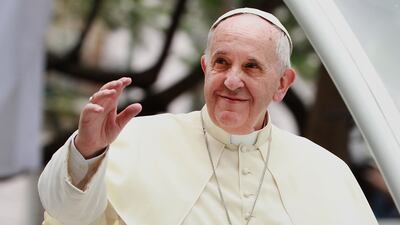
It is 10 years since Pope Francis became head of the Roman Catholic Church. The National looks back at that decade. Getty Images -
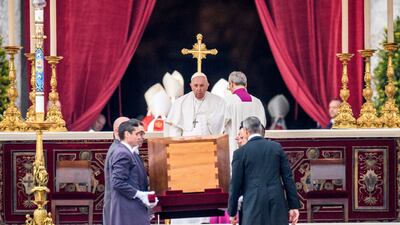
Pope Francis attends the funeral mass for Pope Emeritus Benedict XVI in January 2023 at St Peter's square in Vatican City. Getty Images -
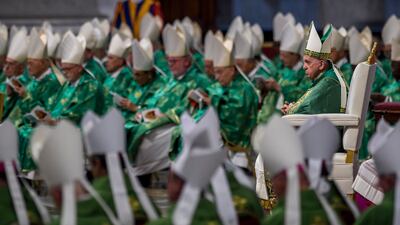
Pope Francis leads mass with the new cardinals in August 2022 at Vatican City. Getty Images -
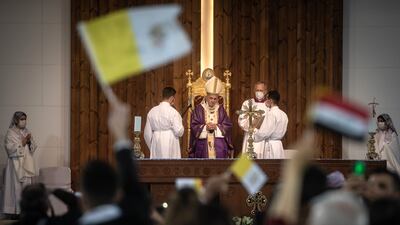
Pope Francis in March 2021 conducts mass at the Franso Hariri Stadium in Erbil, Iraq. Getty Images -
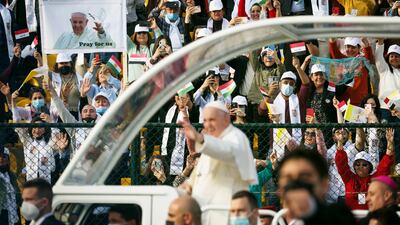
Pope Francis arrives at the Franso Hariri Stadium in Erbil, Iraq, March 2021. Getty Images -
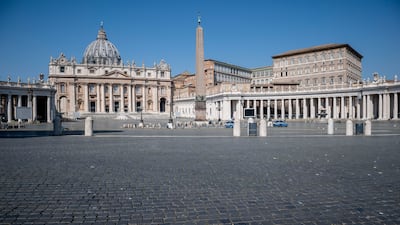
St Peter's Square stands empty while Pope Francis celebrates the Easter Mass in an empty St Peter's Basilica during the coronavirus pandemic in April 2020. Getty Images -

Pope Francis drives around Tokyo Dome before conducting mass during a visit to Japan in November 2019. Getty Images -
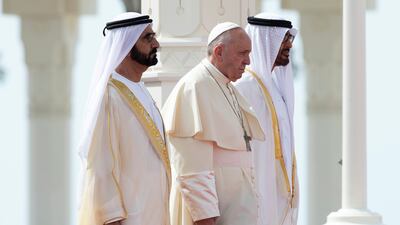
Sheikh Mohamed bin Zayed, who was Crown Prince of Abu Dhabi and Deputy Supreme Commander of the UAE Armed Forces at the time, with Sheikh Mohammed bin Rashid, Vice President and Ruler of Dubai and Pope Francis at the Presidential Palace in Abu Dhabi, in February 2019. Photo: Ministry of Presidential Affairs -
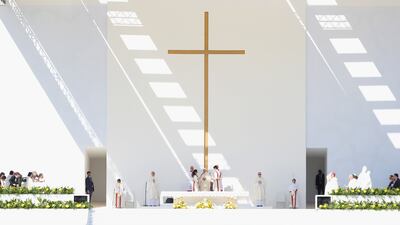
Pope Francis celebrates mass at Zayed Sport City, Abu Dhabi, in February 2019. Getty Images -
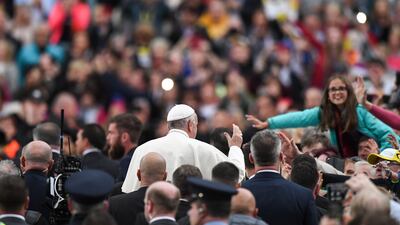
Pope Francis attends the festival of families at Croke Park in August 2018 in Dublin, Ireland. Getty Images -
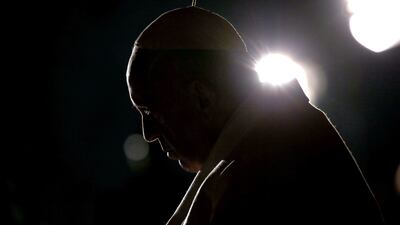
Pope Francis during the Stations of the Cross at the Colosseum in March 2018 in Rome. Getty Images -
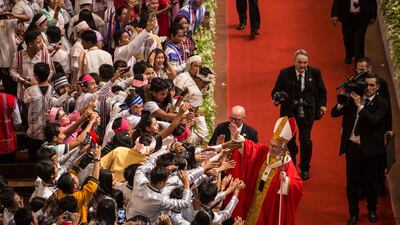
The Pope at a public engagement in November 2017 in Yangon, Myanmar. Getty Images -
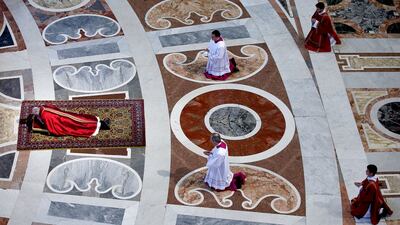
Pope Francis at the Celebration of the Lord's Passion at St Peter's Basilica, Vatican City, April 14, 2017. Getty Images -
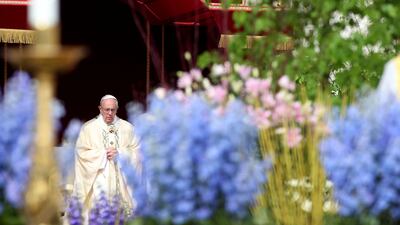
Pope Francis at Easter Mass at St Peter's Square, Vatican City, April 2017. Getty Images -
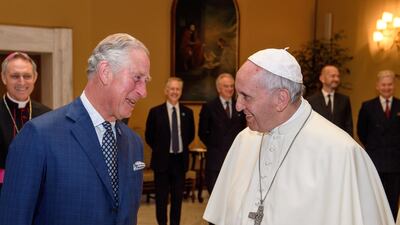
Pope Francis with Prince Charles, Prince of Wales during the British royal's visit to the Vatican in April 2017. Getty Images -
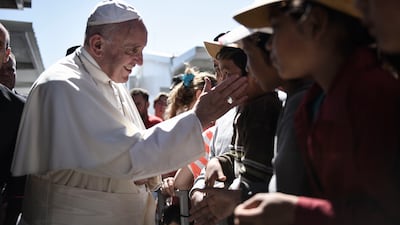
Pope Francis meets migrants at the Moria detention centre in Lesbos, Greece, April 2016. Getty Images -
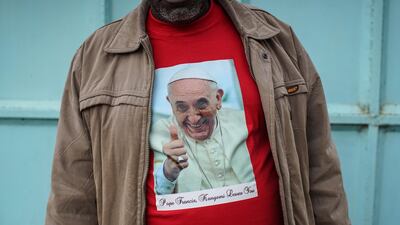
Father Paschal Mwijage of the St Joseph the Worker Parish in Nairobi's Kangemi slum wears a T-shirt featuring Pope Francis in Kenya in November 2015. Getty Images -
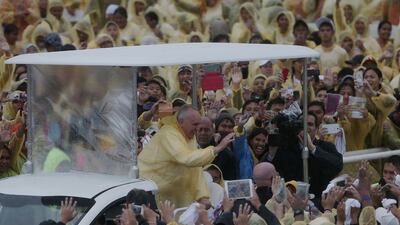
Pope Francis after conducting mass at Tacloban Airport in the Philippines, January 2015. Getty Images -
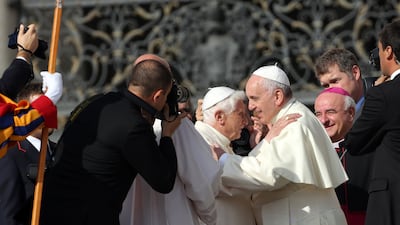
Pope Francis greets Pope Emeritus Benedict XVI at St Peter's Basilica in September 2014. Getty Images -
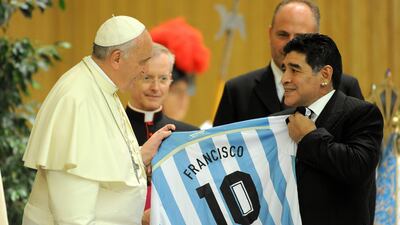
Pope Francis meets football legend Diego Maradona during an audience in Rome in September 2014. Getty Images -

Pope Francis prays by the Western Wall in Jerusalem, Israel, May 2014. Getty Images -
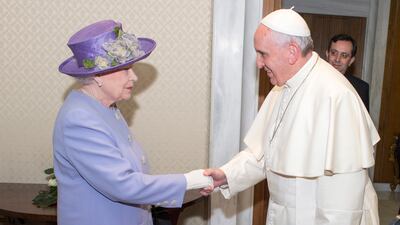
Pope Francis welcomes Britain's Queen Elizabeth II for a private audience in Rome, April 2014. Getty Images -
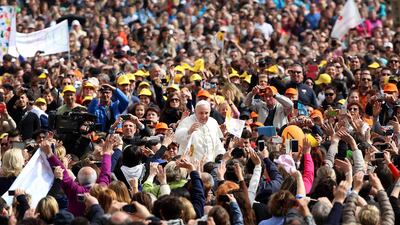
Pope Francis during his weekly audience in St Peter's Square, the Vatican, in March 2014. Getty Images -
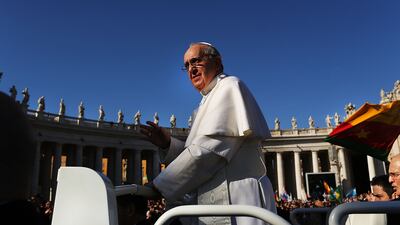
Pope Francis during the Inauguration Mass for the Pope in St Peter's Square in March 2013. Getty Images -
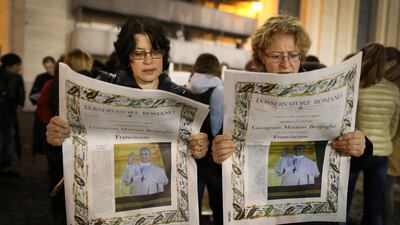
Women read a special edition of L'Osservatore Romano newspaper, which carries a photograph of the newly elected Pope Francis, March 2013. Getty Images -
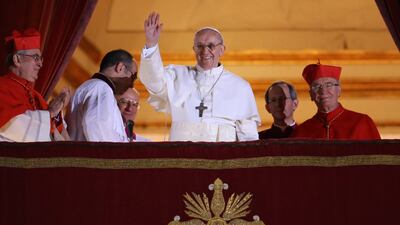
Pope Francis on the central balcony of St Peter's Basilica in March 2013. Getty Images



