


Greece's Prime Minister Kyriakos Mitsotakis announced on Monday he is seeking a new vote just a day after his party's success in the national elections.
It comes after the country's elections failed to produce a single-party government.
The New Democracy party won the parliamentary elections on Sunday with a 20-point lead over its nearest contender - its best result since 2007.
But the party fell just short of the threshold needed to form a government on its own by just five seats, leaving Mr Mitsotakis with the option of either seeking a coalition or calling a new vote.
On Monday, he told President Katerina Sakallaropoulou, who handed him the mandate to form a government, that it was not possible to form a coalition under the current parliamentary line-up.
He told her Greece should head for new elections "as soon as possible".
A senior judge will shortly be named as an interim prime minister and will call for new elections.
The latest election saw the New Democracy taking a commanding lead of 40.8 per cent, soundly defeating the radical leftist Syriza, which governed from 2015 to 2019 and polled 20.1 per cent.
On Monday, President Sakellaropoulou had given the top three parties – New Democracy, Syriza and the Socialist Pasok – three days each in turn to form a coalition government.
But following Mr Mitsotakis's rejection of the move, she will now appoint a caretaker government to prepare for new elections.
Under a new electoral law that comes into play in the next ballot, the winner can obtain a bonus of up to 50 seats. Based on Sunday's showing and that calculation, New Democracy is virtually assured of a victory.
On Sunday, Mr Mitsotakis announced his party had been given a clear mandate.
"The ballot results are decisive," he told cheering crowds outside party headquarters in Athens.
"They show that New Democracy has the approval of the people to rule, strong and autonomous."
The result was a boost for Mr Mitsotakis, whose administration had to contend with a wiretapping scandal, the Covid pandemic, a cost of living crisis and a deadly rail crash in February that caused public outrage.
But it was a disaster for Syriza and its leader Alexis Tsipras, a firebrand leftist who shot to power in 2015 as voters showed their discontent with other parties over their handling of the debt crisis that ravaged Greece's economy for more than a decade.
Greek general election - in pictures
-
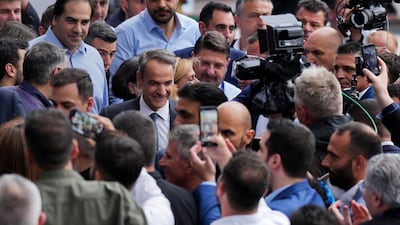
Mr Mitsotakis, centre, arrives at his party's headquarters in Athens, on May 21. AP -
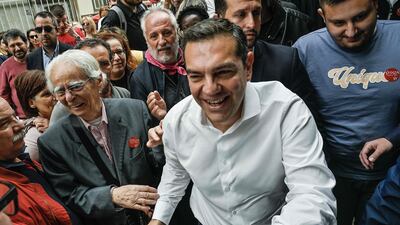
Leader of the leftist Syriza party Alexis Tsipras is greeted by supporters outside a polling station in Athens. AFP -
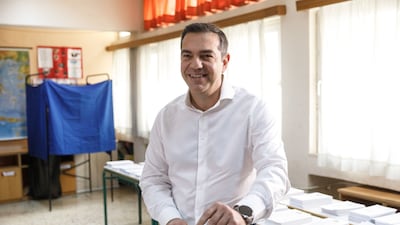
Mr Tsipras casts his ballot at a polling station in Athens. Bloomberg -
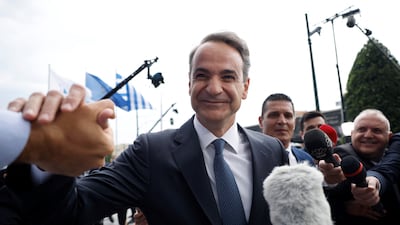
Greek Prime Minister and New Democracy leader Kyriakos Mitsotakis arrives at the party's headquarters after the general elections, in Athens on May 21. Reuters -
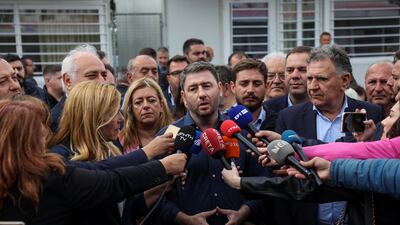
Leader of the Pasok-Kinal socialist party Nikos Androulakis after voting at a polling station in the village of Arkalochori, on the island of Crete, on May 21. Reuters -
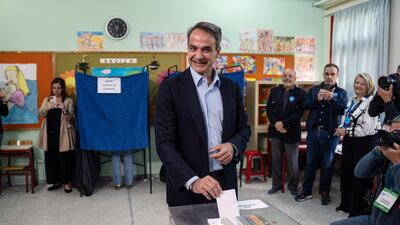
Mr Mitsotakis casts his ballot at an Athens polling station. Bloomberg -
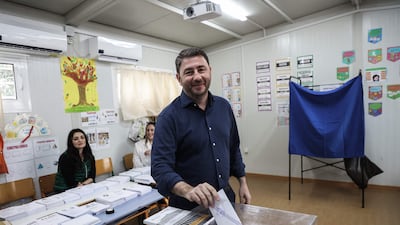
Mr Androulakis casts his ballot in Heraklion, Crete. AFP -
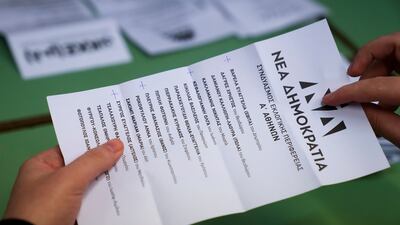
Greek election workers count ballots at a polling station in Athens. AP -
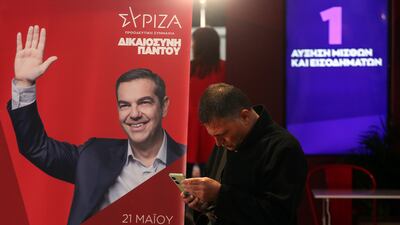
A Syriza party supporter in Athens reacts to the announcement of the exit polls. EPA -
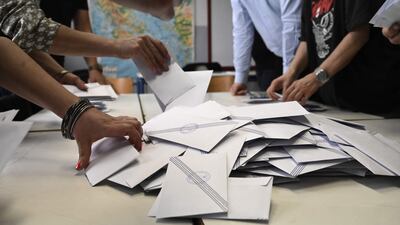
Greek election officials count ballots in Thessaloniki. AFP -
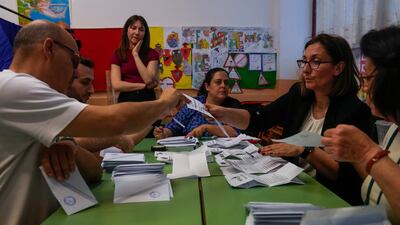
Election workers count ballots in Athens. AP -

A girl casts her mother's ballot at a polling station in an Athens primary school. AFP -
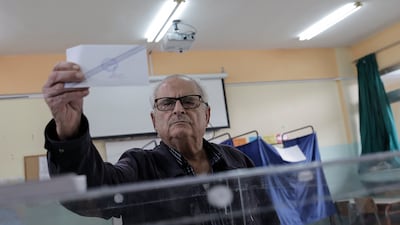
A voter casts his ballot in Piraeus, near Athens. EPA


Mr Mitsotakis, a Harvard graduate and former McKinsey consultant, entered the elections as the favourite, with Greece enjoying fairly robust economic health.
Unemployment and inflation have fallen and growth this year is projected to reach twice that of the EU's – a far cry from the debt crisis a decade ago.
But fears of stagnating wages and rising costs remain key concerns for voters – something Mr Tsipras sought to exploit.
But the result meant he had not succeeded in making his comeback after a first mandate in 2015 to 2019, during which he led rocky negotiations with creditors that nearly crashed Greece out of the euro.
The socialist party Pasok-Kinal, led by Nikos Androulakis, had been earlier seen as a potential coalition partner for Mr Mitsotakis, but things went sour when he discovered he had been under state surveillance.
The wiretap scandal, which erupted last year, forced the resignation of the head of the intelligence service and a nephew of Mr Mitsotakis, who was a top aide in his office.
In the run-up to the vote, Mr Androulakis had firmly ruled out forming a partnership with Mr Mitsotakis's conservatives.
While the socialist party is closer in its policies to Syriza, Mr Androulakis said in March that he would only back a coalition if neither Mr Tsipras nor Mr Mitsotakis became prime minister.

