French police face accusations of brutality during pension protests. Bloomberg

French police investigated over abusive comments to protesters


Marwa Hassan
  • English
  • Arabic

French police officers from the Motorised Brigades for the Repression of Violent Action (BRAV-M) have been recorded threatening and making abusive comments towards arrested protesters, according to an internal report.

The incident took place on March 20, during a protest against President Emmanuel Macron's pension reforms.

The audio recording was shared by French media on March 24, prompting an investigation into the officers' conduct.

In the report, members of the Paris motorbike police unit stated that they were “mentally exhausted” due to working long shifts during the protests.

One officer claimed that he and his team had been on patrol since 10am and that the recording was made after 11pm. Another officer described shifts of up to 16 hours and said that eating and drinking were complicated.

The recording captures the officers making sexually explicit, sexist and racist comments towards a 23-year-old Chadian student who had been arrested.

The officers deny allegations of physical assault, but the recording suggests otherwise.

The incident has prompted calls for the dissolution of the BRAV-M police unit responsible for the alleged abusive comments. EPA

In response to the incident, Paris police chief Laurent Nunez said that he was “extremely shocked by the comments”.

The officers have been taken off duty, but not suspended. The inquiries are continuing.

This incident has fuelled accusations of police brutality during the pension protests, with rights groups accusing French police of disproportionate use of force.

The French interior ministry has denied these accusations, stating that they have been responding to “far-left” radicals intent on damaging public property.

The incident has also prompted activists and left-wing lawmakers to call for the dissolution of the BRAV-M. However, Interior Minister Gerald Darmanin rejected this request, stating that the unit plays a crucial role in maintaining public order.

  • A man throws a flare towards riot police in Rennes, as protests continue across France over pension reforms and the rising cost of living. AP
    A man throws a flare towards riot police in Rennes, as protests continue across France over pension reforms and the rising cost of living. AP
  • A puppet depicting French President Emmanuel Macron is tossed into the air by workers on strike in Nice. Reuters
    A puppet depicting French President Emmanuel Macron is tossed into the air by workers on strike in Nice. Reuters
  • A protester, wearing a CGT labour union vest, during a demonstration in Nice. Reuters
    A protester, wearing a CGT labour union vest, during a demonstration in Nice. Reuters
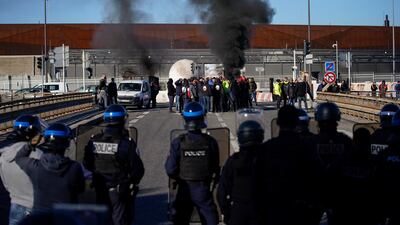
  • Dockers face riot police as a barricade burns near the port of Marseille. AP
    Dockers face riot police as a barricade burns near the port of Marseille. AP
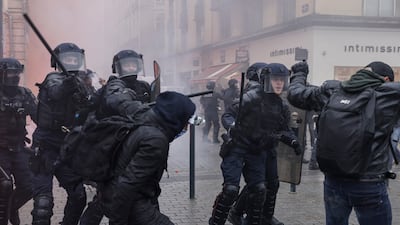
  • Riot police scuffle with protesters in Rennes. AP
    Riot police scuffle with protesters in Rennes. AP
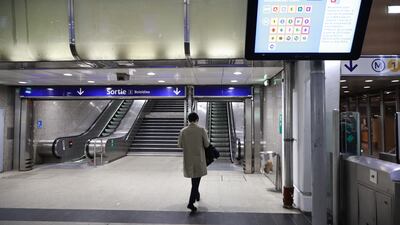
  • An eerily quiet La Defense station on a day of national strikes in Paris. EPA
    An eerily quiet La Defense station on a day of national strikes in Paris. EPA
  • Rubbish piles up in the streets of Paris after refuse workers go on strike. AP
    Rubbish piles up in the streets of Paris after refuse workers go on strike. AP
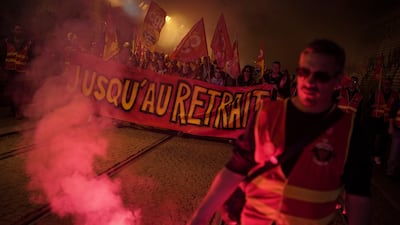
  • Railway workers hold a banner reading 'Until withdrawal' at a demonstration in Lyon. AP
    Railway workers hold a banner reading 'Until withdrawal' at a demonstration in Lyon. AP
  • Ugly scenes in Rennes. AP
    Ugly scenes in Rennes. AP
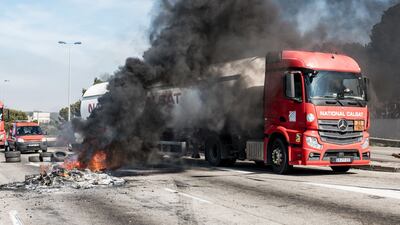
  • A lorry driver navigates through a fire lit by striking members of the General Confederation of Labour union in Fos-sur-Mer. Bloomberg
    A lorry driver navigates through a fire lit by striking members of the General Confederation of Labour union in Fos-sur-Mer. Bloomberg
  • A striking worker brandishes a flare in Nice. Reuters
    A striking worker brandishes a flare in Nice. Reuters
  • French police shield themselves missiles and fireworks in Nantes. AP
    French police shield themselves missiles and fireworks in Nantes. AP

Lawyer Arie Alimi, who is representing the Chadian student and another female protester, said that fatigue cannot exonerate someone of criminal liability, but it could invoke the criminal responsibility of the police chief himself in view of the intensity of the operations he ordered.

The incident is a stark reminder of the tensions between French police and protesters during the pension reform demonstrations.


THE SPECS


Engine: 1.5-litre


Transmission: 6-speed automatic


Power: 110 horsepower 


Torque: 147Nm 


Price: From Dh59,700 


On sale: now  

 
Short-term let permits explained

Homeowners and tenants are allowed to list their properties for rental by registering through the Dubai Tourism website to obtain a permit.

Tenants also require a letter of no objection from their landlord before being allowed to list the property.

There is a cost of Dh1,590 before starting the process, with an additional licence fee of Dh300 per bedroom being rented in your home for the duration of the rental, which ranges from three months to a year.

Anyone hoping to list a property for rental must also provide a copy of their title deeds and Ejari, as well as their Emirates ID.

Ten tax points to be aware of in 2026

1. Domestic VAT refund amendments: request your refund within five years

If a business does not apply for the refund on time, they lose their credit.

2. E-invoicing in the UAE

Businesses should continue preparing for the implementation of e-invoicing in the UAE, with 2026 a preparation and transition period ahead of phased mandatory adoption. 

3. More tax audits

Tax authorities are increasingly using data already available across multiple filings to identify audit risks. 

4. More beneficial VAT and excise tax penalty regime

Tax disputes are expected to become more frequent and more structured, with clearer administrative objection and appeal processes. The UAE has adopted a new penalty regime for VAT and excise disputes, which now mirrors the penalty regime for corporate tax.

5. Greater emphasis on statutory audit

There is a greater need for the accuracy of financial statements. The International Financial Reporting Standards standards need to be strictly adhered to and, as a result, the quality of the audits will need to increase.

6. Further transfer pricing enforcement

Transfer pricing enforcement, which refers to the practice of establishing prices for internal transactions between related entities, is expected to broaden in scope. The UAE will shortly open the possibility to negotiate advance pricing agreements, or essentially rulings for transfer pricing purposes. 

7. Limited time periods for audits

Recent amendments also introduce a default five-year limitation period for tax audits and assessments, subject to specific statutory exceptions. While the standard audit and assessment period is five years, this may be extended to up to 15 years in cases involving fraud or tax evasion. 

8. Pillar 2 implementation 

Many multinational groups will begin to feel the practical effect of the Domestic Minimum Top-Up Tax (DMTT), the UAE's implementation of the OECD’s global minimum tax under Pillar 2. While the rules apply for financial years starting on or after January 1, 2025, it is 2026 that marks the transition to an operational phase.

9. Reduced compliance obligations for imported goods and services

Businesses that apply the reverse-charge mechanism for VAT purposes in the UAE may benefit from reduced compliance obligations. 

10. Substance and CbC reporting focus

Tax authorities are expected to continue strengthening the enforcement of economic substance and Country-by-Country (CbC) reporting frameworks. In the UAE, these regimes are increasingly being used as risk-assessment tools, providing tax authorities with a comprehensive view of multinational groups’ global footprints and enabling them to assess whether profits are aligned with real economic activity. 

Contributed by Thomas Vanhee and Hend Rashwan, Aurifer

The five pillars of Islam

Padmaavat

Director: Sanjay Leela Bhansali

Starring: Ranveer Singh, Deepika Padukone, Shahid Kapoor, Jim Sarbh

3.5/5

Key figures in the life of the fort

Sheikh Dhiyab bin Isa (ruled 1761-1793) Built Qasr Al Hosn as a watchtower to guard over the only freshwater well on Abu Dhabi island.

Sheikh Shakhbut bin Dhiyab (ruled 1793-1816) Expanded the tower into a small fort and transferred his ruling place of residence from Liwa Oasis to the fort on the island.

Sheikh Tahnoon bin Shakhbut (ruled 1818-1833) Expanded Qasr Al Hosn further as Abu Dhabi grew from a small village of palm huts to a town of more than 5,000 inhabitants.

Sheikh Khalifa bin Shakhbut (ruled 1833-1845) Repaired and fortified the fort.

Sheikh Saeed bin Tahnoon (ruled 1845-1855) Turned Qasr Al Hosn into a strong two-storied structure.

Sheikh Zayed bin Khalifa (ruled 1855-1909) Expanded Qasr Al Hosn further to reflect the emirate's increasing prominence.

Sheikh Shakhbut bin Sultan (ruled 1928-1966) Renovated and enlarged Qasr Al Hosn, adding a decorative arch and two new villas.

Sheikh Zayed bin Sultan (ruled 1966-2004) Moved the royal residence to Al Manhal palace and kept his diwan at Qasr Al Hosn.

Sources: Jayanti Maitra, www.adach.ae

Updated: April 08, 2023, 4:56 PM