


Opponents of French President Emmanuel Macron vowed on Tuesday to continue their wave of protests after his government narrowly survived a confidence vote.
More than 200 people were arrested in overnight protests as police fired tear gas and piles of rubbish were set alight amid strikes by bin collectors in Paris.
It came after a no-confidence motion fell nine votes short of defeating Mr Macron's government in the National Assembly, after it invoked special powers to raise the retirement age without a vote.
Mr Macron, who has largely stayed out of the fray, is expected to speak to the nation on Wednesday as he prepares to sign the unpopular pension reform into law.
The flagship measure of Mr Macron's second term could yet face a challenge in France's constitutional court after left-wingers filed complaints.
Yvan Ricordeau, the national secretary of trade union CFDT, said protests planned for Saturday would go ahead even as he called for calm after Monday evening's unrest.
"We find ourselves with a law that has not been passed by members of parliament. There is a democratic flaw in the way things happened," he told French television on Tuesday.
Mr Macron's Prime Minister Elisabeth Borne said she was "determined to continue" to implement "necessary transformations for our country" amid questions about her future.
The 577-seat National Assembly rejected the first no-confidence motion — brought by the centrist Liot coalition and supported by the left — by a margin of nine votes, much narrower than expected.
It then overwhelmingly rejected a motion by the far-right National Rally, with only 94 votes in favour.
The rejection means that the reform to raise the pensions age from 62 to 64 is considered adopted by the legislature.
But it far from represents the end of the biggest domestic crisis of Mr Macron's second mandate, and he has yet to make any public comment on the controversy.
Anti-government protests in Paris - in pictures
-
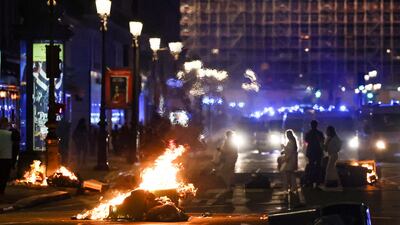
Burning rubbish bins near the Opera Garnier during Monday's protests. Reuters -
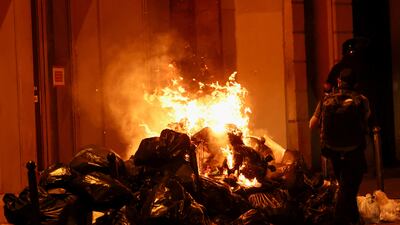
A fire lit during a demonstration in Paris as the French Parliament prepared to vote against two no-confidence motions. Reuters -
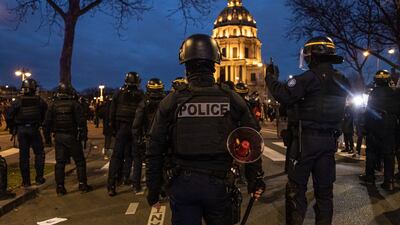
French riot police stand guard after clashes with protesters at Vauban Square in Paris on Monday night. EPA -

Burning bins near the Opera Garnier. Reuters -
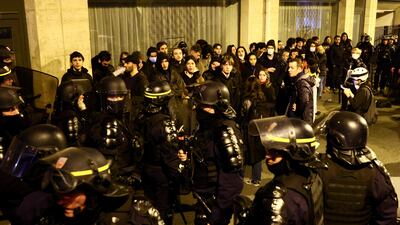
Protesters are surrounded by riot police in Paris. Reuters -
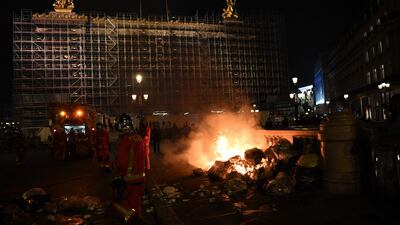
Firefighters extinguish a fire at the Place de l'Opera on Monday night. AFP -
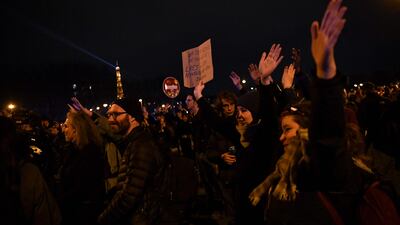
Demonstrators hold a sign reading "Youth Rise Up" during a protest a few days after the government pushed the pensions reform through. AFP -

A cyclist watches a Paris protest. AFP -
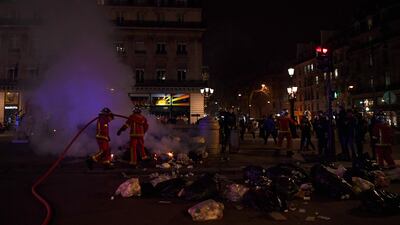
Firefighters extinguish a blaze at the Place de l'Opera on Monday night. AFP -
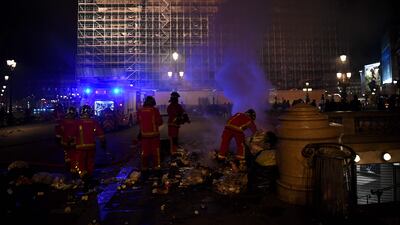
Firefighters extinguish a blaze at the Place de l'Opera on Monday night. AFP -
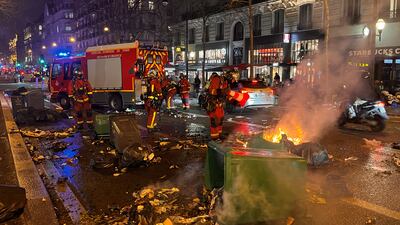
Firefighters extinguish a blaze in the streets of Paris on Monday night. Reuters -

A driver passes burning rubbish bins in Paris on Monday night. Reuters -
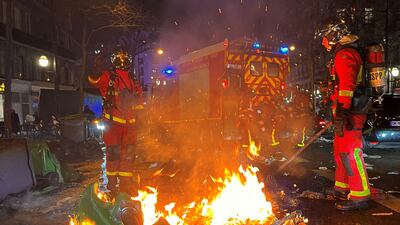
French firefighters extinguish burning rubbish bins. Reuters -
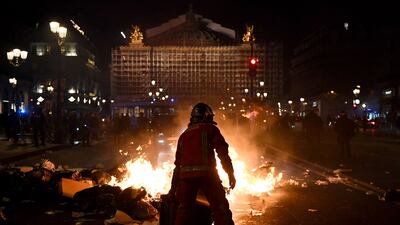
A firefighter stands behind a burning pile of rubbish in front of Opera Garnier in Paris on Monday during a protest over the government pushing through its pension reform through parliament without a vote. AFP -
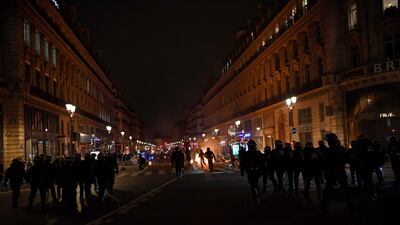
French security police walk towards a demonstration in Paris. AFP -

A protester chants slogans during a protest in Paris, Monday, March 20, 2023. AP -

Protesters march through Place Vauban after pension reforms were pushed through Parliament without a vote. AFP -
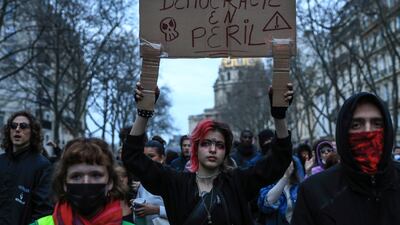
A demonstrator holds a placard that reads "democracy in danger" in Paris on Monday. AP -
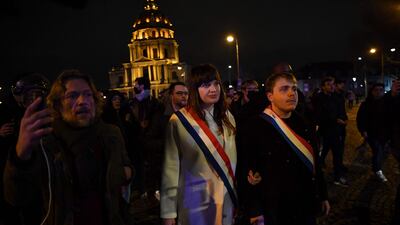
French left-wing members of Parliament Louis Boyard and Alma Dufour march the protest at Place Vauban on Monday night. AFP -
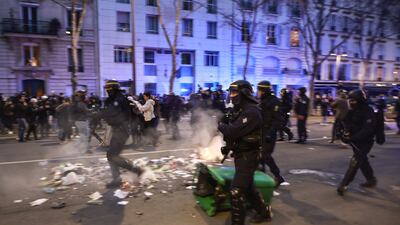
French riot police clash with protesters at Vauban Square. EPA -
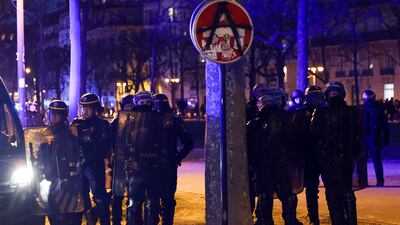
French riot officers stand guard at a Paris protest on Monday night. Reuters -
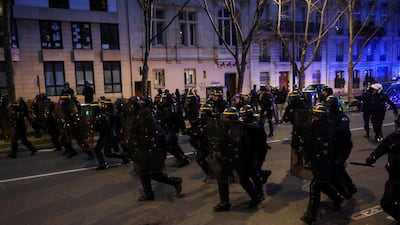
French riot officers prepare for confrontation at a Paris protest on Monday night. Reuters -
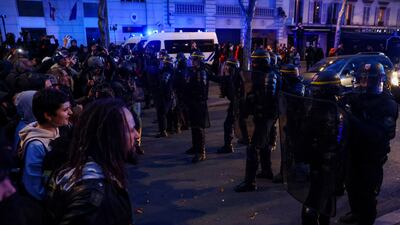
French riot officers face protesters at the Paris rally. Reuters -
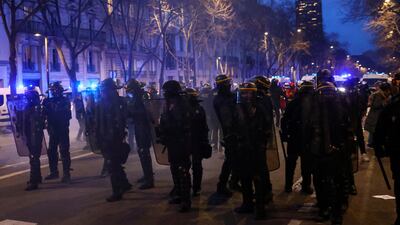
French riot officers stand guard at the Paris protest. Reuters -

French riot officers stand guard at the Paris protest. Reuters


There has been a rolling strike by rubbish collectors in Paris, leading to piles of waste accumulating in the French capital.
Since Ms Borne invoked Article 49.3 of the constitution, there have also been daily protests in Paris and other cities that have on occasion turned violent.
A total of 169 people were arrested nationwide on Saturday during spontaneous protests, including one that assembled 4,000 in the capital.
Hard-left figurehead Jean-Luc Melenchon said people “should express themselves everywhere and in all circumstances to force the withdrawal of the reform”.
Government insiders and observers have raised fears that France is again heading for another bout of violent anti-government protests, only a few years after the “Yellow Vest” movement shook the country in 2018-2019.
To pass, the main multiparty no-confidence motion needed support from about half of the 61 MPs of the traditional right-wing Republicans.
Even after its leadership insisted they should reject the motions, 19 renegade Republican MPs voted in favour.
One of the Republicans who voted to remove the government, Aurelien Pradie, said afterwards that Mr Macron should withdraw the “poisoned law”.
“It is obvious today that the government has a problem of legitimacy and the president cannot remain a spectator of this situation,” Mr Pradie told BFMTV.
The leader of the far-right in parliament, Marine Le Pen, who challenged Mr Macron in the 2022 elections, said Ms Borne “should go or be made to resign by the President”.
A survey on Sunday showed the head of state's personal rating at its lowest level since the height of the “Yellow Vest” protest movement, with only 28 per cent of respondents having a positive view of him.
Mr Macron has said the pension changes are needed to avoid huge deficits in the coming decades linked to France's ageing population.
Opponents of the reform say it places an unfair burden on low earners, women and people doing physically wearing jobs.
Opinion polls have consistently shown that two thirds of French people oppose the changes.

