European Commission Vice President Valdis Dombrovskis speaks during a press conference at EU headquarters in Brussels. AFP

EU unveils strategy to lead green industrial revolution


Soraya Ebrahimi
  • English
  • Arabic

The European Commission on Thursday outlined a new strategy to ensure its industries can compete with the US and China in making cleantech products and obtaining the raw materials required for the green transition.

Part of the Green Deal Industrial Plan, the EU's Net-Zero Industry and Critical Raw Materials acts are designed to ensure the bloc is a leader in cutting carbon emissions and stays ahead on the technology required to achieve that.

But there are signs that it is lagging behind.

The commission says global investment in green transition is set to triple by 2030 from $1 trillion last year.

“The bottom line is that we want to be leaders in the green industries of the future,” Vice President Valdis Dombrovskis told a news conference.

The EU executive set targets for the region to mine 10 per cent of the critical raw materials it consumes, such as lithium and for the first time copper and nickel, with recycling adding a further 15 per cent.

It also aims to increase processing to 40 per cent of its needs by 2030.

The supply of minerals vital for the green transition is a challenge, with China processing almost 90 per cent of rare earths and 60 per cent of lithium, a key element for batteries.

The commission said no more than 65 per cent of any key raw material should come from a single third country.

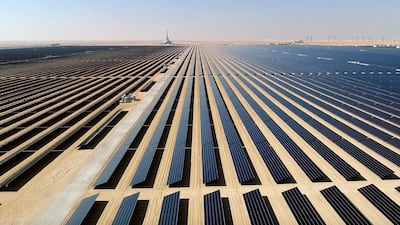
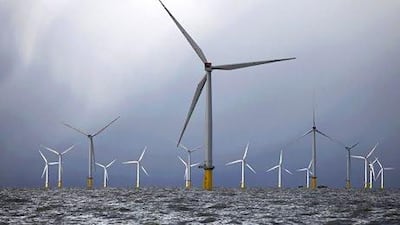
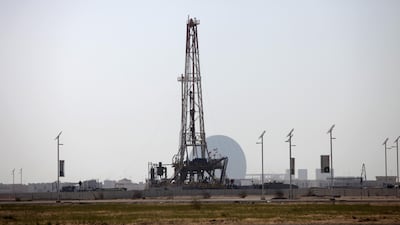
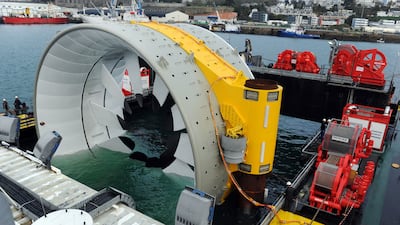
Green energy sources — in pictures

  • The Mohammed bin Rashid Al Maktoum Solar Park is located about 50 kilometres south of Dubai. AP
    The Mohammed bin Rashid Al Maktoum Solar Park is located about 50 kilometres south of Dubai. AP
  • Masdar, the Abu Dhabi clean energy company, owns a one-fifth stake in London Array, the offshore wind farm in the Thames estuary. Chris Ratcliffe / Bloomberg News
    Masdar, the Abu Dhabi clean energy company, owns a one-fifth stake in London Array, the offshore wind farm in the Thames estuary. Chris Ratcliffe / Bloomberg News
  • A hydro plant in Himachal Pradesh, India. Photo: Abu Dhabi National Energy Company (TAQA)
    A hydro plant in Himachal Pradesh, India. Photo: Abu Dhabi National Energy Company (TAQA)
  • The Geothermal Pilot Project drills 4km beneath Masdar City in search of boiling temperatures to generate electricity and fuel the city's cooling system. Nicole Hill /The National
    The Geothermal Pilot Project drills 4km beneath Masdar City in search of boiling temperatures to generate electricity and fuel the city's cooling system. Nicole Hill /The National
  • A hydroelectric motor at a tidal farm in the harbour of Brest, in western France. AFP
    A hydroelectric motor at a tidal farm in the harbour of Brest, in western France. AFP

“We are not a resource-rich continent,” Mr Dombrovskis said. He added that for many materials, Europe relied on a small number of partners.

“This is not a stable nor reliable way to build the industries of the future. So we urgently need to diversify.”

Russia's invasion of Ukraine has reinforced a lesson learnt during the Covid-19 pandemic, namely that the EU cannot rely on a single supplier for essential materials.

The EU executive would recognise plans to mine or process raw materials as “strategic projects”, which would allow them to benefit from streamlined permits and access to financing.

In trade, the EU would seek to expand its network of partnerships, such as with Australia, Canada and Chile.

Jochen Eickholt, chief executive of Siemens Gamesa, the world's largest maker of offshore turbines, said the Critical Raw Materials Act had the potential to foster responsible mining supply chains needed for European industry.

“Such regulatory frameworks are important — we now need to act fast and enforce them,” he said.

The EU also set a target of producing by 2030 at least 40 per cent of the products it needs for “net-zero” technologies, such as solar power or fuel cells, partly by streamlining the granting of permits for green projects.

The bloc also announced a goal for carbon capture of 50 million tonnes by 2030.

Carbon capture is one of a list of “net-zero” technologies the EU recognises. Controversially, these also include advanced nuclear processes.

BusinessEurope described the proposal as having a “limited scope” and said the EU should acknowledge that the decarbonisation of Europe is a priority for the whole economy.

Another industry group WindEurope said the proposals failed to explain what financial support the EU would offer to massively scale up turbine manufacturing or how governments would use the new flexible rules to support this.

Colin Mackey, head of European operations at miner Rio Tinto, said he welcomed the critical raw materials act, but that there was a long way to go to meet expected demand.

Swedish mining and smelting group Boliden said Europe needed much work to improve from a poor starting point and that major projects for copper and nickel were a priority.


How to avoid crypto fraud
  • Use unique usernames and passwords while enabling multi-factor authentication.
  • Use an offline private key, a physical device that requires manual activation, whenever you access your wallet.
  • Avoid suspicious social media ads promoting fraudulent schemes.
  • Only invest in crypto projects that you fully understand.
  • Critically assess whether a project’s promises or returns seem too good to be true.
  • Only use reputable platforms that have a track record of strong regulatory compliance.
  • Store funds in hardware wallets as opposed to online exchanges.
How to donate

Text the following numbers:

2289 - Dh10

6025 - Dh 20

2252 - Dh 50

2208 - Dh 100

6020 - Dh 200 

*numbers work for both Etisalat and du

Representing%20UAE%20overseas
%3Cp%3E%0DIf%20Catherine%20Richards%20debuts%20for%20Wales%20in%20the%20Six%20Nations%2C%20she%20will%20be%20the%20latest%20to%20have%20made%20it%20from%20the%20UAE%20to%20the%20top%20tier%20of%20the%20international%20game%20in%20the%20oval%20ball%20codes.%0D%3Cbr%3E%20%0D%3Cbr%3E%3Cstrong%3ESeren%20Gough-Walters%20(Wales%20rugby%20league)%3C%2Fstrong%3E%0D%3Cbr%3EBorn%20in%20Dubai%2C%20raised%20in%20Sharjah%2C%20and%20once%20an%20immigration%20officer%20at%20the%20British%20Embassy%20in%20Abu%20Dhabi%2C%20she%20debuted%20for%20Wales%20in%20rugby%20league%20in%202021.%0D%3Cbr%3E%20%0D%3Cbr%3E%3Cstrong%3ESophie%20Shams%20(England%20sevens)%3C%2Fstrong%3E%0D%3Cbr%3EWith%20an%20Emirati%20father%20and%20English%20mother%2C%20Shams%20excelled%20at%20rugby%20at%20school%20in%20Dubai%2C%20and%20went%20on%20to%20represent%20England%20on%20the%20sevens%20circuit.%20%0D%3Cbr%3E%20%0D%3Cbr%3E%3Cstrong%3EFiona%20Reidy%20(Ireland)%3C%2Fstrong%3E%0D%3Cbr%3EMade%20her%20Test%20rugby%20bow%20for%20Ireland%20against%20England%20in%202015%2C%20having%20played%20for%20four%20years%20in%20the%20capital%20with%20Abu%20Dhabi%20Harlequins%20previously.%0D%3C%2Fp%3E%0A
Results

6.30pm: Mazrat Al Ruwayah Group Two (PA) US$55,000 (Dirt) 1,600m; Winner: Rasi, Harry Bentley (jockey), Sulaiman Al Ghunaimi (trainer).

7.05pm: Meydan Trophy (TB) $100,000 (Turf) 1,900m; Winner: Ya Hayati, William Buick, Charlie Appleby.

7.40pm: Handicap (TB) $135,000 (D) 1,200m; Winner: Bochart, Richard Mullen, Satish Seemar.

8.15pm: Balanchine Group Two (TB) $250,000 (T) 1,800m; Winner: Magic Lily, William Buick, Charlie Appleby.

8.50pm: Handicap (TB) $135,000 (T) 1,000m; Winner: Waady, Jim Crowley, Doug Watson.

9.25pm: Firebreak Stakes Group Three (TB) $200,000 (D) 1,600m; Winner: Capezzano, Mickael Barzalona, Salem bin Ghadayer.

10pm: Handicap (TB) $175,000 (T) 2,410m; Winner: Eynhallow, Mickael Barzalona, Charlie Appleby.

Ten tax points to be aware of in 2026

1. Domestic VAT refund amendments: request your refund within five years

If a business does not apply for the refund on time, they lose their credit.

2. E-invoicing in the UAE

Businesses should continue preparing for the implementation of e-invoicing in the UAE, with 2026 a preparation and transition period ahead of phased mandatory adoption. 

3. More tax audits

Tax authorities are increasingly using data already available across multiple filings to identify audit risks. 

4. More beneficial VAT and excise tax penalty regime

Tax disputes are expected to become more frequent and more structured, with clearer administrative objection and appeal processes. The UAE has adopted a new penalty regime for VAT and excise disputes, which now mirrors the penalty regime for corporate tax.

5. Greater emphasis on statutory audit

There is a greater need for the accuracy of financial statements. The International Financial Reporting Standards standards need to be strictly adhered to and, as a result, the quality of the audits will need to increase.

6. Further transfer pricing enforcement

Transfer pricing enforcement, which refers to the practice of establishing prices for internal transactions between related entities, is expected to broaden in scope. The UAE will shortly open the possibility to negotiate advance pricing agreements, or essentially rulings for transfer pricing purposes. 

7. Limited time periods for audits

Recent amendments also introduce a default five-year limitation period for tax audits and assessments, subject to specific statutory exceptions. While the standard audit and assessment period is five years, this may be extended to up to 15 years in cases involving fraud or tax evasion. 

8. Pillar 2 implementation 

Many multinational groups will begin to feel the practical effect of the Domestic Minimum Top-Up Tax (DMTT), the UAE's implementation of the OECD’s global minimum tax under Pillar 2. While the rules apply for financial years starting on or after January 1, 2025, it is 2026 that marks the transition to an operational phase.

9. Reduced compliance obligations for imported goods and services

Businesses that apply the reverse-charge mechanism for VAT purposes in the UAE may benefit from reduced compliance obligations. 

10. Substance and CbC reporting focus

Tax authorities are expected to continue strengthening the enforcement of economic substance and Country-by-Country (CbC) reporting frameworks. In the UAE, these regimes are increasingly being used as risk-assessment tools, providing tax authorities with a comprehensive view of multinational groups’ global footprints and enabling them to assess whether profits are aligned with real economic activity. 

Contributed by Thomas Vanhee and Hend Rashwan, Aurifer

Updated: March 16, 2023, 11:23 PM