


The EU is closing in on a deal to cap the price of Russian crude oil at $60 a barrel before a Monday deadline, though Poland wants new sanctions linked to the plan.
The cap is a highly anticipated and complex political and economic manoeuvre designed to keep Russia’s supplies flowing into global markets while clamping down on President Vladimir Putin’s ability to fund his war in Ukraine.
EU nations sought to push the cap across the finish line after Poland held out to get as low a figure as possible, diplomats said on Thursday. Negotiations were continuing on Friday.
The latest offer comes ahead of a deadline to set the price for discounted oil by Monday, when a European embargo on seaborne Russian crude and a ban on shipping insurance for those supplies take effect.
Here is what to know about the price cap, the EU embargo and what they could mean for consumers and the global economy:
What is the price cap and how would it work?
US Treasury Secretary Janet Yellen has proposed the cap with other Group of 7 leading industrial powers as a way to limit Russia’s earnings while keeping Russian oil flowing to the global economy. The aim: hurt Moscow’s finances while avoiding a sharp oil price surge if Russia’s oil is suddenly taken off the global market.
Insurance companies and other firms needed to ship oil would only be able to deal with Russian crude if the oil is priced at or below the cap. Most insurers are located in the EU or the UK and could be required to participate in the cap.
The $60 figure would mean a cap near the current price of Russia’s crude — which fell this week below $60 a barrel — and is meant to prevent a sudden loss of Russian oil to the world following the new western sanctions.
It is a big discount to international benchmark Brent, which traded at about $87 per barrel Thursday, but could be high enough for Moscow to keep selling, even while rejecting the idea of a cap.
The G7 has led the price cap effort and still needs to approve the figure.
How would oil keep flowing to the global economy?
Universal enforcement of the insurance ban, imposed by the EU and UK in earlier rounds of sanctions, could take so much Russian crude off the market that oil prices would surge, Western economies would suffer and Moscow would see increased earnings from whatever oil it could ship in defiance of the embargo.
Russia, the world’s No. 2 oil producer, has already rerouted much of its supply to India, China and other Asian countries at discounted prices after Western customers shunned it even before the EU ban.
What effect would different cap levels have?
A $60 cap would not have much impact on Russia’s finances, said Simone Tagliapietra, an energy policy expert at the Bruegel think tank in Brussels. That “will almost go unnoticed,” he said, because it would be near where Russian oil is already selling.
Russian Urals blend sells at a significant discount to international benchmark Brent and fell below $60 for the first time in months this week on fears of reduced demand from China due to outbreaks of Covid-19.
“Up front, the cap is not a satisfying number,” Mr Tagliapietra said, but it would prevent the Kremlin from profiting if oil prices suddenly shoot higher and the cap bites.

“The cap might be lowered over time if we want to increase the pressure on Russian President Vladimir Putin,” he said.
“The problem is: We have already spent a lot of months waiting for a measure to dent [Putin’s oil profits].”
A cap as low as $50 would cut into Russia’s earnings and make it impossible for Russia to balance its state budget, with Moscow believed to require around $60 to $70 per barrel to do that, its so-called “fiscal break-even.”
However, a $50 cap would still be above Russia’s cost of production of between $30 and $40 a barrel, giving Moscow an incentive to keep selling oil simply to avoid having to cap wells that can be hard to restart.
Ukrainian President Volodymyr Zelenskyy has praised a push by Poland for a $30 cap.
Will it work?
Robin Brooks, chief economist at global financial industry association the Institute for International Finance in Washington, tweeted last week that a $30 cap would “give Russia the financial crisis it deserves”.
He said the cap should have been implemented earlier this year, when oil was hovering around $120 per barrel.
“Since then, obviously oil prices have fallen and global recession is a real thing,” he said. “The reality is that it is unlikely to be binding given where oil prices are now.”
Wrangling over where to set the cap highlights disagreement on which goal to pursue: hurting Russia’s finances or taming inflation, with the US coming down on the side of controlling price increases, said Maria Shagina, a sanctions expert at the International Institute for Strategic Studies think tank.
-

The coffin of Valeriy Krasnyan is brought out of St. Michael's Golden-Domed Monastery in Kyiv. Getty Images -
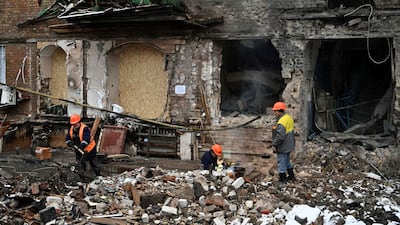
Repairmen work near a residential building damaged following a missile attack in Vyshgorod, outside of Kyiv. AFP -
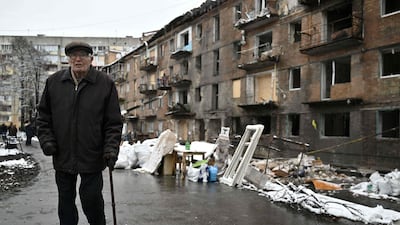
An elderly man walks in front of a residential building damaged following a missile attack in Vyshgorod. AFP -

A boy kisses a dog while he charges his phone at the heating tent dubbed a Point of Invincibly in Bucha, Ukraine. AP -

A couple uses a laptop in the heating tent. AP -
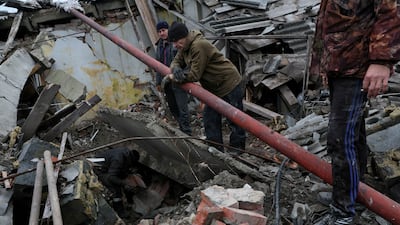
Workers dig out a tire from the rubble of a destroyed storage building at a grain processing center so they can use it for repairs in Siversk, Donetsk region. Reuters -
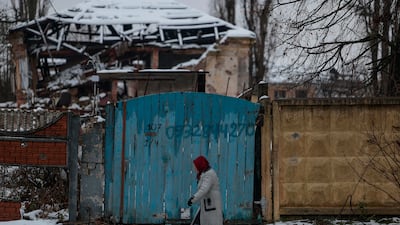
The Chernihiv region found itself on the frontline of Russia's invasion in February, when Moscow's forces were attempting to quickly seize Kyiv. Getty -
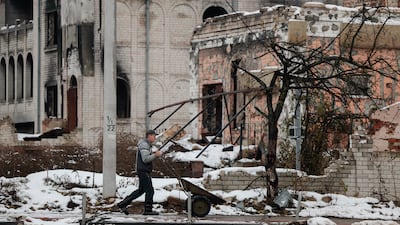
Russia ultimately retreated from northern Ukraine to focus its attack on the east and south. Getty -
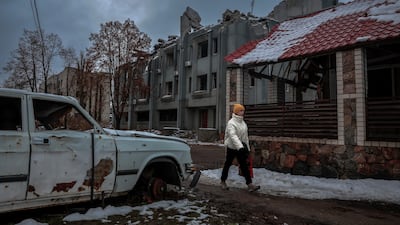
The city of Chernihiv on November 28, 2022 in Chernihiv, Ukraine. Getty -
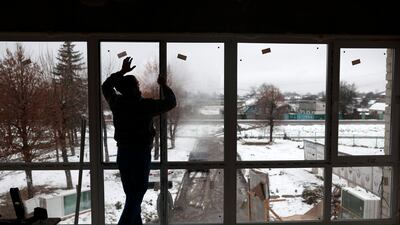
A worker fits in new windows of a building in Chernihiv. Getty -

People receive food from AFAT - Disaster and Emergency Management Presidency in Chernihiv. Getty -
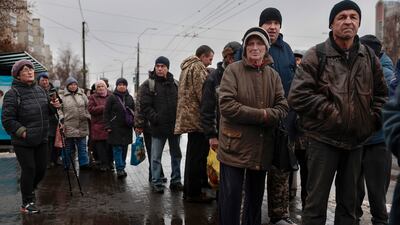
The people Chernihiv queue up for hot food. Getty -
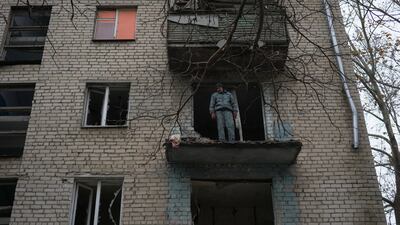
Oleksandr Antonenko stands on a balcony of his apartment damaged by a recent Russian military strike in Kherson. Reuters -
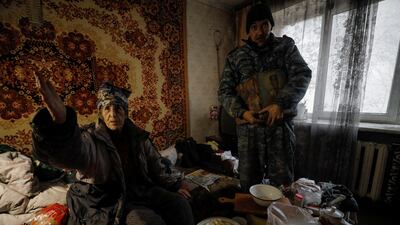
Mr Antonenko and his mother Liudmyla inside their apartment recently damaged by a Russian military strike in Kherson. Reuters -

A woman walks in an underpass in Kyiv, on November 26, 2022. AFP -
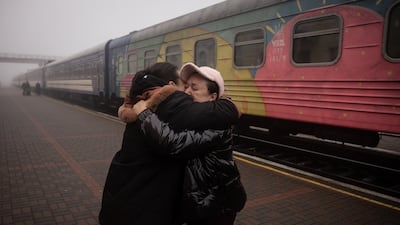
Friends hug after the arrival of a train in the southern city of Kherson. Getty -
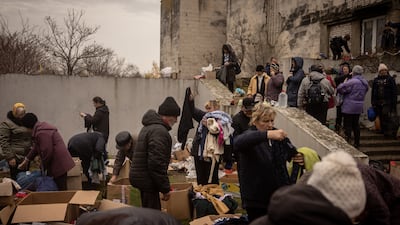
Residents sort through donated clothing at an aid centre in Kherson. Getty -
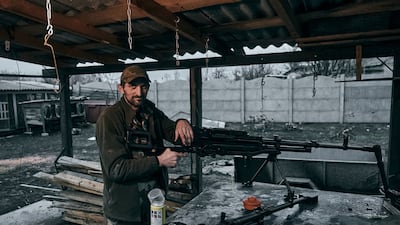
A Ukrainian soldier stands with a machinegun near Liman in the Donetsk region. AP -

Children attend a physical education class at Spilno School in Kyiv. Getty -

A woman embraces her friend, a soldier in the Ukrainian army, in Kherson. AFP -
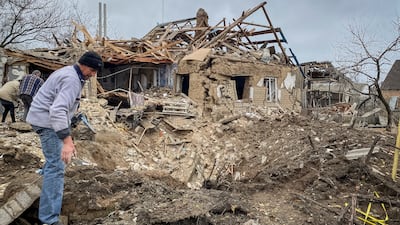
Residents inspect a crater left by a Russian military strike in the village of Komyshuvakha in the Zaporizhzhia region. Reuters -
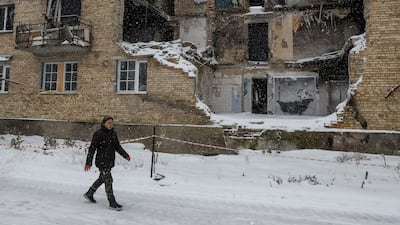
Resident Tetiana Reznychenko walks past a work by world-renowned graffiti artist Banksy, on the wall of a destroyed building in the Ukrainian village of Horenka. Reuters -
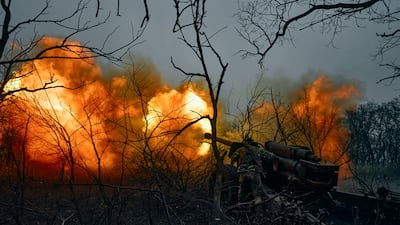
Ukrainian soldiers fire artillery at Russian positions near Bakhmut in the Donetsk region. AP -

A fisherman sails his boat on the Dnipro as black smoke rises from an oil reserve in Kherson. AFP


With Monday’s deadline looming, there isn’t “much time to parse out this disagreement for much longer,” she said, adding that “$60 is better than not agreeing at all. They can obviously revise it later on to reflect conditions on the market … and tighten it.”
Former US treasury secretary Steven Mnuchin has dismissed the plan as “ridiculous.”
Mr Mnuchin told CNBC during a panel in November at the Milken Institute think tank's Middle East and Africa summit that the price cap was “not only not feasible, I think it’s the most ridiculous idea I’ve ever heard”.
Rachel Ziemba, an adjunct senior fellow at the Centre for a New American Security think tank, said “this will be an interesting few weeks and few months”.
“Russia has made is clear the countries that abide by the cap won’t receive their oil and that could result in cuts to natural gas exports as well,” she said.
What if Russia and other countries won't go along?
Russia has said it will not observe a cap and will halt deliveries to countries that do. While Russia could ignore the cap if it’s above the selling price of its oil, a lower limit could see Moscow retaliate by shutting off shipments in the hope of profiting from a higher global oil price on whatever it can sell around the sanctions.
Buyers in China and India might not go along with the cap, while Russia or China could try to set up their own insurance providers to replace those barred by US, UK and Europe. Russia could also sell oil off the books by using “dark fleet” tankers with obscure ownership, as have Venezuela and Iran.
Even under those circumstances, the cap would make it “more costly, time-consuming and cumbersome” for Russia to sell oil around the restrictions, Ms Shagina said.
The greater distances involved in shipping oil to Asia means up to four times more tanker capacity is needed — and not everyone will take Russian insurance.
“You need to tap into this dark fleet, and it’s not limitless,” she said. “Iran and Venezuela are using it, rather effectively, but you might face competition with the same targets. … This cat-and-mouse game is always inherent in sanctions mechanisms.”
What about the EU embargo?
Russia may struggle to find buyers for all of the 1 million barrels a day it is shipping to Europe, formerly its biggest customer, but will likely reroute most of them as Europe finds new suppliers on the global market.
The biggest impact from the EU embargo may not come Monday, as Europe finds new suppliers and Russian barrels are rerouted, but on Feb. 5, when Europe’s additional ban on refinery products made from oil — such as diesel — come into effect.
Europe still has many cars that run on diesel. The fuel also is used for lorry transport to get a huge range of goods to consumers and to run agricultural machinery — so those higher costs will be spread throughout the economy.

