


Ukraine’s social media is the key to winning the “first digital war” fought by citizens, the head of Britain’s Strategic Command has said.
The deluge of information provided by the local population taking pictures of Russian military was a “significant factor” in Ukraine’s success, said Gen Sir Jim Hockenhull.
This meant that individual citizens had essentially become spotters for the military. “What's happened is that so many people have become sensors, that every citizen, every phone has become a sensor,” he told the RUSI think tank.
The rapid feedback of information from commercial and social media information was “increasing the speed of action” in being able to target Russian forces.
He also argued that whichever side gained the upper hand first in the new open source intelligence war would “win” with mobile phones playing a key role.
Military observers believe that it is now becoming clear that the combination of precision weapons, drone and the social media information has allowed Ukraine to defeat Russia’s invasion.
In a David versus Goliath context this has allowed Ukraine to very quickly attack Russian targets of opportunity with exacting consequences and is a counterbalance to Moscow’s numerically superior forces.
The sheer number of civilian surveillance satellites and other surveillance meant that unlike military communications they were hard to “jam or disrupt,” said Gen Hockenhull, who previously commanded the UK’s Defence Intelligence organisation.

“It's incredibly difficult to overcome those commercial networks and therefore, that force multiplier of sensors has been a really significant factor in the way in which the Ukrainian military have been able to generate information advantage,” he told the webinar How Open-Source Intelligence Has Shaped the Russia-Ukraine War.
The “crowdsourcing” of information via chatbots had “allowed Ukrainian citizens to report Russian units and locations”.
“That civilian sensor network has been both a force multiplier, but also it's been able to provide a variety of viewpoints around information,” he added “That crowdsourcing has been really, really important and as the longer the conflict has gone the Ukrainians have got much better at being able to harness that enormous quantity of information to see what they can divine from it.”
The tremendous opportunities offered by open source intelligence meant that “whoever learns fastest is going to win”, he said.

The open source reporting had also “enabled an amazing extension and reach of the Ukraine military's situational awareness”.
With the huge amount of information available from commercial satellites, military sources and civilian phones the Ukraine conflict “can be viewed as the first digital war”
“This has enabled an amazing extension in reach of the Ukraine military's situational awareness and their ability to conduct some reconnaissance.”
The information had also influenced how the public “understood the way in which the conflict is taking place”.
He highlighted the Russian attempt at disinformation on 17 February – a week before the invasion – when it put out a “false narrative” that it was deploying away from Ukraine’s borders a lie that was “quickly exposed by an open source community”.

“It was able to show that not only were troops still in place but in fact what was happening was a redeployment of force in order to be able to better execute and the invasion,” he said.
“This was incredibly important in being able to rebut false flag narratives from the Russians, The fact that the truth was well known meant that as soon as false narratives put out by the Russians, they were immediately exposed or indeed, in many ways totally understood by the public to be a false narrative. That power of information and knowledge had a really significant impact on public on being able to counter Russian information operations.”
The information war, which included rapid reporting of Russian atrocities, such as in Bucha or attacks on civilian infrastructure with kamikaze drones, was key in getting support from western power.
“We think that one of the crucial elements of success in Ukraine conflict has been the commitment of western nations to provide support,” he said. “I think a lot of that has been driven by the public being able to see and understand what has happened, what is happening.”
But the general said that experts had to be careful on the lesson from Ukraine to avoid “looking in those locations where the light illuminates most” which could mean that important areas are missed due to “availability bias”.
Ukraine war latest - in pictures
-
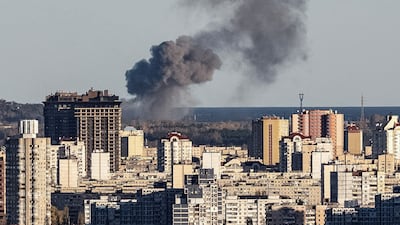
Smoke rises on the outskirts of the city during a Russian missile attack in Kyiv. Reuters -

Workers surround the Monument to the Heroes of the Heavenly Hundred with sandbags against damage from shelling in Mykolaiv. EPA -
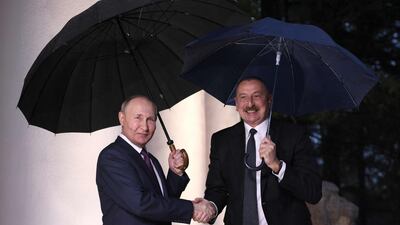
Russian President Vladimir Putin welcomes Azerbaijan President Ilham Aliyev for talks before a meeting between the Russian president and the leaders of Armenia and Azerbaijan in the Black Sea resort city of Sochi, Russia. AFP -
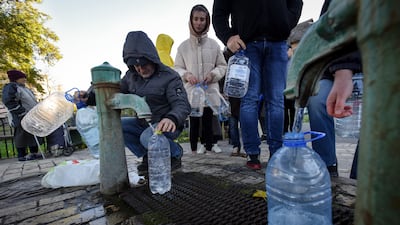
People take water from a water pump in Kyiv. EPA -
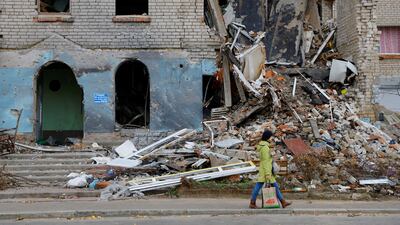
A woman walks past a damaged building in the town of Nova Kakhovka. Reuters -
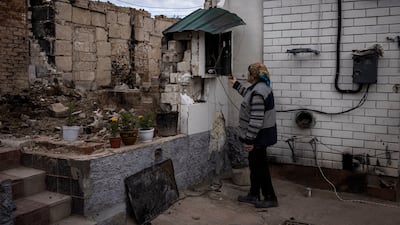
A woman outside her home, which was destroyed during battles at the start of the conflict, in Yahidne, Chernihiv. Getty Images -
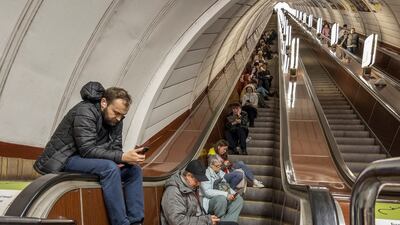
People shelter inside a subway station during a Russian missile attack in Kyiv. Reuters -
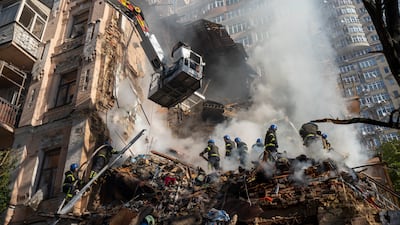
Firefighters at the site of a drone attack in Kyiv, Ukraine. AP -
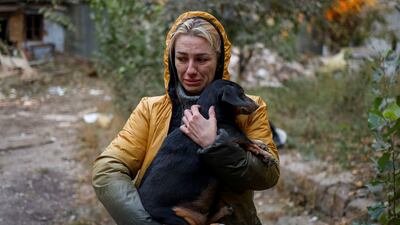
A woman walks past the site of a Russian missile strike in the southern Ukrainian city of Mykolaiv. Reuters -
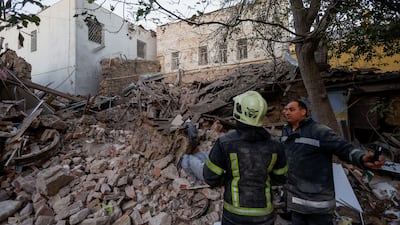
Rescuer workers at a building destroyed in an attack in Mykolaiv. Reuters -
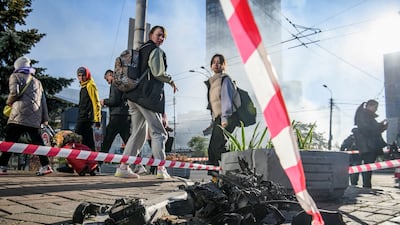
Parts of a drone lie on a street in Kyiv. Reuters -
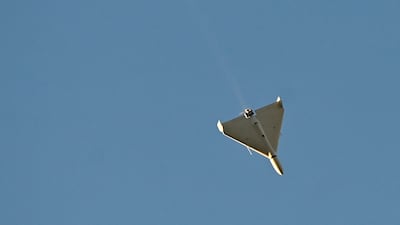
A drone flies over the Ukrainian capital during an attack. AFP -
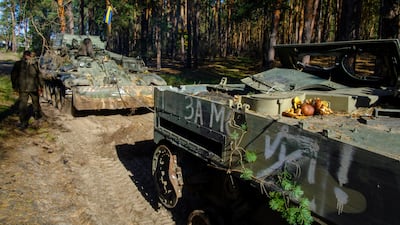
Ukrainian servicemen tow a captured Russian armoured vehicle in Rudneve village, Kharkiv. EPA -
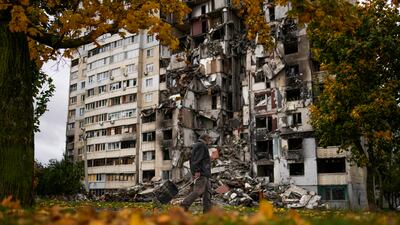
A partially destroyed residential building in Saltivka, in Kharkiv. AP -
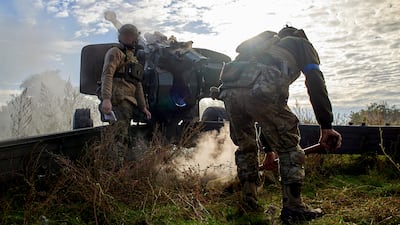
Ukrainian servicemen fire a captured Russian howitzer on a front line near Kupyansk city, Kharkiv. EPA -
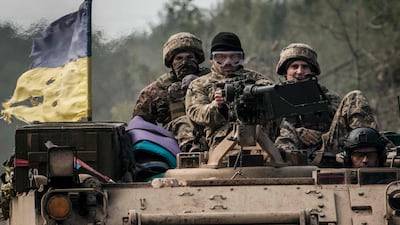
Ukrainian servicemen near the recently retaken town of Lyman in Donetsk region. AFP -
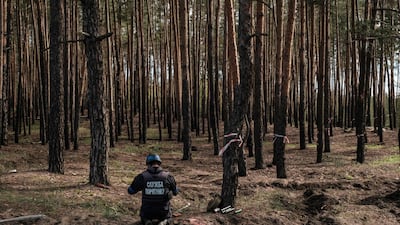
An officer from a Ukrainian national police emergency demining team prepares to detonate collected anti-tank mines and explosives near Lyman, in the Donetsk region. AFP -
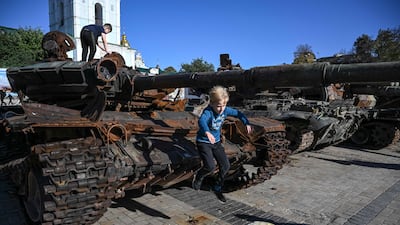
A boy playing on a destroyed Russian tank on display in Kyiv. AFP -
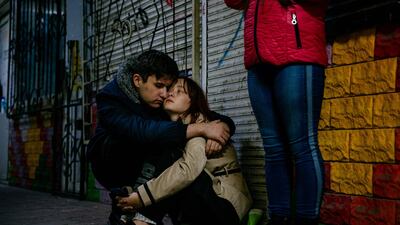
A young couple hiding underground during an air alert in Zaporizhzhia. AFP -
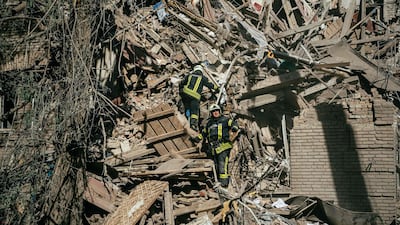
Ukrainian firefighters looking for survivors after a strike in Zaporizhzhia. AFP -
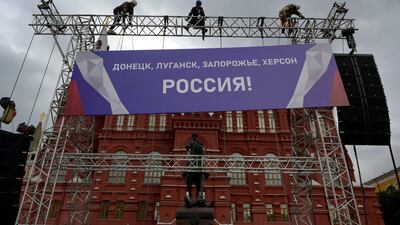
Workers fix a banner reading 'Donetsk, Luhansk, Zaporizhzhia, Kherson - Russia!' to the State Historical Museum near Red Square in Moscow. AFP -

Residents try to cross a destroyed bridge in the Kharkiv region of Ukraine. AFP -
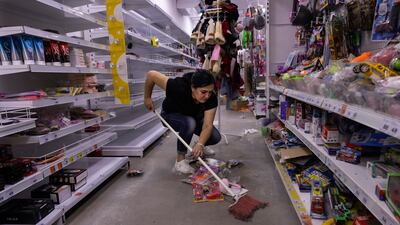
Alyona Kishinskaya helps to clean up a shop as it prepares to reopen in Balakiya, Ukraine, after a six-month Russian occupation. Getty Images -
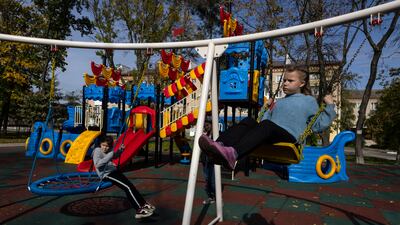
Alla, 12, has a swinging time in Balakiya, Ukraine, as life goes on despite the war. Getty Images -
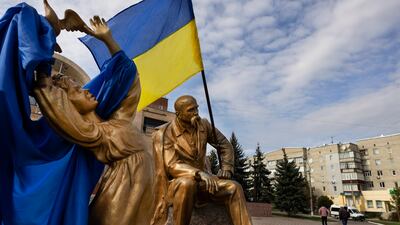
Ukrainian flags in the town square in Balakiya. Getty Images -
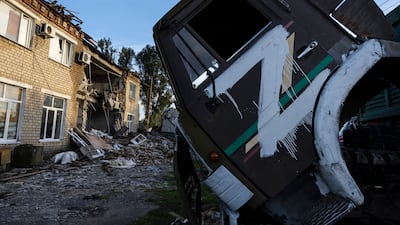
A destroyed Russian command centre in Izium, Ukraine. Getty Images -

In what may be a final farewell, young Russian recruits - escorted by their wives - walk to a train station in Volgograd before being sent to war in Ukraine. AP -
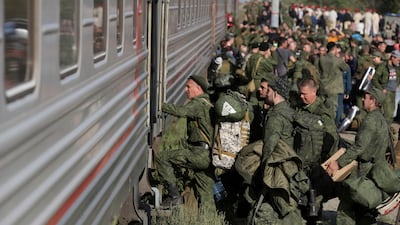
Russian recruits board the train to Ukraine in Volgograd. AP -
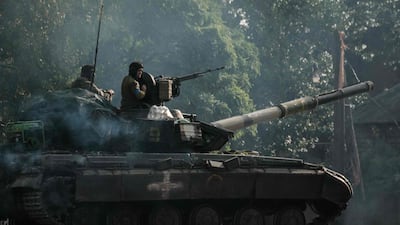
Ukrainian soliders drive a tank at the recently retaken eastern side of the Oskil River in Kharkiv region, Ukraine. AFP -
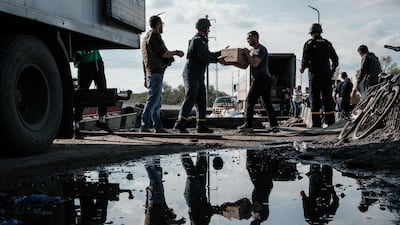
Volunteers pass boxes of food aid on a destroyed bridge over the Oskil River. AFP -
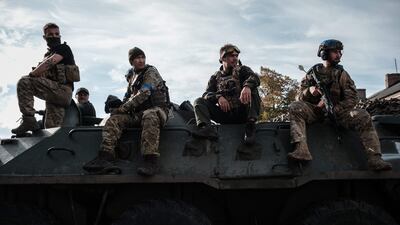
Ukrainian soliders rest on an armoured personnel carrier. AFP -
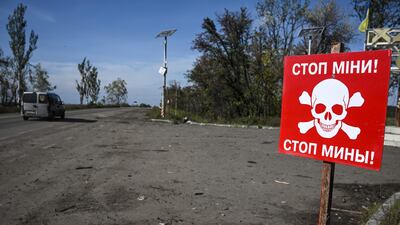
A sign warns of landmines in Izyum, eastern Ukraine. AFP -
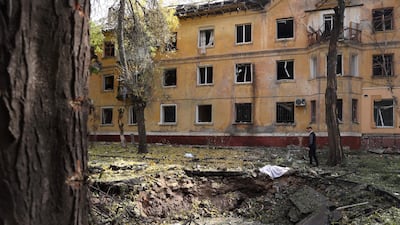
This crater was left after a missile strike in the Donetsk region of Ukraine. AFP



