


Russia says it will take retaliatory action against Lithuania that will have a “serious negative impact” following the Baltic state’s ban on the transit of freight to Kaliningrad.
Moscow is preparing to hit back after the government in Vilnius halted the movement of EU-sanctioned goods to the Russian territory sandwiched between Poland and Lithuania on the Baltic coast.
Shipments of coal, metals, construction materials and advanced technology, accounting for around 50 per cent of all goods imported into Kaliningrad, will no longer reach the enclave by rail through Lithuania in a move that threatens to strangle the territory.
One of President Vladimir Putin's top allies on Tuesday gave warning to Lithuania that the Kremlin would respond in such a way that the citizens of the Nato and EU member would feel the pain.
Nikolai Patrushev, a former KGB spy who is now the secretary of Russia's Security Council, said Lithuania's “hostile” actions showed that Russia could not trust the West.
“Russia will certainly respond to such hostile actions,” Mr Patrushev told state news agency RIA. “Appropriate measures are being worked out in an interdepartmental format and will be taken in the near future. Their consequences will have a serious negative impact on the population of Lithuania.”
Kaliningrad, formerly the port of Koenigsberg, capital of East Prussia, was captured from Nazi Germany by the Red Army in April 1945 and ceded to the Soviet Union after the Second World War. About 490,000 people live there.
Lithuania announced the ban on Monday, saying it was an implementation of EU sanctions unveiled by the bloc after Russia’s invasion of Ukraine on February 24.
Russia's Foreign Ministry summoned the EU's ambassador to Moscow, Markus Ederer, over the situation.
“Lithuania is not taking unilateral measures — it is implementing EU sanctions,” Mr Ederer was quoted as saying by RIA.
The battle for the Donbas region of eastern Ukraine continued to shift in Russia’s favour on Tuesday as invading forces pushed deeper into the heartland of coal mines and factories. Russian forces claimed to have captured the frontline village of Toshkivka near the twin cities of Severodonetsk and Lysychansk, the site of fierce fighting for weeks.
“As of today, according to our information, Toshkivka is controlled entirely by the Russians,” Roman Vlasenko, the head of the Severodonetsk district, told Ukrainian television. He said the battle for Donbas was “now in full swing”.
Toshkivka, with a pre-war population of around 5,000 people, is about 25 kilometres south of Severodonetsk, the flashpoint city where there has been street-to-street fighting in recent weeks.
“The entirety of the Luhansk region is now the epicentre of fighting between Ukraine and the Russian army,” he said.
Meanwhile, a former national security adviser to Donald Trump says the UK is taking a stronger role than that of the US in the West’s collective response to the invasion of Ukraine.
John Bolton, who served in the Trump administration from 2018 to 2019, is expected to say that Brexit has afforded Britain the opportunity to take on a “fully independent role” in Nato.
He is to make the remarks on Tuesday at the launch of a report on Britain’s role in the world after it left the EU.
He will claim that the UK is no longer constrained by the “smoothie-making, decision-making process” of the bloc.
-
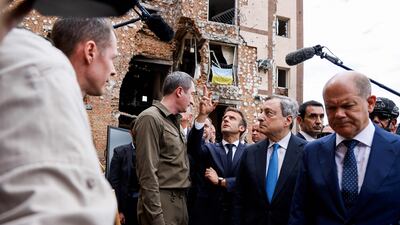
French President Emmanuel Macron (C) makes a point as he visits Irpin with Italian Prime Minister Mario Draghi (2nd L) and German Chancellor Olaf Scholz (L). AFP -
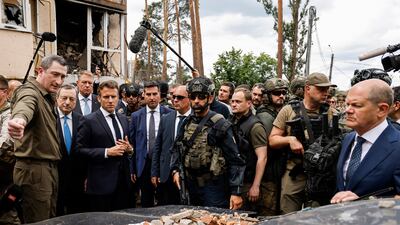
Mr Draghi (2nd-L), Romanian President Klaus Iohannis (3rd-L), Mr Macron (fourth-L) and Mr Scholz (R). EPA -
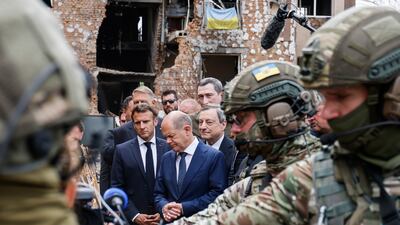
The leaders of France, Germany, Italy and Romania arrived in Kyiv in a show of collective European support for Ukraine. AP -

They visited a building damaged in fighting near Kyiv. Reuters -
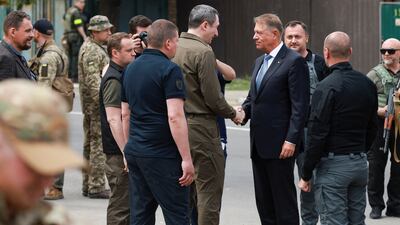
Mr Iohannis is greeted during his visit to Irpin. Reuters -
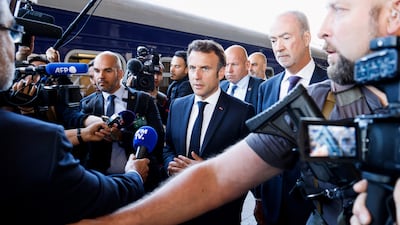
Mr Macron speaks to journalists at a Kyiv railway station. EPA -

Mr Iohannis arrives at the hotel where the leaders are staying. AFP -
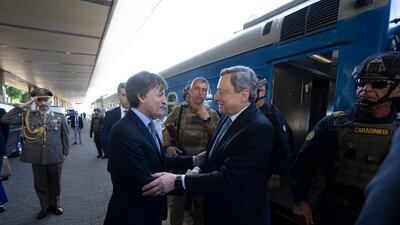
Italian ambassador to Ukraine Pier Francesco Zazo (L) welcomes Italian Prime Minister Mario Draghi to Kyiv. EPA -
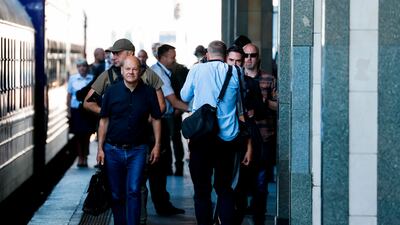
Mr Scholz arrives in Kyiv by train. AP -
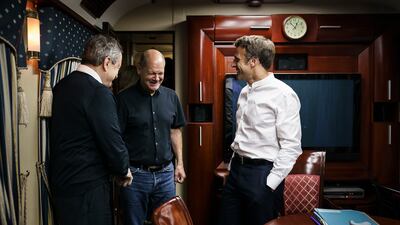
(L-R) Mr Draghi, Mr Macron and Mr Scholz. Getty Images -
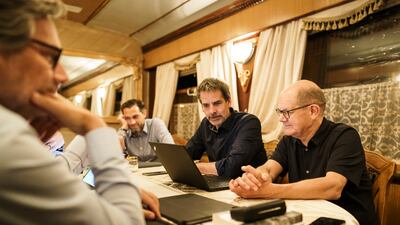
Mr Scholz (R) on a night train to Kyiv. Getty Images


On the Russian invasion of Ukraine, he will say: “Britain has taken a leading role in the West’s efforts to defeat this aggression and to make the point to would-be aggressors around the world.
“In many respects, I say with some envy, taking a stronger and more effective view than the USA.”
The British military on Tuesday said Ukrainian forces had reported their first successful use of western-donated Harpoon anti-ship missiles against Russia.
“The target of the attack was almost certainly the Russian naval tug Spasatel Vasily Bekh, which was delivering weapons and personnel to Snake Island in the north-western Black Sea,” the UK’s Ministry of Defence said in an intelligence update on Twitter.
“The destruction of the Russian vessel on a resupply mission demonstrates the difficulty Russia faces when attempting to support their forces occupying Snake Island.”

