


Nato needs to triple the size of its forces in the Baltic States owing to the risk of hostilities from Russia, Lithuania’s Foreign Minister said before the western alliance summit next month.
Gabrielius Landsbergis has also urged the alliance to base large numbers of tanks, artillery and air defences in his country to deter an invasion.
He told The National that at the Nato summit in Madrid next month, countries that border Russia would “make the arguments” for the alliance to significantly increase its presence on its eastern flank.
Triple defence
Mr Landsbergis called for a significant increase in Nato forces stationed in Lithuania, bringing them to brigade strength.
There is currently only a single battalion of German troops and a few US soldiers that form the Enhanced Forward Presence (EFP), where Nato stations forces on its eastern flank to act as a tripwire for a Russian invasion.
With Lithuania bordering Russia and Belarus, Mr Landsbergis called for the Nato EFP to be increased to about 3,000 troops.

“That's three times more than we currently have,” he said. “We are also talking about forward presence that would be ready to accept even more troops, but they would not need to bring in their equipment if they pre-position tanks, artillery and missiles in Lithuania.
“We would also like to see more allied troops permanently stationed in Lithuania, together with the equipment that would be used to defend what [US] President [Joe] Biden called ‘defending of every inch of the territory’.
“We would like for that strategy to become very practical, not just a political phrase.”
Russian attack
Mr Landsbergis said Lithuania called for an international effort to force through a Black Sea humanitarian food corridor to export grain from Ukraine amid Russia's invasion.
“It is vital we do something quickly to feed the world,” Mr Landsbergis said. “I fear the worst is yet to come in the coming weeks, with people in North Africa and the Middle East paying huge prices to put food on their table.”
While Russian President Vladimir Putin remains in power, it was Lithuania’s “fundamental understanding” that the countries bordering Russia, “either Nato or non-Nato, will be in danger”.
“For now, Russia is fully immersed in its invasion of Ukraine, which isn't going so well, but I think that in the near future it will start doing something in other countries,” Mr Landsbergis said.
“This is why we're worried and one of the reasons why we're asking for our Nato allies to strengthen the eastern flank. Right now, it looks like Russia is overwhelmed with Ukraine but, given time, that might change.
“Clearly Russia is a country that is ready and willing to use massive military force and even when used unsuccessfully, there is still a devastating effect, as we are seeing in Ukraine where cities are levelled to rubble.”
Border states
Lithuania, with a population of three million, and its fellow Baltic states of Estonia and Latvia, are in “a very concerning, geographic position to live in”, but Nato provided a “credible deterrence that the territory would be denied and not an inch would be taken”.
Following the Ukraine invasion, Sweden and Finland have applied for Nato membership.
Lithuania, which has a 300-kilometre border with Russia’s Kaliningrad exclave, would welcome the “more secure environment” the Nordic states would bring.
“But it doesn't change the situation in having Belarusian and Russian military bases on the other side of the border,” Mr Landsbergis said.
“Their application is very much welcomed, but it's not sufficient to change the situation in the Baltic region.”

Their accession would also bring the two Nordic countries under Nato’s nuclear umbrella as there was “always a possibility that Russia could escalate, using unconventional weapons”, he said.
“We have to be very clear that Nato is a nuclear alliance and that that deterrence has to be reminded.”
Energy foresight
He said Lithuania had the foresight to negotiate gas contracts before the invasion began on February 24.
“Since the first mention of a possible war, we were actively looking for contracts for LNG [liquefied natural gas] from the countries that are not Russian suppliers,” he said.
“We managed to pre-purchase several contracts that we were able to use when the war broke out and that allowed us to cut the ties with Russia.”
-

Service members of pro-Russian troops drive a tank past a destroyed residential building in the town of Popasna in the Luhansk region, Ukraine. Reuters -
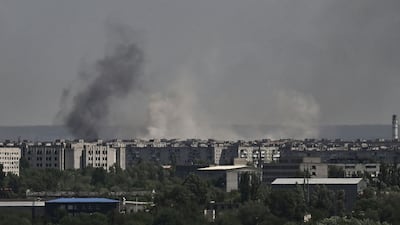
Smoke and dirt rise from the city of Severodonetsk during shelling in the eastern Ukrainian region of Donbas. AFP -
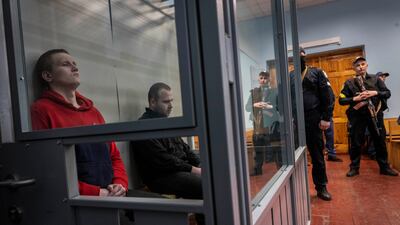
Russian soldiers Alexander Alexeevich Ivanov and Alexander Vladimirovich Bobykin, left, attend their trial hearing in Kotelva, northeastern Ukraine. AP Photo -
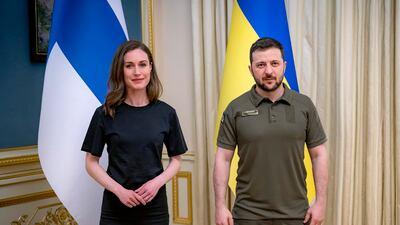
Ukrainian President Volodymyr Zelenskyy, right, meets with Finnish Prime Minister Sanna Marin in Kyiv, Ukraine. AP -
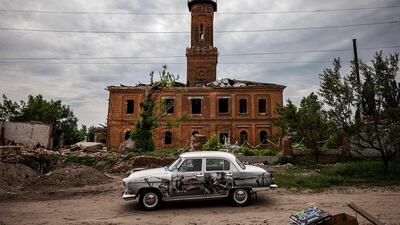
A man drives a GAZ-21 Volga car past a damaged building in Kharkiv, eastern Ukraine, on the 92nd day of the Russian invasion of Ukraine. AFP -
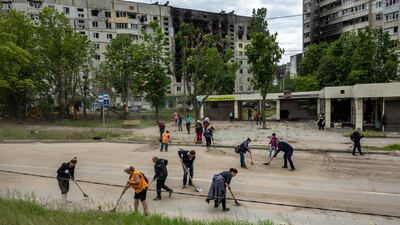
Public transit workers sweep up shrapnel in Kharkiv, Ukraine. Getty Images -
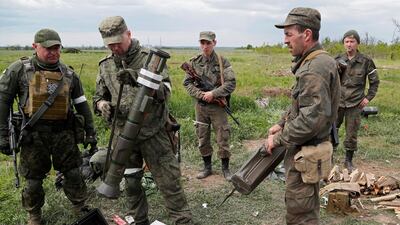
Pro-Russian troops inspect an AT4 anti-tank launcher outside the town of Svitlodarsk in the Donetsk region, Ukraine. Reuters -
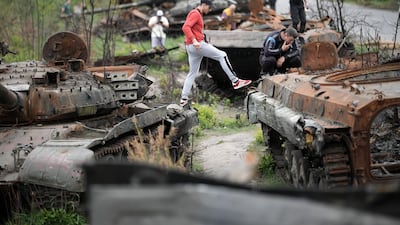
People inspect destroyed Russian tanks and armoured vehicles in Irpin, Ukraine. Getty Images -

A local resident pets a cat next to a destroyed house in Vilkhivka village, near Kharkiv, Ukraine. AFP -
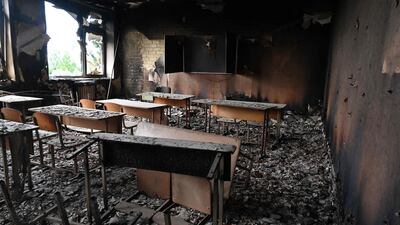
The remains of a school in Vilkhivka village, near Kharkiv. AFP -
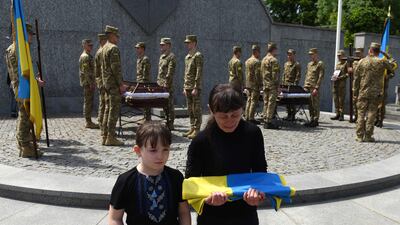
Widow and daughter of Andriy Vertiev, a Ukrainian serviceman, killed during the Russian invasion of Ukraine, attend his funeral at Lychakiv cemetery, Lviv, Ukraine. AFP -
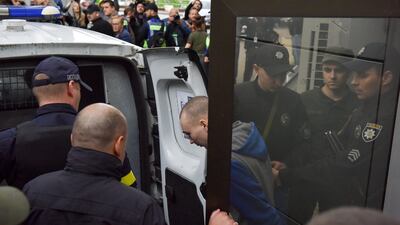
Russian serviceman Vadim Shishimarin, centre, leaves a court hearing in Kyiv. EPA -
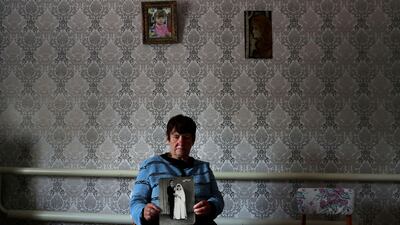
Kateryna Shelikhova, widow of Oleksandr Shelipov, 62, who was shot dead by a Russian soldier. Reuters -
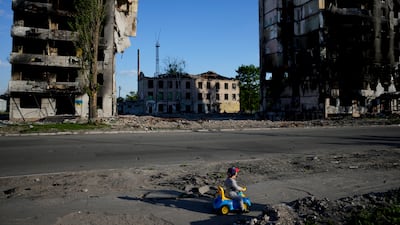
A child plays against a backdrop of buildings ruined by shelling in Borodyanka, Ukraine. AP -
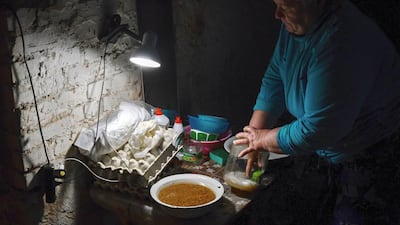
A Ukrainian woman in the basement of a building used as bomb shelter in Soledar, Donetsk region. AP -
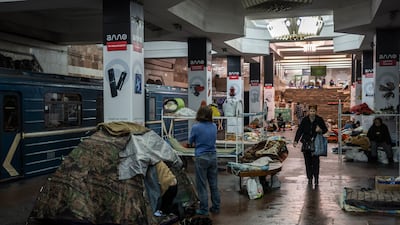
Residents live in a subway station used as temporary shelter in Kharkiv. AP -
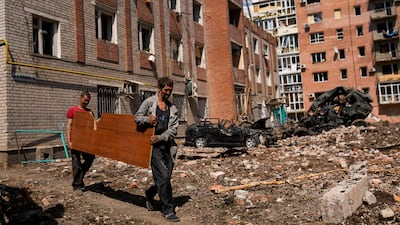
Men with salvageable material from damaged buildings after Russian bombing in Bakhmut, eastern Ukraine. AP -
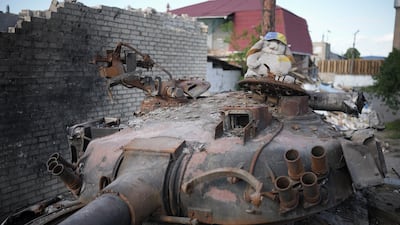
A cuddly toy adorns a destroyed Russian battle tank near damaged homes in Hostomel, Ukraine. Getty Images -
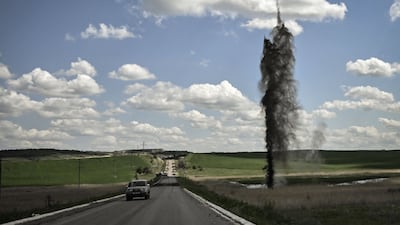
A mortar explodes next to a road leading to the city of Lysychansk, in the eastern Ukrainian region of Donbas. AFP -
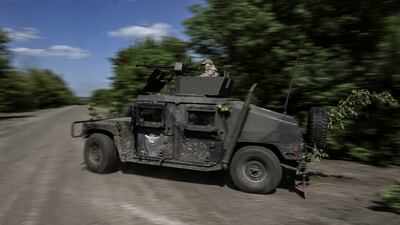
A Ukrainian army vehicle moves towards the front line at a checkpoint near Lysychansk. AFP -
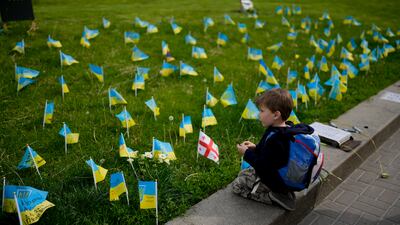
A boy looks at flags honouring soldiers killed while fighting Russian troops, in Kyiv city centre. AP -
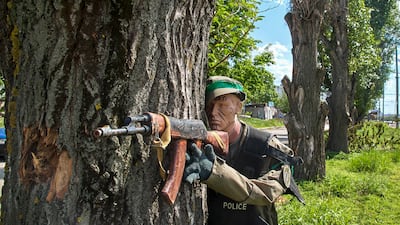
A mannequin with a fake gun is placed as bait on a roadside in the Nord Saltivka district of Kharkiv. EPA -
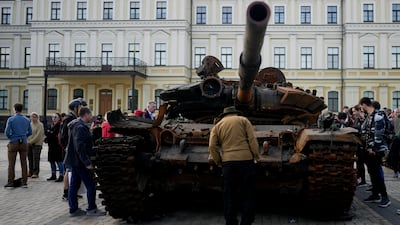
A man looks at a destroyed Russian tank placed as a symbol of war, in central Kyiv. AP -
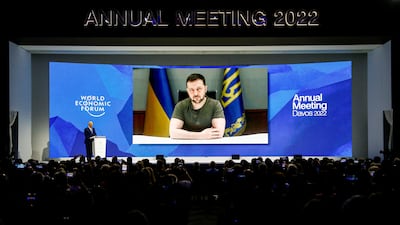
Ukraine's President Volodymyr Zelenskyy on a screen at the opening ceremony for the World Economic Forum in Davos, Switzerland. Reuters -
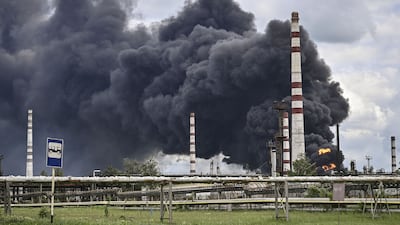
Smoke billows from an oil refinery after an attack outside the city of Lysychansk, in the eastern Ukrainian region of Donbas. AFP -
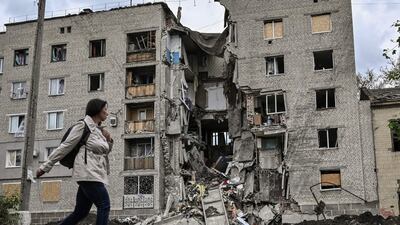
A woman walks by a destroyed apartment building in Bakhmut, Donbas region. AFP -
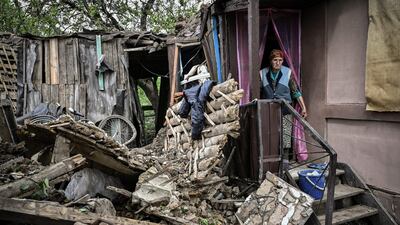
An elderly woman stands inside her heavily damaged house after it was hit by a missile in Bakhmut. AFP -
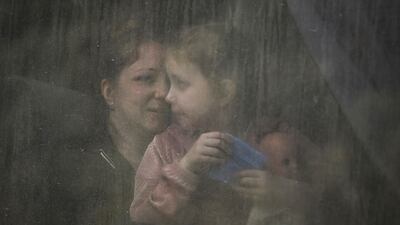
A mother with her daughter sit inside a bus as they leave Bakhmut. AFP -
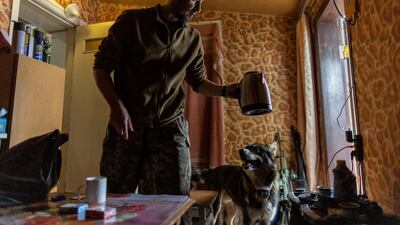
A Ukrainian soldier prepares coffee as he takes a break near an artillery position in the breakaway enclave of Donetsk, in the Donbas region. Reuters -
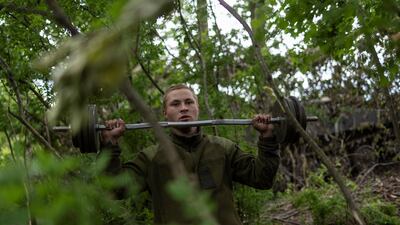
A Ukrainian soldier exercises near Donetsk. Reuters -
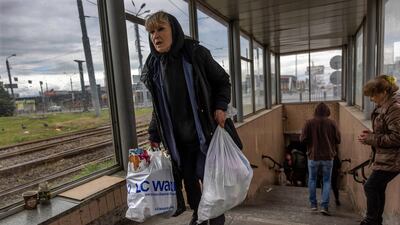
A woman displaced by incessant Russian shelling leaves a metro station where people had been living underground for months in Kharkiv, Ukraine. Getty -

A heavily damaged home spa near Ruski Tyshky village in Ukraine. Getty -

The wreckage of a Ukrainian military helicopter is transported in Kharkiv. Getty -
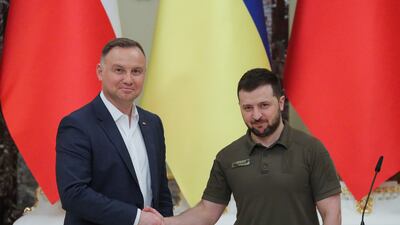
Ukrainian President Volodymyr Zelenskyy and Polish President Andrzej Duda in Kyiv. EPA -
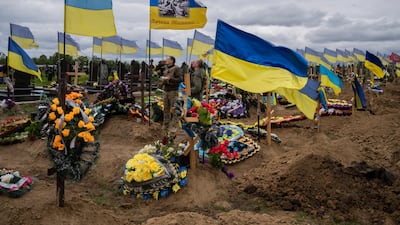
Two Ukrainian national guard soldiers pay their respects at a cemetery in Kharkiv. AP -
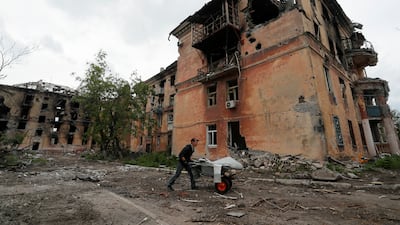
A man pushes a wheelbarrow past a heavily damaged apartment building near Azovstal Iron and Steel Works in Mariupol. Reuters -
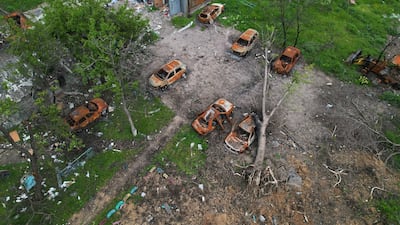
The burnt out shells of cars in a residential area near Azovstal Iron and Steel Works in Mariupol. Reuters -
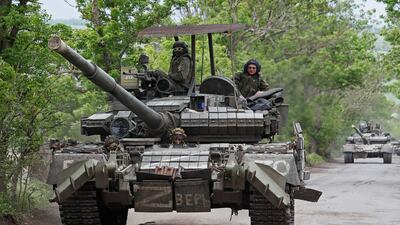
Pro-Russian troops drive a tank in Ukraine's Donetsk region. Reuters -
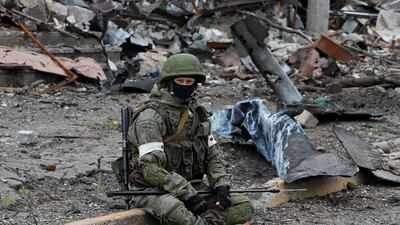
A Russian soldier takes a break during an operation to demine the territory of Azovstal steel plant in Mariupol. Reuters -
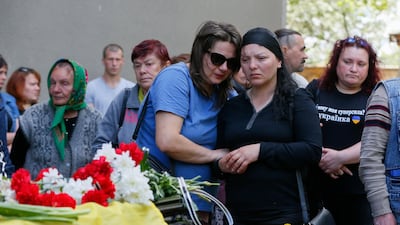
Relatives and friends attend the funeral of a Ukrainian soldier killed in action, in the Odessa region city of Rozdilna. EPA -
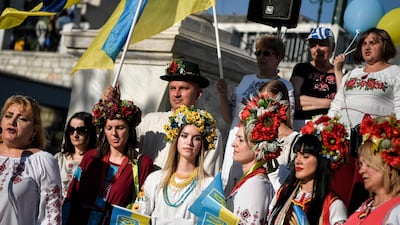
Ukrainians wearing traditional clothing listen to their national anthem as they take part in the celebration of 'Vyshyvanka Day', an annual celebration of Ukrainian folk traditions, in Athens. AFP


The Lithuanian government also came to a political decision in whicvh “we don't want to have any business deals when it comes to energy with Russia", Mr Landsbergis said in London.
“By 2025, we hope to delink our electricity system from Russia and be fully integrated into the European grid.”
Over time, he believes that Europe shutting off the energy link will have a major impact on Russia’s economy and prove “a game-changer” in preventing future aggression.
The move was also pushing Europe much faster towards green energy supplies, with Lithuania among those “aggressively pursuing the renewable strategy” with wind farms.
Food emergency
With the growing global food emergency caused by Russia’s blockade of Ukraine’s Black Sea ports, Mr Landsbergis called for an international solution.
“We are running out of time with a new harvest coming and already 25 million tonnes of grain in storage,” he said.
With different railway gauges between Ukraine and Europe and slow road transport, the “only practical way” of exporting the food is through the Black Sea ports.
An international effort is necessary because “nobody wants Russians to use the opportunity to attack” and it is “obvious that Russia has no interest in finding any workable solution”.

