On board London's 'spectacular' Elizabeth line as long-delayed route prepares to open


Tim Stickings
  • English
  • Arabic

London’s most delayed train is about to arrive roughly four years behind schedule, but the city’s transport chief Andy Byford believes it will be “the envy of the world” when passengers eventually get on board.

The Elizabeth line, a 100-kilometre east-to-west railway first dreamt up when the queen after whom it is named was a young princess, will open its central tunnels this month as a £19 billion ($23bn) project whirrs into life at last.

Its sleek fleet of trains will take commuters from the financial centres of the City of London and Canary Wharf to the Victorian surroundings of Paddington and, when the line’s western arm is linked up in the autumn, to Heathrow Airport.

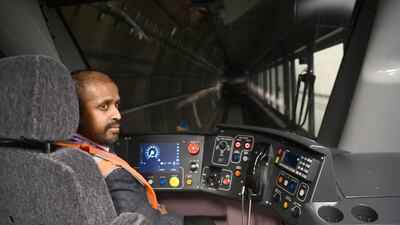
Empty nine-car trains already glide through its stations at five-minute intervals after 15 months of testing, their drivers ready to replace their lonely vigils with what insiders expect to be 200 million passengers a year.

The nine-minute, air-conditioned ride through the centre is likely to be a relief from the overheated conditions on a slower east-west artery, the Central line, while the journey from the City to Heathrow will take less than 40 minutes.

And the 21st-century feel of the line, with its TV displays and automated doors, is meant as an upgrade to London’s 159-year-old rapid transit network – although pulling off the digital wizardry was what held it up for so long.

While the tunnelling was complete and the stations largely built by the time the current queen was meant to open the line in 2018, Mr Byford said his predecessors at Transport for London had underestimated the task of getting its software ready.

“This has been a labour of love,” he said in the cavernous Elizabeth line annexe of Paddington, where The National boarded for a preview ride on Wednesday. “There’s been myriad challenges but we’ve stared them down”.

  • An early peek at the platform of the Paddington Station stop of the new Elizabeth line in London. Tim Stickings / The National
    An early peek at the platform of the Paddington Station stop of the new Elizabeth line in London. Tim Stickings / The National
  • The east-west Elizabeth line railway will open on May 24 after years of delays. Victoria Pertusa / The National
    The east-west Elizabeth line railway will open on May 24 after years of delays. Victoria Pertusa / The National
  • The line will take commuters from the City of London and Canary Wharf to Paddington and, when the western arm is linked up in the autumn, to Heathrow Airport. Victoria Pertusa / The National
    The line will take commuters from the City of London and Canary Wharf to Paddington and, when the western arm is linked up in the autumn, to Heathrow Airport. Victoria Pertusa / The National
  • The new 'diagonal' lifts at Liverpool Street, which are timed to move at the same speed as adjacent escalators. Victoria Pertusa / The National
    The new 'diagonal' lifts at Liverpool Street, which are timed to move at the same speed as adjacent escalators. Victoria Pertusa / The National
  • The excavations required at Liverpool Street were so extensive that 3,000 skeletons were unearthed at the site. Victoria Pertusa / The National
    The excavations required at Liverpool Street were so extensive that 3,000 skeletons were unearthed at the site. Victoria Pertusa / The National
  • All the new stations in the city centre are 10 storeys deep. Victoria Pertusa / The National
    All the new stations in the city centre are 10 storeys deep. Victoria Pertusa / The National
  • A view of the platform at Liverpool Street. Victoria Pertusa / The National
    A view of the platform at Liverpool Street. Victoria Pertusa / The National
  • A map of the new line. Photo: Transport for London
    A map of the new line. Photo: Transport for London
  • A driver rides the Elizabeth line. EPA
    A driver rides the Elizabeth line. EPA
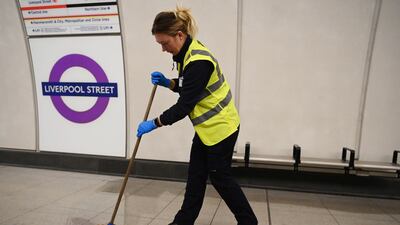
  • A cleaner prepares Liverpool Street station. EPA
    A cleaner prepares Liverpool Street station. EPA
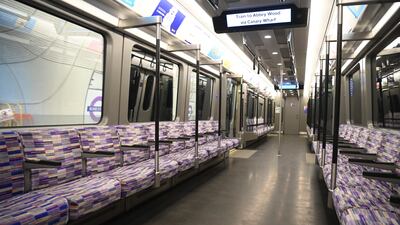
  • A view inside one of the new carriages on the Elizabeth line. EPA
    A view inside one of the new carriages on the Elizabeth line. EPA
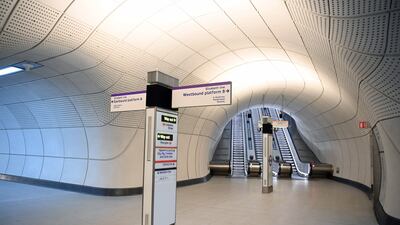
  • The curving tunnels stand ready at Liverpool Street. EPA
    The curving tunnels stand ready at Liverpool Street. EPA

Long road to opening

London has about a dozen railway terminuses handling trains from all over Britain, but only two lines make a complete north-south crossing and until now there has been no east-west line.

An idea similar to Crossrail, as the Elizabeth line is also known, surfaced in the 1940s in a vision for post-war reconstruction but came to nothing. Another proposal in the 1990s ran into economic problems and was rejected by MPs.

The idea was revived after the turn of the millennium and finally received parliamentary approval in 2008, beginning 42 kilometres of tunnelling that required three paths to be beaten under the River Thames.

The name was chosen in 2016 and London Mayor Sadiq Khan has described its opening date as a landmark moment in the year Britain celebrates the queen’s platinum jubilee.

All the new stations in the city centre are 10 storeys deep and London’s tallest building, the 310-metre Shard, could have lain on its side in the empty Paddington cavern after it was hollowed out, said Crossrail chief executive Mark Wild.

The Elizabeth line will initially open in three sections before the 100-kilometre route is joined up. Photo: Transport for London

The platforms are 250 metres long and one station, Liverpool Street, is so large that it effectively merges with nearby Moorgate — an idea “shamelessly stolen” from a Paris rail network that insiders regard as a model, Mr Wild said.

Another unusual element is a diagonal lift at Liverpool Street, timed to move at the same speed as adjacent escalators and built because it proved too difficult to construct a vertical lift shaft.

The excavations required at Liverpool Street were so extensive that 3,000 skeletons were unearthed at the site, including the remains of City of London parishioners who died in the medieval Black Death.

“I think people will be blown away when they see the scale of these stations, the length of the platforms,” said Mr Byford, who took over as boss of Transport for London in 2020 and made finishing the Elizabeth line a priority.

The 2018 opening date slipped back several times before Crossrail chiefs eventually committed to unveiling the line in the first half of this year, last week announcing May 24 as the opening date.

Liverpool Street station has a diagonal lift that moves at the same speed as adjacent escalators. Victoria Pertusa / The National

One of the software challenges was integrating the new tunnels and signals with the existing tracks of London on either side, which give the Elizabeth line its full length, from Reading in the west to Shenfield in the east.

The line will initially be in three parts – from Shenfield into Liverpool Street, the central stretch to Paddington and the final section to Heathrow and Reading – before it is joined up in what insiders say will be a few months.

This is absolutely spectacular, what we’re about to unveil to Londoners
Andy Byford

It will not open on Sundays until that work is complete and Bond Street station near London’s upmarket shopping district is not yet ready for passengers. There will initially be 12 trains an hour, eventually doubling to 24.

A longer-term goal is to link Heathrow to the north of England with a connection to the High Speed 2 railway line, but that is many years from completion and has been partly scaled back by ministers.

While pedants argue over whether Crossrail is a new London Tube line or part of the National Rail network, Mr Wild believes it is “a bit of both”, combining rapid urban transit with the comforts of a longer-distance train.

A fleet of air-conditioned, nine-car trains will run on the Elizabeth line. Victoria Pertusa / The National

Mr Byford is proud of what he calls the modern, uncluttered and temperature-controlled environment on the platforms, believing commuters will feel welcome as they resume normal travel schedules after the pandemic.

The fleet of air-conditioned trains known as Class 345s were built especially for Crossrail and are intended to run for decades.

But designers also dropped in nods to London’s heritage, with brickwork in the Paddington ticket hall evoking the station’s Victorian design and a ceiling at Liverpool Street meant to depict the pinstripe suits of City bankers.

At Paddington, Mr Wild said it was an honour to open London’s newest train line in the same place that the Tube was born in 1863, when a stretch from Paddington to Farringdon became the world’s first underground railway.

Meanwhile, at Liverpool Street, the curving tunnels stand ready with posters advertising the reduced journey times, while signs to the Elizabeth line are on proud display after premature ones were sheepishly covered up in 2018.

“This is absolutely spectacular, what we’re about to unveil to Londoners, to the UK and also to the world,” said Mr Byford, who compared the new line to Japan’s famously punctual bullet trains. “This is our pride and joy.”


THE BIO

Born: Mukalla, Yemen, 1979

Education: UAE University, Al Ain

Family: Married with two daughters: Asayel, 7, and Sara, 6

Favourite piece of music: Horse Dance by Naseer Shamma

Favourite book: Science and geology

Favourite place to travel to: Washington DC

Best advice you’ve ever been given: If you have a dream, you have to believe it, then you will see it.

Who's who in Yemen conflict

Houthis: Iran-backed rebels who occupy Sanaa and run unrecognised government

Yemeni government: Exiled government in Aden led by eight-member Presidential Leadership Council

Southern Transitional Council: Faction in Yemeni government that seeks autonomy for the south

Habrish 'rebels': Tribal-backed forces feuding with STC over control of oil in government territory

Mercer, the investment consulting arm of US services company Marsh & McLennan, expects its wealth division to at least double its assets under management (AUM) in the Middle East as wealth in the region continues to grow despite economic headwinds, a company official said.

Mercer Wealth, which globally has $160 billion in AUM, plans to boost its AUM in the region to $2-$3bn in the next 2-3 years from the present $1bn, said Yasir AbuShaban, a Dubai-based principal with Mercer Wealth.

Within the next two to three years, we are looking at reaching $2 to $3 billion as a conservative estimate and we do see an opportunity to do so,” said Mr AbuShaban.

Mercer does not directly make investments, but allocates clients’ money they have discretion to, to professional asset managers. They also provide advice to clients.

“We have buying power. We can negotiate on their (client’s) behalf with asset managers to provide them lower fees than they otherwise would have to get on their own,” he added.

Mercer Wealth’s clients include sovereign wealth funds, family offices, and insurance companies among others.

From its office in Dubai, Mercer also looks after Africa, India and Turkey, where they also see opportunity for growth.

Wealth creation in Middle East and Africa (MEA) grew 8.5 per cent to $8.1 trillion last year from $7.5tn in 2015, higher than last year’s global average of 6 per cent and the second-highest growth in a region after Asia-Pacific which grew 9.9 per cent, according to consultancy Boston Consulting Group (BCG). In the region, where wealth grew just 1.9 per cent in 2015 compared with 2014, a pickup in oil prices has helped in wealth generation.

BCG is forecasting MEA wealth will rise to $12tn by 2021, growing at an annual average of 8 per cent.

Drivers of wealth generation in the region will be split evenly between new wealth creation and growth of performance of existing assets, according to BCG.

Another general trend in the region is clients’ looking for a comprehensive approach to investing, according to Mr AbuShaban.

“Institutional investors or some of the families are seeing a slowdown in the available capital they have to invest and in that sense they are looking at optimizing the way they manage their portfolios and making sure they are not investing haphazardly and different parts of their investment are working together,” said Mr AbuShaban.

Some clients also have a higher appetite for risk, given the low interest-rate environment that does not provide enough yield for some institutional investors. These clients are keen to invest in illiquid assets, such as private equity and infrastructure.

“What we have seen is a desire for higher returns in what has been a low-return environment specifically in various fixed income or bonds,” he said.

“In this environment, we have seen a de facto increase in the risk that clients are taking in things like illiquid investments, private equity investments, infrastructure and private debt, those kind of investments were higher illiquidity results in incrementally higher returns.”

The Abu Dhabi Investment Authority, one of the largest sovereign wealth funds, said in its 2016 report that has gradually increased its exposure in direct private equity and private credit transactions, mainly in Asian markets and especially in China and India. The authority’s private equity department focused on structured equities owing to “their defensive characteristics.”

UAE%20v%20West%20Indies
%3Cp%3EFirst%20ODI%20-%20Sunday%2C%20June%204%20%0D%3Cbr%3ESecond%20ODI%20-%20Tuesday%2C%20June%206%20%0D%3Cbr%3EThird%20ODI%20-%20Friday%2C%20June%209%26nbsp%3B%3C%2Fp%3E%0A%3Cp%3EMatches%20at%20Sharjah%20Cricket%20Stadium.%20All%20games%20start%20at%204.30pm%0D%3Cbr%3E%0D%3Cbr%3E%3Cstrong%3EUAE%20squad%3C%2Fstrong%3E%0D%3Cbr%3EMuhammad%20Waseem%20(captain)%2C%20Aayan%20Khan%2C%20Adithya%20Shetty%2C%20Ali%20Naseer%2C%20Ansh%20Tandon%2C%20Aryansh%20Sharma%2C%20Asif%20Khan%2C%20Basil%20Hameed%2C%20Ethan%20D%E2%80%99Souza%2C%20Fahad%20Nawaz%2C%20Jonathan%20Figy%2C%20Junaid%20Siddique%2C%20Karthik%20Meiyappan%2C%20Lovepreet%20Singh%2C%20Matiullah%2C%20Mohammed%20Faraazuddin%2C%20Muhammad%20Jawadullah%2C%20Rameez%20Shahzad%2C%20Rohan%20Mustafa%2C%20Sanchit%20Sharma%2C%20Vriitya%20Aravind%2C%20Zahoor%20Khan%0D%3C%2Fp%3E%0A
Countries recognising Palestine

France, UK, Canada, Australia, Portugal, Belgium, Malta, Luxembourg, San Marino and Andorra


The Sand Castle

Director: Matty Brown

Stars: Nadine Labaki, Ziad Bakri, Zain Al Rafeea, Riman Al Rafeea

Rating: 2.5/5

The five pillars of Islam
Living in...

This article is part of a guide on where to live in the UAE. Our reporters will profile some of the country’s most desirable districts, provide an estimate of rental prices and introduce you to some of the residents who call each area home. 

Company%20profile
%3Cp%3E%3Cstrong%3ECompany%20name%3A%20%3C%2Fstrong%3EHakbah%0D%3Cbr%3E%3Cstrong%3EStarted%3A%20%3C%2Fstrong%3E2018%0D%3Cbr%3E%3Cstrong%3EFounder%3A%20%3C%2Fstrong%3ENaif%20AbuSaida%0D%3Cbr%3E%3Cstrong%3EBased%3A%20%3C%2Fstrong%3ESaudi%20Arabia%0D%3Cbr%3E%3Cstrong%3ESector%3A%20%3C%2Fstrong%3EFinTech%0D%3Cbr%3E%3Cstrong%3ECurrent%20number%20of%20staff%3A%20%3C%2Fstrong%3E22%20%0D%3Cbr%3E%3Cstrong%3EInitial%20investment%3A%20%3C%2Fstrong%3E%24200%2C000%0D%3Cbr%3E%3Cstrong%3EInvestment%20stage%3A%20%3C%2Fstrong%3Epre-Series%20A%0D%3Cbr%3E%3Cstrong%3EInvestors%3A%20%3C%2Fstrong%3EGlobal%20Ventures%20and%20Aditum%20Investment%20Management%0D%3Cbr%3E%3Cbr%3E%3C%2Fp%3E%0A
The%20specs
%3Cp%3E%3Cstrong%3EEngine%3A%3C%2Fstrong%3E%201.8-litre%204-cyl%20turbo%0D%3Cbr%3E%3Cstrong%3EPower%3A%20%3C%2Fstrong%3E190hp%20at%205%2C200rpm%0D%3Cbr%3E%3Cstrong%3ETorque%3A%3C%2Fstrong%3E%20320Nm%20from%201%2C800-5%2C000rpm%0D%3Cbr%3E%3Cstrong%3ETransmission%3A%20%3C%2Fstrong%3ESeven-speed%20dual-clutch%20auto%0D%3Cbr%3E%3Cstrong%3EFuel%20consumption%3A%3C%2Fstrong%3E%206.7L%2F100km%0D%3Cbr%3E%3Cstrong%3EPrice%3A%3C%2Fstrong%3E%20From%20Dh111%2C195%0D%3Cbr%3E%3Cstrong%3EOn%20sale%3A%20%3C%2Fstrong%3ENow%3C%2Fp%3E%0A
T20 World Cup Qualifier A, Muscat

Friday, February 18: 10am - Oman v Nepal, Canada v Philippines; 2pm - Ireland v UAE, Germany v Bahrain

Saturday, February 19: 10am - Oman v Canada, Nepal v Philippines; 2pm - UAE v Germany, Ireland v Bahrain

Monday, February 21: 10am - Ireland v Germany, UAE v Bahrain; 2pm - Nepal v Canada, Oman v Philippines

Tuesday, February 22: 2pm – semi-finals

Thursday, February 24: 2pm – final

UAE squad: Ahmed Raza (captain), Muhammad Waseem, Chirag Suri, Vriitya Aravind, Rohan Mustafa, Kashif Daud, Zahoor Khan, Alishan Sharafu, Raja Akifullah, Karthik Meiyappan, Junaid Siddique, Basil Hameed, Zafar Farid, Mohammed Boota, Mohammed Usman, Rahul Bhatia

All matches to be streamed live on icc.tv

Dunbar
Edward St Aubyn
Hogarth

The burning issue

The internal combustion engine is facing a watershed moment – major manufacturer Volvo is to stop producing petroleum-powered vehicles by 2021 and countries in Europe, including the UK, have vowed to ban their sale before 2040. The National takes a look at the story of one of the most successful technologies of the last 100 years and how it has impacted life in the UAE.

Read part three: the age of the electric vehicle begins

Read part two: how climate change drove the race for an alternative 

Read part one: how cars came to the UAE

Updated: May 13, 2022, 10:19 AM