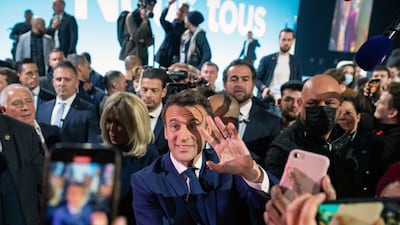
French President Emmanuel Macron greets onlookers after casting his ballot a polling station in Le Touquet, northern France, on April 10. AFP

French election: Emmanual Macron leads Marine Le Pen in presidential battle


Soraya Ebrahimi
  • English
  • Arabic

Emmanuel Macron will face far-right challenger Marine Le Pen in the final round of France's presidential election after they emerged as the top two candidates from Sunday's first round.

Near-final results showed Mr Macron in the lead with 27.6 per cent of the vote, ahead of Ms Le Pen on 23.4 per cent, setting them up for an April 24 rematch of the presidential run-off in 2017.

Despite entering the campaign late and holding only one rally before the vote, Mr Macron slightly outperformed opinion polls and won immediate support from defeated rivals for the second round.

Far-left candidate Jean-Luc Melenchon was third with 22.0 per cent, while the candidates for France's traditional parties of government, the Socialists and the Republicans, were on course for humiliating defeats and historic low tallies.

Far-right commentator Eric Zemmour, a political newcomer, was on course for 7.1 per cent.

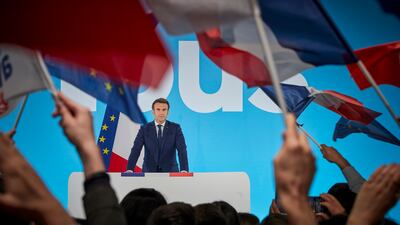
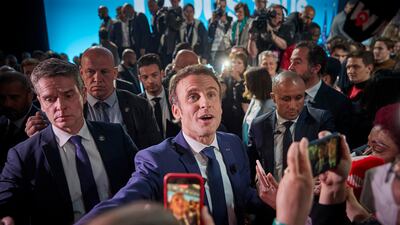
  • Emmanuel Macron, the president of France, at an election night event after voting in the first round of the French presidential election, in Paris. Bloomberg
    Emmanuel Macron, the president of France, at an election night event after voting in the first round of the French presidential election, in Paris. Bloomberg
  • Emmanuel Macron at a rally in Paris after the first round of voting in the French presidential election as early exit polls suggested victory. Getty Images
    Emmanuel Macron at a rally in Paris after the first round of voting in the French presidential election as early exit polls suggested victory. Getty Images
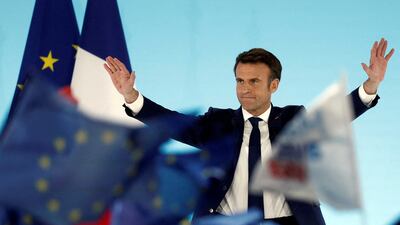
  • Mr Macron after partial results were declared in the first round of the 2022 French presidential election. Reuters
    Mr Macron after partial results were declared in the first round of the 2022 French presidential election. Reuters
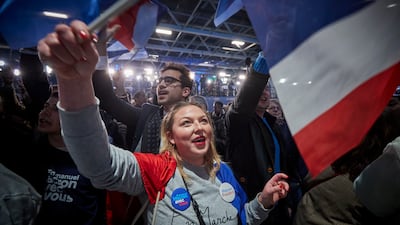
  • Supporters in Paris cheer Mr Macron at a rally after the first-round vote. Getty Images
    Supporters in Paris cheer Mr Macron at a rally after the first-round vote. Getty Images
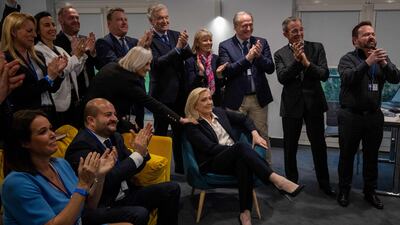
  • Marine Le Pen, centre, of the French far-right party Rassemblement National, and supporters after the first round of voting. AFP
    Marine Le Pen, centre, of the French far-right party Rassemblement National, and supporters after the first round of voting. AFP
  • Supporters cheer in Paris as exit polls indicated Mr Macron would win the election. Getty Images
    Supporters cheer in Paris as exit polls indicated Mr Macron would win the election. Getty Images
  • The French leader acknowledges his supporters at a rally in Paris. Getty Images
    The French leader acknowledges his supporters at a rally in Paris. Getty Images
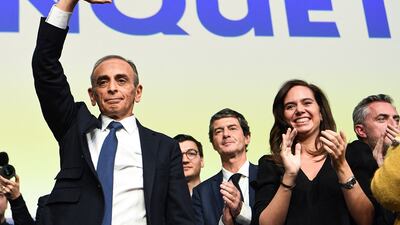
  • Eric Zemmour, candidate of the far-right Reconquete! party, waves to supporters after voting ended in the first round of the French presidential election. AFP
    Eric Zemmour, candidate of the far-right Reconquete! party, waves to supporters after voting ended in the first round of the French presidential election. AFP
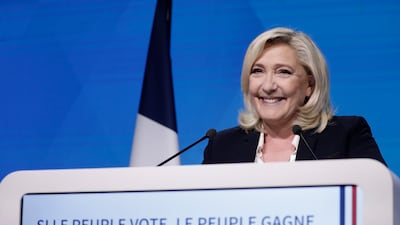
  • Far-right candidate Marine Le Pen delivers a speech at her election day headquarters in Paris. AP
    Far-right candidate Marine Le Pen delivers a speech at her election day headquarters in Paris. AP
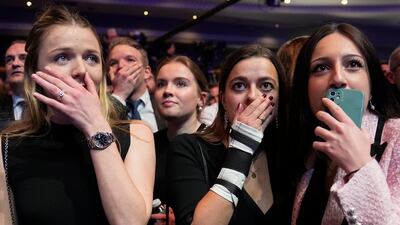
  • Supporters of Mr Zemmour as preliminary results of the first round of the presidential election were announced in Paris. AP
    Supporters of Mr Zemmour as preliminary results of the first round of the presidential election were announced in Paris. AP
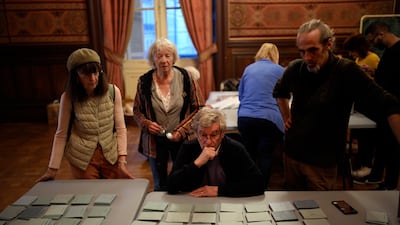
  • Ballots for the first round of the presidential election are counted in Marseille, southern France. AP
    Ballots for the first round of the presidential election are counted in Marseille, southern France. AP
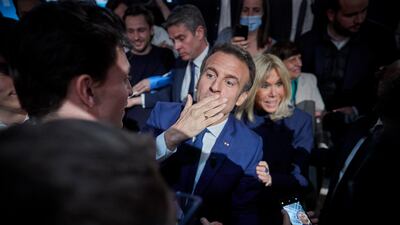
  • French President Emmanuel Macron, who was seeking re-election, accompanied by his wife Brigitte, greets people at a polling station in Le Touquet-Paris, France. EPA
    French President Emmanuel Macron, who was seeking re-election, accompanied by his wife Brigitte, greets people at a polling station in Le Touquet-Paris, France. EPA
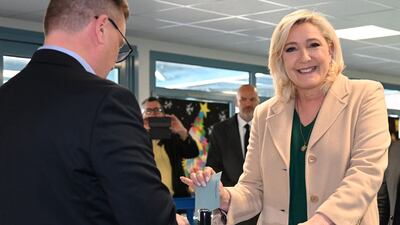
  • Far-right presidential candidate Marine Le Pen casts her ballot at a polling station in Henin-Beaumont, northern France. AFP
    Far-right presidential candidate Marine Le Pen casts her ballot at a polling station in Henin-Beaumont, northern France. AFP
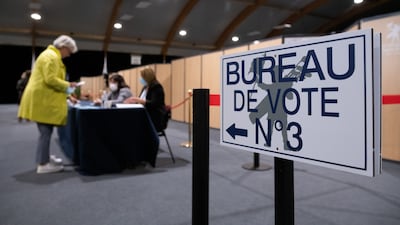
  • A sign indicates where to vote at a polling station, in Le Touquet-Paris. Bloomberg
    A sign indicates where to vote at a polling station, in Le Touquet-Paris. Bloomberg
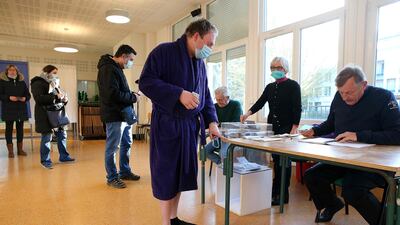
  • A voter wearing a robe and slippers arrives to cast his ballot at a polling station in Reims, north-eastern France. AFP
    A voter wearing a robe and slippers arrives to cast his ballot at a polling station in Reims, north-eastern France. AFP
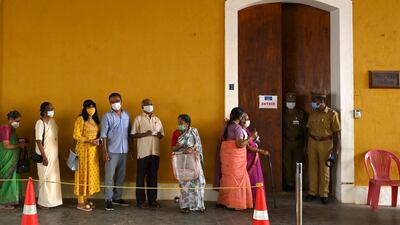
  • French citizens living in India arrive to cast their votes at France's consulate general, in the region of Pondicherry. AFP
    French citizens living in India arrive to cast their votes at France's consulate general, in the region of Pondicherry. AFP
  • A man votes in Saint-Denis, outside Paris. AP
    A man votes in Saint-Denis, outside Paris. AP
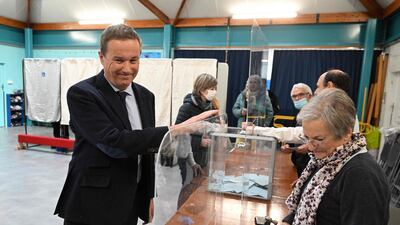
  • Presidential candidate of the far-right DLF party, Nicolas Dupont-Aignan, casts his ballot in Yerres, south-east of Paris. AFP
    Presidential candidate of the far-right DLF party, Nicolas Dupont-Aignan, casts his ballot in Yerres, south-east of Paris. AFP
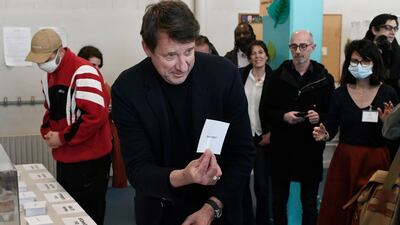
  • The French ecologist party EELV's presidential candidate, Yannick Jadot, takes ballots before voting at a polling station in Paris. AFP
    The French ecologist party EELV's presidential candidate, Yannick Jadot, takes ballots before voting at a polling station in Paris. AFP
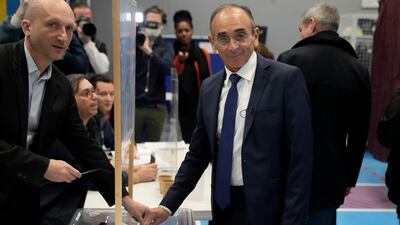
  • Far-right candidate Eric Zemmour votes in Paris. AP
    Far-right candidate Eric Zemmour votes in Paris. AP
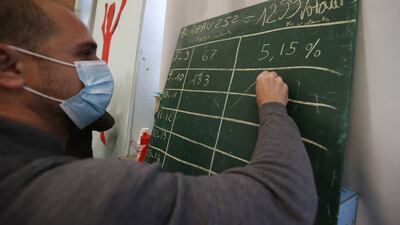
  • A polling station worker checks voters turnout by hour at a polling station in Marseille. EPA
    A polling station worker checks voters turnout by hour at a polling station in Marseille. EPA
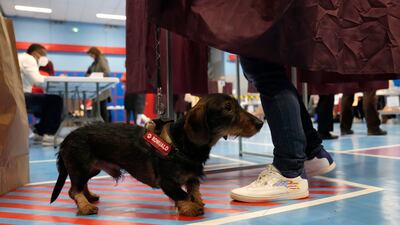
  • A voter inside a voting booth in Paris. AP
    A voter inside a voting booth in Paris. AP
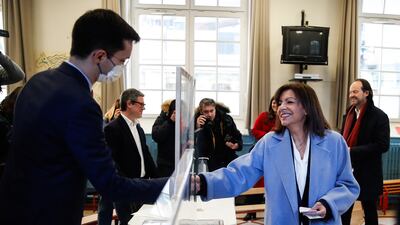
  • Mayor of Paris and presidential candidate Anne Hidalgo votes at a polling station in the French capital. EPA
    Mayor of Paris and presidential candidate Anne Hidalgo votes at a polling station in the French capital. EPA
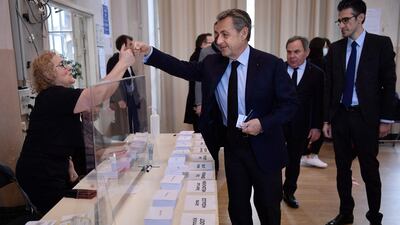
  • Former French president Nicolas Sarkozy, centre, greets an electoral officer at a polling station in Paris. AFP
    Former French president Nicolas Sarkozy, centre, greets an electoral officer at a polling station in Paris. AFP
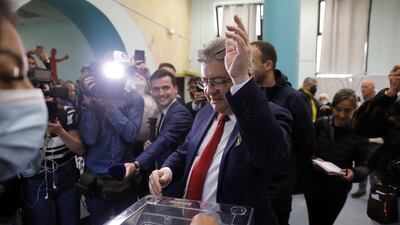
  • The presidential candidate of the LFI party, Jean-Luc Melenchon, casts his ballot at a polling station in Marseille. EPA
    The presidential candidate of the LFI party, Jean-Luc Melenchon, casts his ballot at a polling station in Marseille. EPA

"It's a new campaign that is opening now," French Economy Minister Bruno Le Maire said after the publication of the projections, which led supporters of Mr Macron to erupt in joy at the candidate's headquarters in Paris.

The final-round duel between Mr Macron and Ms Le Pen is expected to be tighter than the run-off they fought in 2017, when he won with 66 per cent of the vote.

Ms Le Pen, bidding to be France's first woman president, looked on course for a higher first-round score than in 2017 when she won 21.3 per cent, and she will be able to pick up most of Mr Zemmour's votes in the second round.

"I will put France in order within five years," she told her supporters in Paris, urging "all those who did not vote for Emmanuel Macron" in the first round to back her in the second.

Election officials start to count ballots from the first round of the presidential election, in Nantes, western France, on April 10. Up to 48 million French voters headed to polling stations nationwide for the first round of the country's presidential election. AP

Mr Zemmour, who called each of his two million votes "a cry from a people that does not want to die", urged his supporters to back Ms Le Pen.

But Mr Macron, 44, swiftly won the support of the defeated Socialist, Communist, Green and traditional right-wing candidates for the second round.

Mr Melenchon urged his supporters to refrain from voting for Ms Le Pen, but did not issue a call to back Mr Macron.

About 48.7 million voters were eligible to vote after an unusual campaign overshadowed by Russia's invasion of Ukraine.

The projections are compiled by polling companies based on a sample of votes from stations especially chosen from across the country. They have proved to be highly accurate in past elections.

A pivotal moment in the next stage of the campaign is likely to come on April 20 when the two candidates are due to take part in a debate broadcast live on national television.

The final debate has in the past had a crucial impact on the outcome of the vote, such as in 2017 when Mr Macron was seen as gaining the upper hand in exchanges with a flustered Ms Le Pen.

He is expected for the next two weeks to put his diplomatic efforts on the Ukraine crisis to one side and focus more on campaigning in a bid to find the election momentum that has so far eluded his team.

Although her opponents accuse her of being an extremist bent on dividing society, Ms Le Pen has sought to project a more moderate image in this campaign and has focused on voters' daily worries over rising prices.

Anne Hidalgo, the Socialist mayor of Paris, was set for an estimated 1.8 to 2.0 per cent, a historic low for the Socialists who were in power just five years ago under president Francois Hollande.

Greens candidate Yannick Jadot was seen as winning 4.4 to 5.0 per cent and right-wing Republicans candidate Valerie Pecresse was projected to score an estimated 4.3 to 5 per cent.

This marks the third time that a far-right candidate has made the run-off vote of a French presidential election, including the 2002 breakthrough by Ms Le Pen's father, Jean-Marie, which shocked France, although he was ultimately defeated by Jacques Chirac.

French far-right party Rassemblement National's presidential candidate Marine Le Pen and French President and La Republique en Marche party candidate Emmanuel Macron. AFP

Pollsters forecast that the final turnout would be about 76 to 74 per cent, down on 2017, although probably above the record-low turnout of just under 73 per cent in the first round of 2002.

The stakes are high for Mr Macron, who came to power aged 39 as France's youngest president with a pledge to shake up the country.

He would be the first French president to win a second term since Chirac in 2002.

If he does, Mr Macron would have five more years to push through reforms that would include raising the pension age to 65 from 62, against strong union opposition.

He would also seek to consolidate his number-one position among European leaders after the departure of German chancellor Angela Merkel.

A victory to Ms Le Pen would be seen as a triumph for right-wing populism, adding to election victories last weekend by Hungarian Prime Minister Viktor Orban and Serbian leader Aleksandar Vucic, both of whom have cordial ties with Russian President Vladimir Putin.

Mr Zemmour made a stunning entry into the campaign last year but has since lost ground.

Analysts say he has helped Ms Le Pen by making her appear to be more moderate.

Avatar: Fire and Ash

Director: James Cameron

Starring: Sam Worthington, Sigourney Weaver, Zoe Saldana

Rating: 4.5/5

CHATGPT%20ENTERPRISE%20FEATURES
%3Cp%3E%E2%80%A2%20Enterprise-grade%20security%20and%20privacy%3C%2Fp%3E%0A%3Cp%3E%E2%80%A2%20Unlimited%20higher-speed%20GPT-4%20access%20with%20no%20caps%3C%2Fp%3E%0A%3Cp%3E%E2%80%A2%20Longer%20context%20windows%20for%20processing%20longer%20inputs%3C%2Fp%3E%0A%3Cp%3E%E2%80%A2%20Advanced%20data%20analysis%20capabilities%3C%2Fp%3E%0A%3Cp%3E%E2%80%A2%20Customisation%20options%3C%2Fp%3E%0A%3Cp%3E%E2%80%A2%20Shareable%20chat%20templates%20that%20companies%20can%20use%20to%20collaborate%20and%20build%20common%20workflows%3C%2Fp%3E%0A%3Cp%3E%E2%80%A2%20Analytics%20dashboard%20for%20usage%20insights%3C%2Fp%3E%0A%3Cp%3E%E2%80%A2%20Free%20credits%20to%20use%20OpenAI%20APIs%20to%20extend%20OpenAI%20into%20a%20fully-custom%20solution%20for%20enterprises%3C%2Fp%3E%0A
Ten tax points to be aware of in 2026

1. Domestic VAT refund amendments: request your refund within five years

If a business does not apply for the refund on time, they lose their credit.

2. E-invoicing in the UAE

Businesses should continue preparing for the implementation of e-invoicing in the UAE, with 2026 a preparation and transition period ahead of phased mandatory adoption. 

3. More tax audits

Tax authorities are increasingly using data already available across multiple filings to identify audit risks. 

4. More beneficial VAT and excise tax penalty regime

Tax disputes are expected to become more frequent and more structured, with clearer administrative objection and appeal processes. The UAE has adopted a new penalty regime for VAT and excise disputes, which now mirrors the penalty regime for corporate tax.

5. Greater emphasis on statutory audit

There is a greater need for the accuracy of financial statements. The International Financial Reporting Standards standards need to be strictly adhered to and, as a result, the quality of the audits will need to increase.

6. Further transfer pricing enforcement

Transfer pricing enforcement, which refers to the practice of establishing prices for internal transactions between related entities, is expected to broaden in scope. The UAE will shortly open the possibility to negotiate advance pricing agreements, or essentially rulings for transfer pricing purposes. 

7. Limited time periods for audits

Recent amendments also introduce a default five-year limitation period for tax audits and assessments, subject to specific statutory exceptions. While the standard audit and assessment period is five years, this may be extended to up to 15 years in cases involving fraud or tax evasion. 

8. Pillar 2 implementation 

Many multinational groups will begin to feel the practical effect of the Domestic Minimum Top-Up Tax (DMTT), the UAE's implementation of the OECD’s global minimum tax under Pillar 2. While the rules apply for financial years starting on or after January 1, 2025, it is 2026 that marks the transition to an operational phase.

9. Reduced compliance obligations for imported goods and services

Businesses that apply the reverse-charge mechanism for VAT purposes in the UAE may benefit from reduced compliance obligations. 

10. Substance and CbC reporting focus

Tax authorities are expected to continue strengthening the enforcement of economic substance and Country-by-Country (CbC) reporting frameworks. In the UAE, these regimes are increasingly being used as risk-assessment tools, providing tax authorities with a comprehensive view of multinational groups’ global footprints and enabling them to assess whether profits are aligned with real economic activity. 

Contributed by Thomas Vanhee and Hend Rashwan, Aurifer

Mercer, the investment consulting arm of US services company Marsh & McLennan, expects its wealth division to at least double its assets under management (AUM) in the Middle East as wealth in the region continues to grow despite economic headwinds, a company official said.

Mercer Wealth, which globally has $160 billion in AUM, plans to boost its AUM in the region to $2-$3bn in the next 2-3 years from the present $1bn, said Yasir AbuShaban, a Dubai-based principal with Mercer Wealth.

Within the next two to three years, we are looking at reaching $2 to $3 billion as a conservative estimate and we do see an opportunity to do so,” said Mr AbuShaban.

Mercer does not directly make investments, but allocates clients’ money they have discretion to, to professional asset managers. They also provide advice to clients.

“We have buying power. We can negotiate on their (client’s) behalf with asset managers to provide them lower fees than they otherwise would have to get on their own,” he added.

Mercer Wealth’s clients include sovereign wealth funds, family offices, and insurance companies among others.

From its office in Dubai, Mercer also looks after Africa, India and Turkey, where they also see opportunity for growth.

Wealth creation in Middle East and Africa (MEA) grew 8.5 per cent to $8.1 trillion last year from $7.5tn in 2015, higher than last year’s global average of 6 per cent and the second-highest growth in a region after Asia-Pacific which grew 9.9 per cent, according to consultancy Boston Consulting Group (BCG). In the region, where wealth grew just 1.9 per cent in 2015 compared with 2014, a pickup in oil prices has helped in wealth generation.

BCG is forecasting MEA wealth will rise to $12tn by 2021, growing at an annual average of 8 per cent.

Drivers of wealth generation in the region will be split evenly between new wealth creation and growth of performance of existing assets, according to BCG.

Another general trend in the region is clients’ looking for a comprehensive approach to investing, according to Mr AbuShaban.

“Institutional investors or some of the families are seeing a slowdown in the available capital they have to invest and in that sense they are looking at optimizing the way they manage their portfolios and making sure they are not investing haphazardly and different parts of their investment are working together,” said Mr AbuShaban.

Some clients also have a higher appetite for risk, given the low interest-rate environment that does not provide enough yield for some institutional investors. These clients are keen to invest in illiquid assets, such as private equity and infrastructure.

“What we have seen is a desire for higher returns in what has been a low-return environment specifically in various fixed income or bonds,” he said.

“In this environment, we have seen a de facto increase in the risk that clients are taking in things like illiquid investments, private equity investments, infrastructure and private debt, those kind of investments were higher illiquidity results in incrementally higher returns.”

The Abu Dhabi Investment Authority, one of the largest sovereign wealth funds, said in its 2016 report that has gradually increased its exposure in direct private equity and private credit transactions, mainly in Asian markets and especially in China and India. The authority’s private equity department focused on structured equities owing to “their defensive characteristics.”

The Vile

Starring: Bdoor Mohammad, Jasem Alkharraz, Iman Tarik, Sarah Taibah

Director: Majid Al Ansari

Rating: 4/5

Updated: April 11, 2022, 9:08 AM