


Live updates: follow the latest news on Russia-Ukraine
The Ukrainian state nuclear company said on Thursday that all of the Russian forces occupying the Chernobyl nuclear power station had withdrawn from the territory of the defunct plant.
There was no immediate comment from the Russian authorities.
The UN nuclear watchdog, International Atomic Energy Agency (IAEA), said it is preparing to send a mission to the radioactive waste facilities at Chernobyl in northern Ukraine.
Though Russian soldiers seized control of Chernobyl soon after the February 24 invasion, the plant's Ukrainian staff continued to oversee the safe storage of spent nuclear fuel and supervise the concrete-encased remains of the reactor that exploded in 1986 in the world's worst nuclear accident.
“According to the staff of the Chernobyl nuclear power plant, there are now no outsiders on site,” state-owned Energoatom said in an online post.
Energoatom had earlier said most troops had gone, leaving only a small number behind.
-

Girls wearing face masks place candles among others forming a radioactivity sign at the monument to Chernobyl victims in Slavutich, the city where the power station's personnel lived, some 50 kilometres from the accident site, on April 26, 2020. AFP -

An aerial view at the site of the worst nuclear disaster in history. In April 1986, the nuclear reactors at the Chernobyl plant ruptured and exploded, causing radioactive contamination in the surrounding areas. A few photographers risked exposure to radiation in order to document the disaster. This photograph was taken in May 1986 just weeks after the accident. Getty -

Ukrainians light candles and lay flowers at the memorial for 'liquidators' who died during cleaning up works after the Chernobyl nuclear power plant disaster, during a ceremony in Slavutich city. EPA -

A nuclear technician checks, on September 1987, the radioactivity on the upper part of the nuclear reactor. AFP -

Women wearing face masks light candles at the monument to Chernobyl victims in Slavutich. AFP -

This picture, dated 1 October 1986, shows repairs being carried out on the Chernobyl nuclear plant. AFP -

Former liquidators of the Chernobyl nuclear accident wearing face masks lay flowers at Chernobyl's memorial in Kiev amid the Covid-19 coronavirus pandemic. AFP -
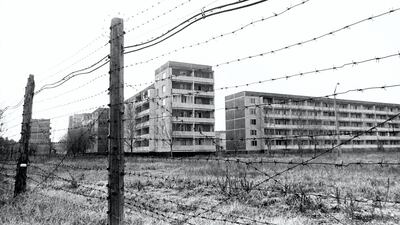
This picture, taken in April 1990, shows buildings abandoned because of the radioactive contamination produced by the Chernobyl nuclear plant No. 4 reactor's blast. AFP -

An elderly woman wearing a face mask visits Chernobyl's memorial in Kiev to commemorate the victims on the 34th anniversary of the tragedy. AFP -

People wearing face masks to protect against coronavirus pray during a commemorative religious ceremony in front of the church at a memorial of the Chernobyl tragedy victims in capital Kiev, Ukraine. AP -

A clean-up operation veteran wearing a face mask to protect against coronavirus pays respect to the Chernobyl victims at a memorial in capital Kiev, Ukraine. AP


Russian forces have also retreated from the nearby town of Slavutych, where those who work at Chernobyl live, the company said.
In a separate post, Energoatom said the Russian side had formally agreed to hand back to Ukraine the responsibility of protecting Chernobyl.
It shared a scanned document signed by people it identified as senior staff members at Chernobyl and the Russian military official assigned to guarding Chernobyl.
Reuters could not immediately verify the authenticity of the document.
Ukraine has repeatedly expressed safety concerns about Chernobyl and demanded the withdrawal of Russian troops, whose presence prevented the rotation of personnel for a time.
Earlier this week, workers at the site told Reuters that Russian soldiers had driven without radiation protection through the Red Forest, the most radioactively contaminated part of the zone around Chernobyl, kicking up clouds of radioactive dust.
Asked to comment on the accounts from Chernobyl staff, Russia's Ministry of Defence did not respond.
Energoatom said that as a result of their concerns about radiation, “almost a riot began to brew among the soldiers”, suggesting this was the reason for their unexpected departure.
The IAEA said it had not been able to confirm the reports of Russian forces receiving high radiation doses.
Earlier on Thursday, the head of Energoatom urged the IAEA to help ensure Russian nuclear officials do not interfere in the operation of Chernobyl and the Zaporizhzhia nuclear power plant, Europe's largest, which is also occupied by Russian soldiers.

