


Live updates: follow the latest news on Russia-Ukraine
Right-wing extremists are using the war in Ukraine to spread conspiracy theories, echo Russian propaganda and drive a wedge between groups of refugees, according to analysts in Germany.
A report by the Amadeu Antonio Foundation, which monitors extremism on platforms such as Telegram, identified five ways in which the far right had spun the crisis to suit its political narratives.
It said the far-right scene had developed competing views on whether Russian President Vladimir Putin was a figure to be admired or a pawn in a wider conspiracy after he ordered the attack on Ukraine.
“The bogeymen remain the same, but current events are re-interpreted accordingly,” analysts said in their 14-page findings.
One example of this, they said, was a theory shared on Telegram that the war was part of an imagined Jewish conspiracy, possibly aimed at reducing the world population or establishing a new world order.
The attraction of this for neo-Nazis is that they “do not have to choose one side or the other, but spread their traditional stereotypes of the enemy”, researchers said.
A second narrative is that a caricatured global elite wants to distract people from the coronavirus pandemic, which has long spawned its own web of conspiracy theories.
One extremist magazine in Germany argued that the “corona narrative” of the past two years was falling apart and that elites had concocted the war in Ukraine as a new way of stirring up fear.

While those interpretations regard the war as a bad thing, a third school of neo-Nazi thought welcomes the opportunity for a fight and for possible alignment with Ukraine’s far-right Azov Battalion.
The Azov group is fighting against Russia and is often invoked by pro-Kremlin media to back up Mr Putin’s claims that the invasion is designed to “demilitarise and de-Nazify” Ukraine.
That claim is rejected as nonsense by Ukraine and its President Volodymyr Zelenskyy, a Jew whose grandfather saw three of his brothers killed during the Holocaust.
But since the war broke out, the Azov fighters have appealed for new recruits in far-right channels, including in English and German, analysts said, leading to fears of European extremists going to fight for the group.
On the Russian side, a fourth far-right narrative lauds Mr Putin as a fighter against the modern West, which extremists see as tarnished by the rise of liberal social norms.
One post on Telegram said that “if Putin marches into Berlin … men will be men, electricity will be cheaper, Islamisation will be ended”.
A similar strand of pro-Kremlin opinion tries to justify Russia’s invasion by echoing its propaganda about Ukraine developing biological weapons or having no right to sovereignty.
The Kremlin’s theory that Ukraine is developing sensitive weapons was described this week as “just another lie” by the head of Nato.
-

A woman cries near a building damaged by shelling in Kyiv as Russia's attack on Ukraine continues. EPA -
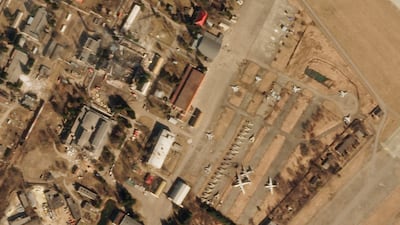
A satellite photo from Planet Labs PBC shows the damage from a Russian strike on Lviv's international airport. AP -
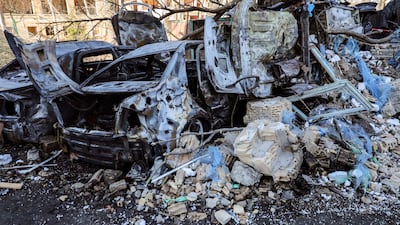
Destroyed cars hit by shelling in Kyiv. EPA -
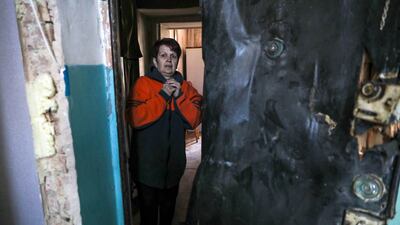
A woman stands in her home after her building was damaged by shelling in Kyiv. EPA -
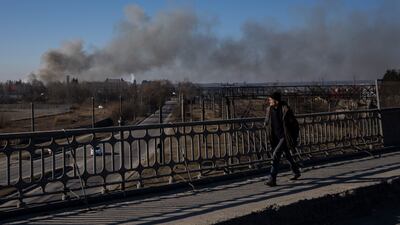
A pedestrian looks at a cloud of smoke rising after an explosion in Lviv. AP -
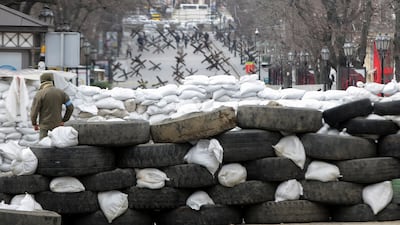
General view of a street behind a barricade in the southern Ukrainian city of Odesa. EPA -
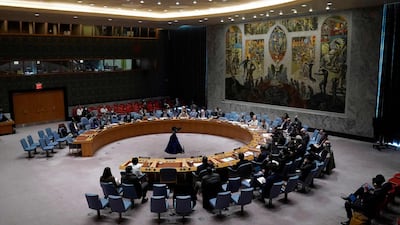
The UN Security Council meets on threats to international peace and security in New York. AFP -
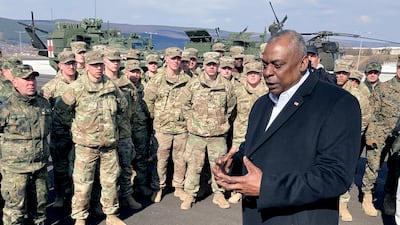
US Defence Secretary Lloyd Austin speaks with US troops at an army training range in Bulgaria. AP -

Empty strollers are seen outside the Lviv city council building during an action to highlight the number of children killed during the Russian invasion of Ukraine. AFP -

Children play on the stage of the theatre of the Ukrainian House where a shelter for refugees has been installed in Przemysl, south-eastern Poland. AFP -
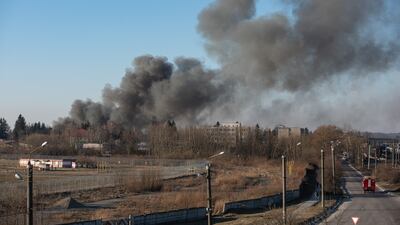
Smoke is seen above buildings close to the airport in Lviv, Ukraine. Lviv's mayor said the airport was not hit, but an area nearby. Getty Images -
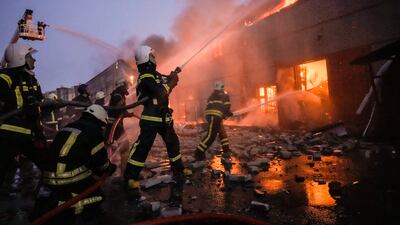
Ukrainian firefighters try to extinguish a blaze at a warehouse after a bombing in Kyiv. AP Photo -

President Volodymyr Zelenskiy presents flowers to Kateryna Vlasenko, 16 - who was injured as she fled with her family from the town of Vorzel - at a hospital in Kyiv. Reuters -
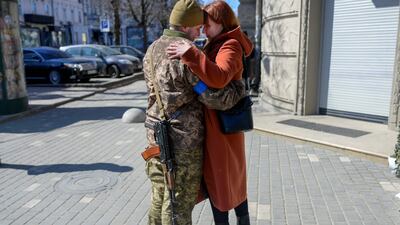
Igor, a 40 year-old Ukranian soldier, embraces his wife in front of his military basement in the centre of Odesa. AFP -
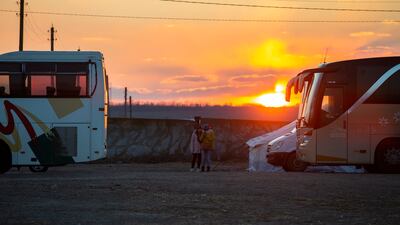
Ukrainian refugees arrive at the reception centre near Palanca Village, about 3 kilometres from the Moldova-Ukraine border. EPA -
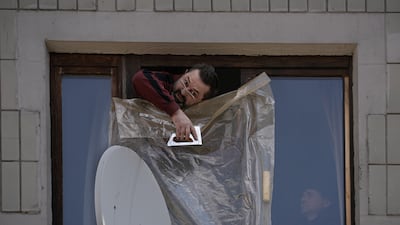
Broken windows after parts of a Russian missile, shot down by Ukrainian air defences, hit an apartment block in Kyiv. AP -

People clear debris outside a medical centre damaged by the same Russian missile after it was intercepted. AP -

A police officer looks through the window of a damaged flat in Kyiv. One person was killed and three injured when debris from a downed rocket hit an apartment in the Ukrainian capital. AFP -
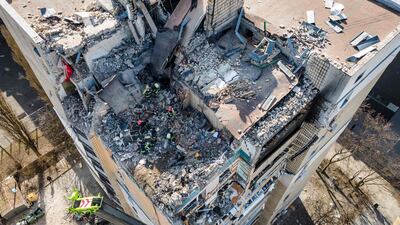
Firemen working in the rubble after extensive damage in Kyiv. AFP -
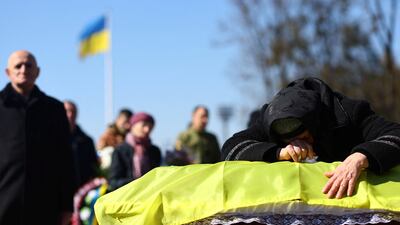
Family members and comrades of Ivan Skrypny, who was killed in a rocket attack on a military base in Yavoriv, pay their last respects at his memorial service in Lviv, Ukraine. Reuters -

A man feels the despair as his home was hit by debris from a downed rocket in Kyiv. Russian troops trying to encircle the capital have launched early morning strikes on the city for several successive days. AFP -
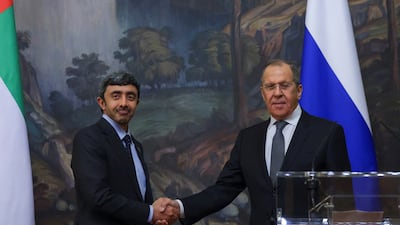
UAE Foreign Minister Sheikh Abdullah bin Zayed shakes hands with Russia's Foreign Minister Sergey Lavrov during a news conference following their talks in Moscow. Reuters -

The Donetsk Regional Theatre of Drama, which was destroyed by an air strike during Russia's military onslaught in Mariupol, Ukraine. Reuters -
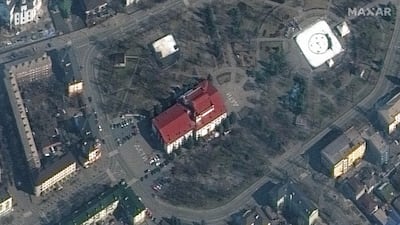
A satellite image of the theatre before the bombing, with the word 'children' written in Russian in large white letters on the pavement in front of and behind the building. Reuters -
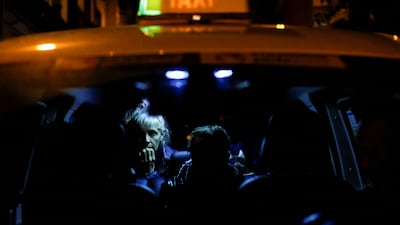
A Ukrainian woman and her family in a taxi displaying the colours of the Ukrainian flag upon arriving in Madrid with a group of Spanish taxi drivers who drove to Poland to support the mass evacuation of refugees. Reuters -

A sanitised train arrives in Kielce, Poland, carrying children with oncological diseases who fled Russia's invasion of Ukraine. Reuters -
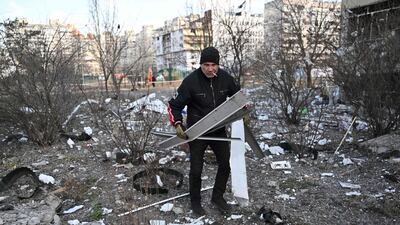
A man outside a damaged housing block after it was hit by debris from a downed rocket in Kyiv. AFP -
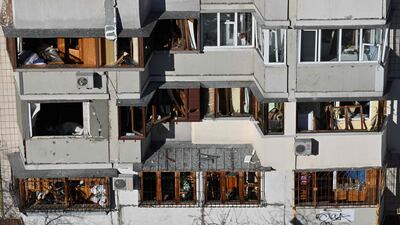
A residential building damaged by a blast wave at the scene where debris from a downed rocket hit a nearby apartment block in Kyiv. AFP -
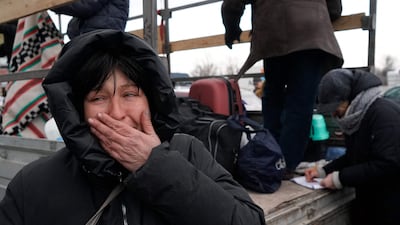
Evacuees from Mariupol are seen upon arrival at the car park of a shopping centre on the outskirts of the city of Zaporizhzhia, which is now a registration centre for displaced people. AFP -
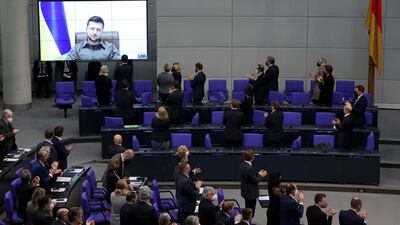
Legislators applaud Volodymyr Zelenskyy, Ukraine's president, after an address via video link at the Bundestag in Berlin. Bloomberg


Russian state media “continues to enjoy a great popularity in the conspiracy theorist scene”, the German report said.
A fifth line of argument focuses on Ukrainian refugees and distinguishes them in what analysts say is a racially motivated manner from the typically non-European arrivals in previous flurries of migration.
A branch of the far-right Alternative for Germany (AfD) party said the country was right to take in “genuine war refugees” from Ukraine but that space should be freed up by deporting earlier migrants.
Such a viewpoint “spreads the narrative of refugees who only have a right to temporary safety if they are white”, the analysts said.
Almost 3.3 million people have fled Ukraine since the war broke out, according to the UN’s refugee agency, with Poland taking in more than half of those and many others crossing into Romania, Moldova, Hungary and Slovakia.

