


Live updates: follow the latest news on Russia-Ukraine
Germany is better prepared for a rush of refugee arrivals from Ukraine than it was for the migration crisis in 2015 that prompted years of political rancour, the government’s integration commissioner has said.
Reem Alabali-Radovan said 200,000 people had been registered in Germany after fleeing the Russian invasion, with the true number of refugees likely to be higher after some went straight to relatives without alerting authorities.
She told parliament that the task ahead to accommodate the refugees “is gigantic”, with some cities already feeling the strain and the government laying on 147 buses on Thursday alone to move people away from the busiest areas.
But “since I keep being asked … I am confident, and I know from my experience and my work in the reception centres, that in 2022 we are better prepared than in 2015,” she said.
That year’s wave of migration from the Middle East saw more than a million people cross Europe’s borders, with Germany taking in the bulk of them under an open-door policy overseen by former chancellor Angela Merkel.
The subsequent years were dominated by often fractious debates over integration, crime and national identity that spurred the rise of the far-right Alternative for Germany (AfD) party.
But politicians hope the swift registration process for Ukrainians and the immediate right to work granted under an EU-wide asylum scheme will make integration easier this time around.
The EU’s offer makes Ukrainians eligible for an initial one-year residency permit and allows their children to go to school in Germany.
Berlin’s Mayor Franziska Giffey spoke of “lessons learnt” after previous migration spikes that could now be applied to helping Ukrainians in Europe's richest country.
She said the capital was looking to use youth hostels so people could avoid sleeping in sports halls as they did at the height of the 2015 crisis. Ministers expect the number of refugees to keep rising.
-
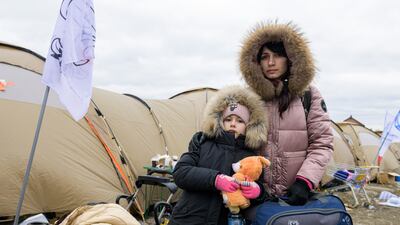
Mykhaila and her daughter from Loubny, central Ukraine, travelled by train to the Ukrainian city of Lviv then took a bus to Medyka on the Polish border, before walking across. Photo: DEC -
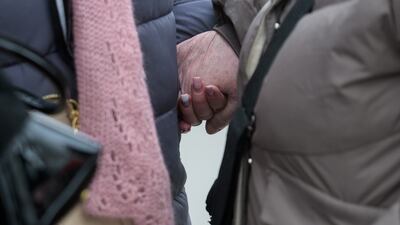
Women hold hands at the Medyka border crossing point, through which thousands of Ukrainian refugees have passed. Photo: DEC -
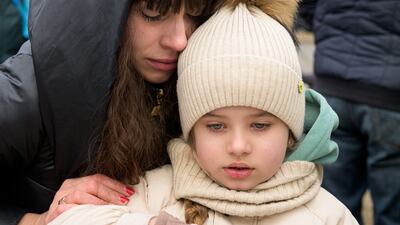
Angelika, 27, and her daughter Diana, 4, from Khmelnytskyi in Ukraine arrive at a reception centre on the outskirts of Przemysl, Poland. Photo: DEC -

Maria, 38, from Chernihiv, left Ukraine with a friend. They came to the Romanian border to wait for another friend before crossing. Photo: Panos Pictures -
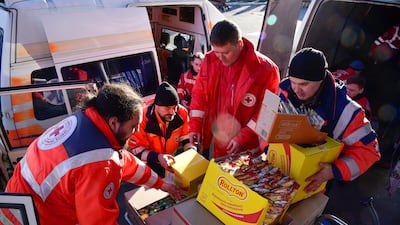
Ukrainian Red Cross staff and volunteers are providing food and other basic necessities to about 8,000 people sheltering in an underground station in Kyiv. Photo: Tebukhukhov Maksym -
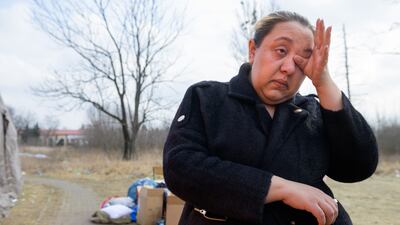
Kristina wipes away tears at Lwowska reception centre on the outskirts of Przemysl, Poland. Photo: DEC -
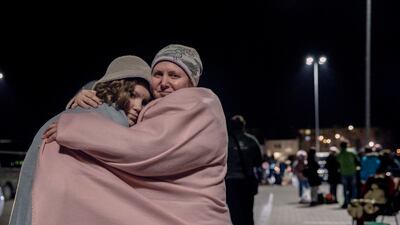
Ira, 45, and her daughter Olena, 12, outside a transit centre in Przemysl, Poland. Photo: Adrienne Surprenant -
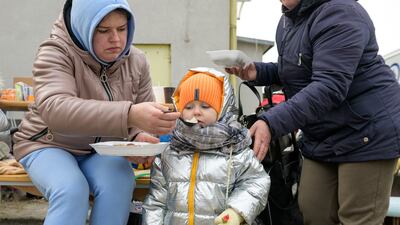
Veronika feeds her son Aleksander at the temporary refugee station in Medyka, eastern Poland. Photo: DEC


“Many people who are now dealing with the consequences of the crisis were involved in 2015 and 2016, and we can use the experiences that we gained back then,” Ms Giffey said.
The arrivals in Germany are only a minority of the almost 3.2 million Ukrainians who have fled the war since Russian tanks rolled in, according to the UN’s refugee agency UNHCR, with Poland taking in the largest share.
Ms Alabali-Radovan praised the work of organisations and volunteers after charities sprang into action and many Germans went to train stations to offer accommodation to Ukrainians.
“What is being achieved right now is outstanding,” she said. “Germany is standing together. People are simply going at it, day in and day out.”

